
This guide reflects Sweden's rules as reviewed on 21 October 2026. Structured e-invoicing applies to covered public procurement, while domestic private B2B e-invoicing generally requires recipient consent. Public-buyer Peppol SMP registration took effect on 23 January 2026, and Peppol Authority duties moved to Upphandlingsmyndigheten on 1 July 2026. CESOP payment reporting has been in effect since 2024. New cash-register technical requirements take effect on 1 January 2027. Publication remains blocked pending the unresolved legal checks recorded in the audit report.
Is electronic invoicing mandatory in Sweden?
Structured electronic invoicing is mandatory in Sweden for public procurement transactions, but it is not mandatory for private domestic business-to-business transactions. Under Lag (2018:1277) om elektroniska fakturor till följd av offentlig upphandling, contractors supplying public contracting authorities and contracting entities must issue electronic invoices conforming to the European standard EN 16931. In contrast, electronic invoicing between private enterprises remains voluntary and requires the buyer's prior consent under Chapter 17, Section 20 of the Swedish VAT Act (Mervärdesskattelag 2023:200).
Digital tax reporting in Sweden operates through several distinct mechanisms rather than a centralised continuous transaction control model. Taxable persons declare value added tax through periodic returns submitted to the Swedish Tax Agency (Skatteverket) on an annual, quarterly or monthly basis. Cross-border intra-Community supplies of goods and services require supplementary recapitulative statements. In addition, payment service providers operating in Sweden have been subject to mandatory quarterly cross-border payment reporting under the European Union Central Electronic System of Payment Information (CESOP) framework since 1 January 2024. Point-of-sale retail transactions involving cash or card equivalents fall under specific statutory cash-register fiscalisation rules.
Sweden's digital tax administration strategy relies on interoperable European open standards for public procurement, automated application programming interfaces for periodic tax filings, and targeted digital controls for high-risk payment and retail cash flows. The government has commissioned an official inquiry to evaluate potential wider electronic reporting mechanisms, but no general real-time invoice clearance model has been enacted for domestic commercial trade.
How did Sweden's e-invoicing and tax compliance framework develop?
Sweden's electronic invoicing framework developed initially within the public sector to rationalise public purchasing and implement European standards. Following the adoption of Directive 2014/55/EU by the European Parliament and the Council, the Swedish Parliament enacted Lag (2018:1277), which entered into force on 1 April 2019. This statute established a mandatory electronic invoicing requirement across all covered public procurements, requiring suppliers to issue structured electronic invoices conforming to the referenced European standard.
From 1 March 2021, MDFFS 2021:1 imposed Peppol BIS Billing 3 and supplier-portal capability rules on all central government agencies. Electronic purchase-order processing duties, by contrast, apply to agencies with more than 50 full-time-equivalent staff. The regulation also covers inter-agency e-invoicing and specific legacy-format exceptions; its VAT Act references were updated by MDFFS 2026:2.
The broader tax compliance system was restructured on 1 July 2023, when Mervärdesskattelag (2023:200) replaced the longstanding 1994 VAT Act, updating the statutory provisions governing invoice content, recipient consent and small-business exemptions. On 1 January 2024, Sweden implemented the EU CESOP framework under Skatteförfarandelag (2011:1244), as amended by SFS 2023:638, imposing quarterly transaction-level reporting on payment service providers.
Technical requirements for public procurement were updated on 23 January 2026 under MDFFS 2026:1, making registration in Peppol's Service Metadata Publisher (SMP) mandatory for contracting authorities and entities. On 1 July 2026, administrative responsibility for the Swedish Peppol Authority officially transferred from the Agency for Digital Government (Myndigheten för digital förvaltning, Digg) to the National Agency for Public Procurement (Upphandlingsmyndigheten). To evaluate future domestic electronic invoicing obligations and adapt to the European Union's VAT in the Digital Age initiative, the Swedish government established committee inquiry Dir. 2026:9 on 5 February 2026.
What is the compliance timeline for Swedish e-invoicing and reporting?
The implementation of Sweden's electronic invoicing, digital reporting and fiscalisation rules follows a defined sequence of statutory and administrative milestones.
Date | Legal status | Milestone | Business impact |
|---|---|---|---|
1 April 2019 | Applicable | B2G e-invoicing mandate takes effect under Lag (2018:1277) | Suppliers to public buyers must issue structured electronic invoices conforming to EN 16931 |
1 March 2021 | Applicable | Central government agency regulation MDFFS 2021:1 takes effect | All state agencies need Peppol BIS Billing 3 invoice capability and supplier portals; some order duties cover agencies with over 50 staff |
1 July 2023 | Applicable | New Swedish VAT Act (SFS 2023:200) enters into force | Modernised rules on recipient invoice consent, issuance timing and mandatory particulars apply |
1 January 2024 | Applicable | CESOP cross-border payment reporting begins under Skatteförfarandelag (2011:1244), amended by SFS 2023:638 | Covered payment service providers must submit quarterly XML records to Skatteverket |
1 January 2025 | Applicable | Modernised small-business VAT exemption takes effect | The SEK 120,000 exemption requires conditions including current and two preceding calendar-year turnover, with separate rules for EU-based suppliers |
14 April 2025 | In force (EU) | EU ViDA legislative package enters into force | EU legislation adopted; staged future obligations and national options must be assessed separately |
23 January 2026 | Applicable | Buyer-side Peppol SMP registration requirement under MDFFS 2026:1 | Public contracting authorities and entities must be discoverable in Peppol SMP infrastructure |
5 February 2026 | Announced | Swedish government launches national inquiry under Dir. 2026:9 | Appointed committee examines potential domestic e-invoicing and e-reporting rules |
1 April 2026 | Applicable | Temporary qualifying food VAT reduction to 6% begins | Skatteverket applies 6% rate to eligible food supplies until 31 December 2027 |
1 July 2026 | Applicable | Swedish Peppol Authority transfers to Upphandlingsmyndigheten | Agency assumes operational governance of Swedish Peppol Service Providers and standardisation |
31 December 2026 | Transitional end | Final date of existing cash-register transitional arrangements | Retail businesses prepare certified cash registers for updated technical standards |
1 January 2027 | Future technical requirement | Cash registers must satisfy SKVFS 2021:17 per Skatteverket | Registers with journal memory must support XML data extraction for tax audit inspections |
30 November 2027 | Announced | Submission deadline for Swedish government inquiry Dir. 2026:9 | Official committee presents legislative proposals regarding national ViDA implementation |
31 December 2027 | Scheduled expiry | Expiry of temporary 6% VAT rate on qualifying food | VAT rate on eligible food supplies scheduled to revert to 12% on 1 January 2028 |
1 July 2030 | EU scheduled phase | Scheduled EU cross-border digital reporting phase under the ViDA package | Commission schedule describes future transaction-level reporting for relevant intra-EU B2B transactions, subject to operative scope |
Which laws govern e-invoicing and VAT reporting in Sweden?
The legal framework governing electronic invoicing, digital reporting, fiscalisation and record retention in Sweden comprises national statutes, agency regulations and directly applicable European Union provisions.
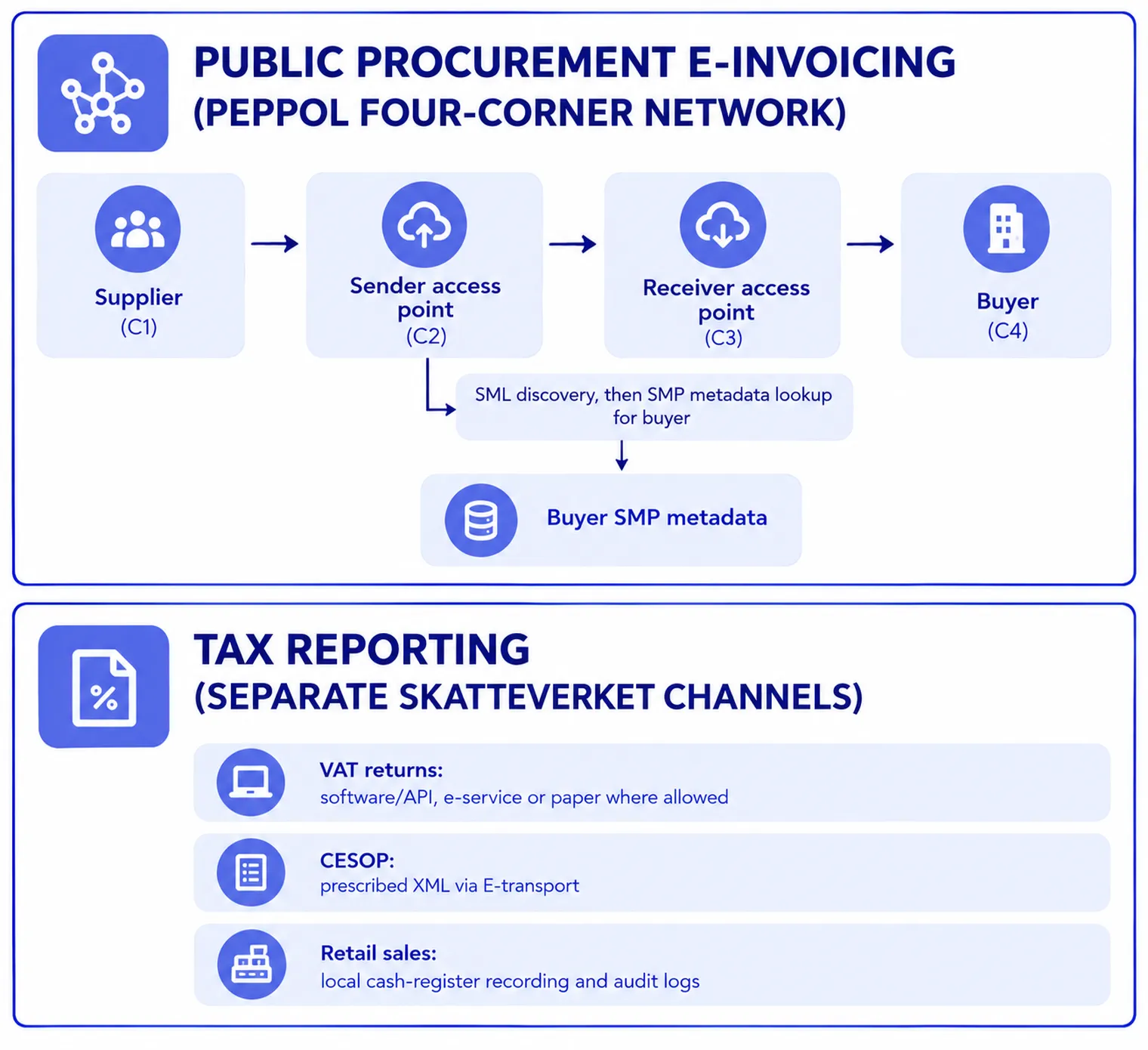
Primary national legislation
Lag (2018:1277) om elektroniska fakturor till följd av offentlig upphandling: Enacted under SFS 2018:1277, this statute governs public procurement invoicing. Under Sections 1 to 4, suppliers must issue structured electronic invoices conforming to European standard EN 16931 for covered public procurements. Section 5 obliges contracting authorities and entities to receive and process compliant invoices. Sections 7 and 8 establish compliance orders, conditional fines and appeal routes.
Mervärdesskattelag (2023:200): The Swedish VAT Act sets invoice issuance and recipient-consent rules in Chapter 17, including the ordinary invoice particulars in Section 24, specific exemptions and simplified invoices in Sections 25–28. Chapter 9 sets VAT rates; eligible food supplies are temporarily taxed at 6% from 1 April 2026 to 31 December 2027. Chapter 18 provides conditional small-business VAT exemption, including the SEK 120,000 current-year and two-prior-calendar-year tests. EU-established businesses face additional identification and EU-wide turnover conditions. Businesses established outside the EU cannot use this small-business VAT exemption.
Skatteförfarandelag (2011:1244): Governed by SFS 2011:1244, the Tax Procedures Act regulates tax returns, fiscalisation and compliance fees. Chapter 26 establishes filing frequencies and statutory deadlines for VAT declarations. Chapter 33 c, enacted via SFS 2023:638, transposes the EU CESOP cross-border payment reporting regime. Chapter 39, Sections 4 to 8 regulate cash-register obligations and receipt production for retail sales. Chapters 48, 49, 49 b, 49 c and 50 regulate late filing, tax surcharges, CESOP documentation and reporting fees, and cash-register charges.
Bokföringslag (1999:1078): Swedish accounting law under SFS 1999:1078, amended by SFS 2024:342, governs document retention. Chapter 7, Section 1 establishes that electronic accounting documents must initially be preserved in their received or created format and content. Chapter 7, Section 2 sets a retention period ending seven years after the calendar year in which the financial year concluded. Chapter 7, Section 6 permits the destruction of original source media following a complete and reliable transfer to another medium without risk of loss or alteration.
Agency regulations and European context
Agency regulations issued by Digg and Upphandlingsmyndigheten define technical public-sector rules. Under MDFFS 2026:1, Section 2, contracting authorities and entities must maintain Peppol SMP registration. Regulation MDFFS 2021:1, as amended by MDFFS 2026:2, sets state-agency e-invoicing standards. At the European level, Sweden operates within the framework of Directive 2014/55/EU for public procurement and Council Regulation (EU) 904/2010 for CESOP administrative cooperation.
Which public authorities oversee e-invoicing and tax compliance in Sweden?
Public administration of electronic invoicing, tax collection, public procurement standards and technical registers is divided between several competent authorities.
Institution | Official role | Operational compliance responsibility |
|---|---|---|
Skatteverket (Swedish Tax Agency) | National tax authority | Administers VAT returns, receives quarterly CESOP submissions via E-transport, conducts cash-register fiscal inspections and issues statutory penalties under the Tax Procedures Act. |
Upphandlingsmyndigheten (National Agency for Public Procurement) | Public procurement authority and Peppol Authority | Governs public procurement rules, oversees the Swedish Peppol Authority function transferred on 1 July 2026, manages Peppol Service Provider agreements and issues technical e-commerce guidance. |
Digg (Agency for Digital Government) | Former Peppol Authority and digital governance body | Issued historical procurement regulations (MDFFS series); transferred operational Peppol Authority functions to Upphandlingsmyndigheten on 1 July 2026. |
Riksdagen and Regeringen (Parliament and Government) | Legislative and executive authorities | Enact primary legislation, commission public inquiries such as committee directive Dir. 2026:9, and table draft fiscal bills such as Proposition 2025/26:278. |
SFTI / SKR (Single Face to Industry / Swedish Association of Local Authorities and Regions) | Public sector standardisation initiative | Publishes technical implementation specifications, syntax recommendations and semantic profiles for Peppol BIS Billing 3, UBL 2.1 and UN/CEFACT CII. |
Statistics Sweden (SCB) | National statistical authority | Publishes annual price base amounts (prisbasbelopp); the 2026 amount of SEK 59,200 informs the cash-register threshold. |
European Commission (DG TAXUD) | European Union taxation authority | Oversees EU-wide VAT directive frameworks, administers the central CESOP hub, and coordinates the phased timetable for VAT in the Digital Age. |
Administrative responsibilities for public-sector e-invoicing and tax collection remain structurally separate. Upphandlingsmyndigheten regulates procurement e-invoicing and Peppol infrastructure, whereas Skatteverket oversees tax returns, CESOP data files and retail cash-register inspections.
Which transactions are covered by Sweden's e-invoicing and reporting rules?
Sweden distinguishes sharply between mandatory public-sector e-invoicing, consent-based private commercial billing, and specialised reporting for retail and cross-border payment flows.
Transaction type | Issuance requirement | Reception requirement | Tax reporting obligation | Main statutory exceptions |
|---|---|---|---|---|
Domestic B2G | Mandatory structured electronic invoice conforming to EN 16931 | Mandatory reception and processing by contracting entities | Supplier VAT filing where required; exemptions and reverse-charge cases vary | Secrecy or security risk; procurements initiated before 1 April 2019 (supplier issuance rule); agreed alternative structured standard |
Central government inter-agency | Mandatory electronic invoice under MDFFS 2021:1 | Mandatory electronic reception | Accounting and VAT treatment depend on the transaction | Exclusions specified in government agency regulations |
Domestic B2B | VAT invoice required for taxable supplies; structured format voluntary | Recipient consent required for electronic formats | Periodic VAT return (annual, quarterly or monthly) | Supply-specific VAT invoice exceptions; SME exemption subject to multi-year and establishment tests |
Domestic B2C | Structured e-invoice not mandatory; VAT invoice for specified supplies | Recipient consent applies | Cash-register recording and receipt offering for cash/card/Swish sales | Retail turnover not exceeding SEK 236,800 including VAT (2026 threshold); open invoicing |
Intra-EU B2B goods | Invoice by 15th of next month for qualifying exempt intra-EU goods supplies | Governed by recipient member-state rules | VAT return and monthly/quarterly recapitulative statement | Specific statutory VAT exemptions and zero-rated supply conditions |
Intra-EU B2B services | Invoice by the 15th of the next month for services in EU recapitulative statements | Governed by recipient member-state rules | VAT return and monthly/quarterly recapitulative statement | Non-reportable services; reverse-charge place-of-supply exclusions |
Cross-border payment flows | Commercial invoicing governed by underlying transaction rules | Standard commercial rules | Mandatory quarterly CESOP XML reporting for payment service providers | Fewer than 26 payments to payee per quarter; payer PSP where payee PSP is in the EU |
Foreign supplier to public buyer | Mandatory structured electronic invoice conforming to EN 16931 | Mandatory reception by Swedish contracting entity | VAT registration and reverse-charge treatment depend on the supply | Pre-commencement procurements; security and confidentiality exceptions |
Foreign supplier to private buyer | Swedish invoicing rules apply only where Sweden governs the transaction; structured format generally voluntary | Recipient consent required for electronic invoices | VAT liability depends on transaction and establishment rules | Supply category and territorial place-of-supply rules |
Procurement scope and foreign suppliers
The public procurement electronic invoicing mandate under Lag (2018:1277) applies broadly to contracting authorities (upphandlande myndigheter) and contracting entities (upphandlande enheter), covering direct procurement awards as well as above-threshold tenders. The obligation applies to foreign suppliers, including businesses established outside the European Union, as confirmed by Upphandlingsmyndigheten guidance. The small-turnover VAT exemption ceiling of SEK 120,000 does not exempt suppliers from issuing structured e-invoices for covered public procurement contracts.
Under Section 3 of Lag (2018:1277), the rules do not apply where e-invoicing risks revealing secret information or harming security-sensitive operations. The transitional provision excludes procurements initiated before 1 April 2019 from supplier duties under Sections 4 and 7. Section 4 permits an agreed alternative electronic invoicing standard; it does not permit an unstructured PDF to meet the statutory definition.
Private commercial and retail transactions
For domestic business-to-business transactions, Swedish law does not require structured electronic invoices. Under Chapter 17, Section 20 of the VAT Act, issuing an electronic invoice requires the recipient's consent. This consent is a commercial agreement; it does not legally require the parties to use Peppol, UBL or any specific software.
In retail transactions (B2C), businesses within the cash-register regime must record covered cash, card or equivalent Swish payments and produce and offer a receipt, unless a statutory exemption applies under Chapter 39 of the Tax Procedures Act. Certain business-to-consumer transactions still require a full VAT invoice under Chapter 17, Section 11 of the VAT Act, including supplies of new means of transport and specific construction services provided to private individuals.
What are the electronic invoicing and archiving requirements in Sweden?
Swedish law regulates technical standards, mandatory invoice fields, issuance deadlines and document retention rules across both public procurement and general commercial trade.
Which invoice formats are accepted in Sweden?
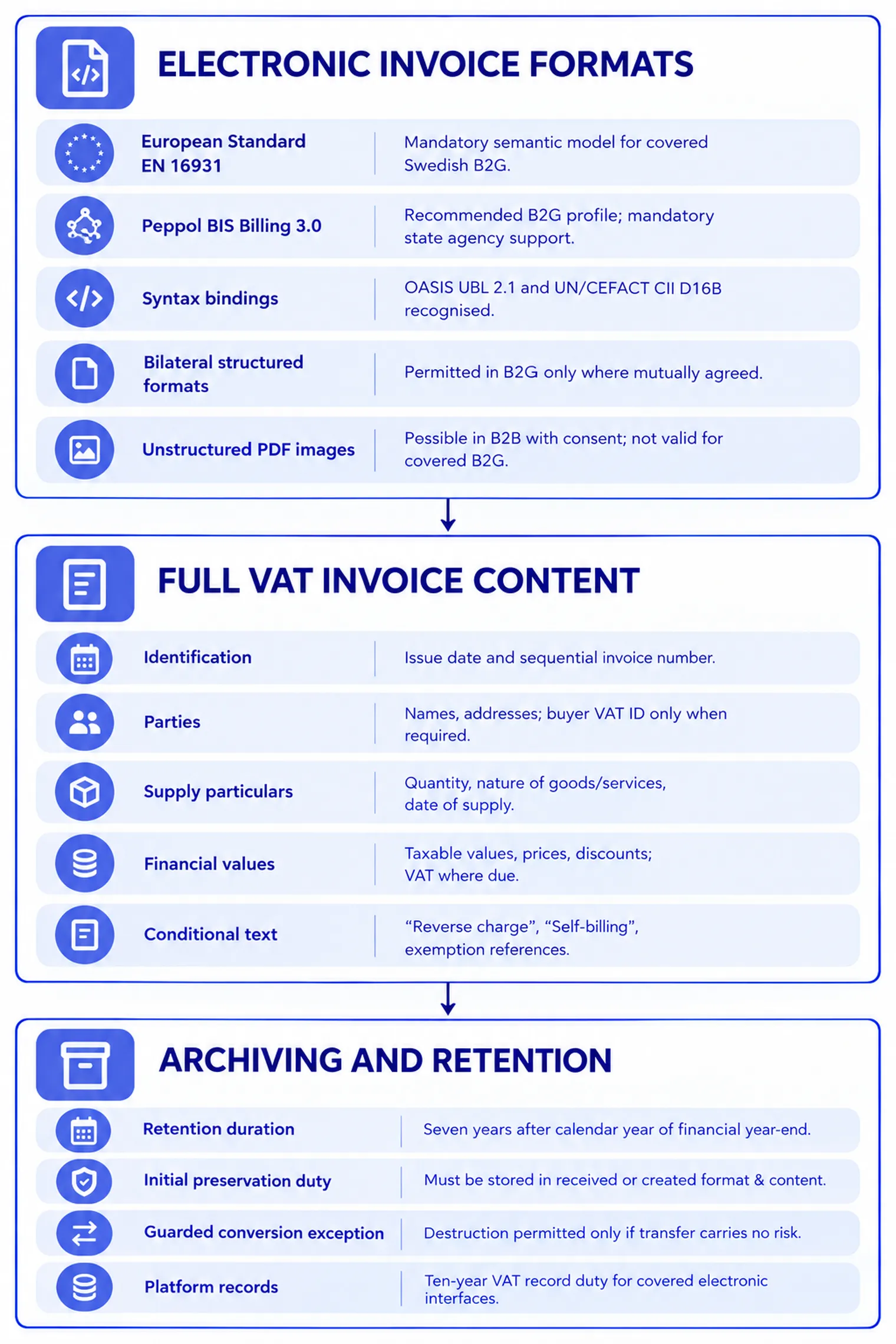
For covered public procurement, electronic invoices must satisfy European standard EN 16931. The Single Face to Industry (SFTI) initiative confirms that Sweden officially recognises two syntax bindings for EN 16931:
OASIS UBL 2.1 (ISO/IEC 19845)
UN/CEFACT Cross Industry Invoice (CII) D16B
In practice, public authorities strongly recommend Peppol BIS Billing 3.0, primarily adapted for UBL 2.1, with limited CII D16B use. Central government agencies are legally obliged under MDFFS 2021:1 to support Peppol BIS Billing 3.0 for electronic invoice processing. Where both supplier and buyer validly agree under Section 4 of Lag (2018:1277), an alternative structured electronic format may be used. MDFFS 2021:1 restricts continued Svefaktura 1.0 capability to business relationships established before 1 March 2021, subject to the regulation.
Unstructured electronic documents, such as graphic PDF invoices sent via email, do not satisfy the statutory structured e-invoicing mandate in public procurement. PDF invoices can be used where the applicable VAT invoicing rules are met and the buyer accepts electronic delivery. Under Chapter 17 §30, authenticity, integrity and legibility must be maintained throughout retention.
What mandatory content must Swedish VAT invoices include?
Under Chapter 17, primarily Section 24, subject to Sections 25 to 29 of Mervärdesskattelag (2023:200), full VAT invoices must state:
The date of issue and a unique sequential invoice number.
The supplier's full name, address and VAT identification number.
The buyer's full name and address, and VAT identification number where the buyer is liable for VAT or the invoice covers a qualifying intra-EU supply of goods under Chapter 10, Section 42.
The quantity and nature of the goods supplied or the extent and nature of the services performed.
The supply or qualifying advance-payment date, if determinable and different from the invoice issue date.
The taxable amount per rate or exemption, unit prices exclusive of tax, and any price reductions or discounts not included in the unit price.
The applicable VAT rate and VAT amount, except where Chapter 17 §25 or another special rule permits an omission. Where VAT is payable in Sweden, Chapter 17 §29 also requires the VAT amount in SEK, or in EUR where the invoice issuer keeps accounts in euros.
Mandatory conditional notations where applicable, such as "Reverse charge" (omvänd skattskyldighet), "Self-billing" (självfakturering), or references to statutory VAT exemptions or margin schemes.
Simplified invoices may be issued under Chapter 17, Sections 26–28 where the total does not exceed SEK 4,000 including VAT, a sector’s practice or technical limits make full particulars difficult, the document corrects an earlier invoice, or the supplier applies the qualifying small-business exemption. Section 27 excludes specified intra-EU and cross-border supplies and defined reverse-charge situations; it does not prohibit simplified invoices for every cross-border transaction. VAT Act.
Self-billing is permitted under Chapter 17, Section 15, provided there is a prior formal agreement between the parties and a specific procedure ensuring that the supplier approves each invoice. Under Section 22, any corrective document amending an earlier invoice and referencing it clearly is treated as an invoice.
What are the invoicing deadlines under Swedish VAT law?
Statutory deadlines for issuing invoices depend on the category of transaction:
Intra-EU supplies of goods: Under Chapter 17, Section 17 of the VAT Act, invoices for exempt intra-Community supplies of goods must be issued no later than the 15th day of the month following the calendar month in which the chargeable event occurred.
Intra-EU supplies of services: Under Chapter 17, Section 18, invoices for cross-border services subject to EU recapitulative reporting must be issued no later than the 15th day of the month following the calendar month of supply.
Construction services: Under Chapter 17, Section 16, taxable persons supplying construction services and associated goods must issue invoices no later than the end of the second calendar month following the month of supply.
Ordinary domestic supplies: Swedish law does not prescribe a universal fixed calendar deadline for all general domestic B2B supplies, but specific invoice duties, tax accounting and contract terms still apply.
How must electronic invoices and accounting records be archived in Sweden?
Accounting and invoice retention is governed by Bokföringslag (1999:1078), as amended by SFS 2024:342.
Accounting information, including incoming and outgoing invoices, vouchers and accounts, must be retained until the end of the seventh year following the calendar year in which the financial year ended. Under Chapter 7, Section 1, electronic accounting documents received from third parties or created by the enterprise must initially be preserved in the format and with the content in which they were received or created.
Under Chapter 7, Section 6 of the Bookkeeping Act, original source media (such as physical paper or original electronic files) may be destroyed following a transfer to another storage medium only if the transfer is carried out in a reliable and complete manner without risk of alteration or loss of accounting information. Businesses cannot convert structured XML accounting vouchers into unstructured PDF formats and destroy the XML unless that rigorous standard is satisfied. In addition, Chapter 17, Section 30 of the VAT Act requires authenticity of origin, integrity of content and readability throughout the invoice storage period.
Electronic records are normally retained in Sweden under Chapter 7, Section 2 of the Bookkeeping Act. Electronic storage in another EU country is permitted under Section 3 a only with notification, immediate authority access and Swedish printout capability; certain third countries with comparable mutual-assistance arrangements may qualify, while other cases require specific permission under Section 4. Separate exceptions apply to independent foreign branches under Section 5. Covered electronic-interface operators also have a ten-year VAT transaction record duty under Chapter 17, Sections 35–37 of the VAT Act.
Which identifiers and routing schemes apply in Swedish Peppol transmission?
Participant addressing in the Swedish Peppol network is governed by Upphandlingsmyndigheten instructions. Two primary International Code Designator (ICD) schemes are used:
Scheme 0007: Swedish organisation numbers (organisationsnummer). The prefix 0007: is followed by the ten-digit entity registration number (for example, 0007:5512345678).
Scheme 0088: Global Location Numbers (GLN), using the prefix 0088: followed by the thirteen-digit GLN.
The participant selects the scheme based on its registered business identifier or GLN. The Peppol identifier is distinct from the Swedish VAT registration number (which uses the format SE followed by ten digits and 01). Network routing is resolved automatically through the Peppol Service Metadata Locator (SML) and Service Metadata Publisher (SMP) architecture.
What electronic VAT and transaction reporting is required in Sweden?
Digital tax reporting in Sweden consists of periodic VAT returns, recapitulative statements for intra-EU trade, quarterly CESOP declarations for payment service providers, and point-of-sale fiscal cash-register recording.
Swedish tax reporting systems | |||
Mechanism | Frequency | Nominal deadline | Official channel |
VAT return (high) | Monthly (>SEK 40m) | 26th next month* | Software API / e-serv. |
VAT return (medium) | Quarterly (<=SEK 40m) | 12th/17th, 2nd month | API / e-service |
VAT return (low) | Annual (<=SEK 1m) | Varies by filer/year-end | API/e-service/paper |
EU recap statement | Monthly / quarterly | 20th paper / 25th | Skatteverket e-service |
OSS return | Quarterly | End of next month | Skatteverket OSS hub |
IOSS return | Monthly | End of next month | Skatteverket IOSS hub |
CESOP reporting | Quarterly | End of next month | XML via E-transport |
Cash register fiscal | Continuous | At point of sale | Certified register |
*November: 27 December; dates may shift on non-business days.
How do periodic VAT returns work in Sweden?
Under Chapter 26 of Skatteförfarandelag (2011:1244), reporting periods and filing deadlines are determined by annual taxable turnover:
Turnover exceeding SEK 40 million (monthly): Normally monthly, subject to the statutory turnover base and agency decisions. Under Chapter 26, Section 30, the nominal due date is the 26th of the month after the reporting period, except for November, which is due on 27 December. Adjustments for non-business days may apply.
Turnover up to SEK 40 million (quarterly or monthly): Quarterly reporting generally applies, with a monthly option or tax agency decision. Under Chapter 26, Section 26, the nominal quarterly deadlines are 12 May, 17 August, 12 November and 12 February for the preceding quarters. Lower-turnover monthly filers normally use the deadline table in that section; the normal month-after-next rule has January/August variants and may shift on non-business days.
Turnover up to SEK 1 million (annual, if eligible): For qualifying individuals and estates who file an income tax return, the normal deadline is 12 May following the tax year, subject to exceptions for certain intra-EU trade. For specified legal entities, Section 33 b instead sets deadlines based on the financial year-end: 12 July, 12 November, 27 December or 12 March. Eligible electronic filers may use the statutory one-month extension. Some categories use the separate Section 33 deadline.
As confirmed by Skatteverket guidance, ordinary VAT returns may be submitted via direct accounting software integrations using Skatteverket's API, through the agency's web e-service, or on authorised paper forms.
What are Sweden's recapitulative statement and one-stop shop requirements?
Businesses making qualifying supplies of goods or reverse-charge services to VAT-registered buyers in other EU member states must submit periodic recapitulative statements (periodisk sammanställning) under Chapter 35 of the Tax Procedures Act. According to Skatteverket, statements are due:
By the 20th day of the following month for paper filings.
By the 25th day of the following month for electronic filings.
Goods are normally reported monthly; quarterly reporting requires a Skatteverket decision on request and qualifying goods supplies of no more than SEK 500,000 excluding VAT in the current and each of the preceding four quarters. Services alone are normally reported quarterly, but businesses reporting goods and services together usually report monthly.
Businesses enrolled in special European schemes declare cross-border consumer sales via Skatteverket's digital portals:
One Stop Shop (OSS): Quarterly returns submitted by the last day of the month following the calendar quarter.
Import One Stop Shop (IOSS): Monthly returns submitted by the last day of the month following the reporting period. Paper filing is strictly prohibited for OSS and IOSS declarations.
Who must submit quarterly CESOP payment reports in Sweden?
Under Chapter 33 c of the Tax Procedures Act, introduced through SFS 2023:638 to implement EU Directive 2020/284, reporting payment service providers in Sweden, including relevant registered providers and foreign EEA institutions or branches, must submit quarterly records of qualifying cross-border payments to Skatteverket.
Reporting is triggered when a PSP executes more than 25 qualifying cross-border payments (at least 26 payments) to the same payee in a calendar quarter. Under Chapter 33 c, Section 6, a payer-side PSP is exempt from reporting payments where at least one payee-side PSP is located in an EU member state, although those transactions still count toward the 26-payment threshold.
CESOP returns are due no later than the last calendar day of the month following the quarter:
First quarter (January to March): due 30 April
Second quarter (April to June): due 31 July
Third quarter (July to September): due 31 October
Fourth quarter (October to December): due 31 January of the following year
Under Skatteverket’s CESOP instructions, filings use the currently prescribed XML/XSD format and its E-transport file-transfer service. The agency may revise schema and validation versions. CESOP filing extensions are not available; filers also need the required Swedish organisation number and an Expisoft Serverlegitimation/Organisationslegitimation certificate, together with CESOP E-transport access approval.
What fiscalisation and cash-register rules apply to Swedish retail sales?
Retail businesses selling goods or services for cash or payment cards must use a certified cash register (kassaregister) and offer a cash-register receipt under Chapter 39, Sections 4 to 8 of the Tax Procedures Act. Skatteverket officially treats mobile payment methods, including Swish, as equivalent to card payments.
Under Chapter 39, Section 5, businesses with low retail sales are exempt from the cash-register requirement if total cash, card and Swish sales do not exceed four statutory price base amounts during a 12-month financial year. For 2026, Statistics Sweden set the price base amount at SEK 59,200, establishing an insignificant-sales exemption ceiling of SEK 236,800 including VAT, as confirmed by Skatteverket guidance. Invoiced sales are treated separately; other exemptions and mixed-payment rules may also matter.
From 1 January 2027, covered cash registers must meet technical regulation SKVFS 2021:17. Registers equipped with electronic journal memory must be capable of exporting registration data in XML format for tax auditing. Cash-register data exports are inspection tools; they do not constitute real-time invoice clearance.
How are electronic invoices and tax reports transmitted in Sweden?
Sweden does not operate a single government gateway for all commercial invoices and tax returns. Instead, the technical architecture separates commercial document routing from official tax filings.
Public procurement transport
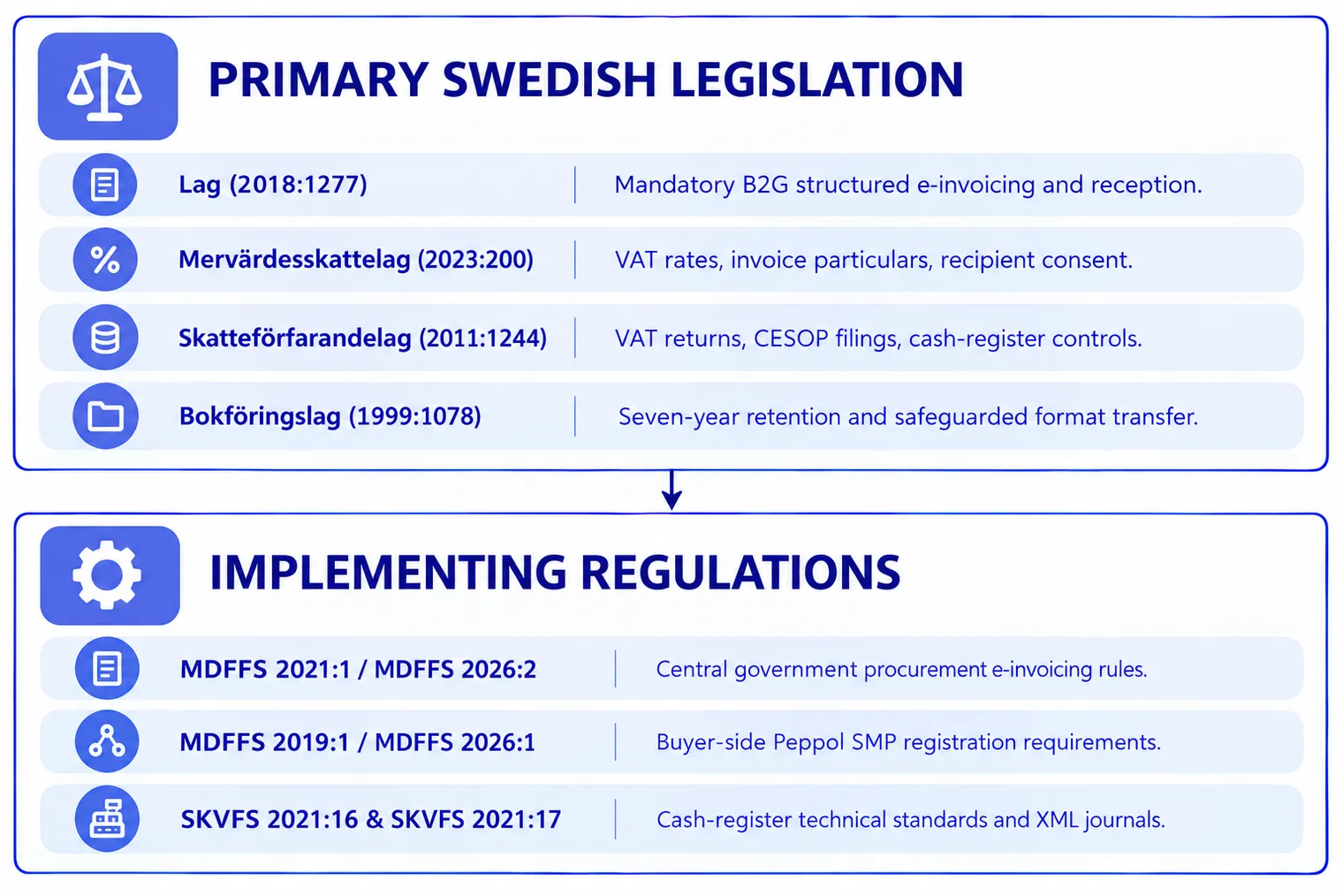
Public procurement electronic invoices are exchanged predominantly through the Peppol 4-corner network. Under MDFFS 2026:1, public contracting authorities and contracting entities must maintain registration in a Peppol SMP to receive invoices. The supplier (Corner 1) sends a compatible structured invoice to its Peppol access point (Corner 2), which uses SML/SMP discovery to obtain the buyer's service metadata and forwards the message to the buyer's Service Provider (Corner 3) for delivery into the buyer's enterprise system (Corner 4).
For central government agencies, regulation MDFFS 2021:1 requires central agencies to maintain Peppol invoice capability and supplier portals for those unable to exchange invoices electronically. Section 4 of Lag (2018:1277) permits the supplier and public purchaser to agree on an alternative electronic invoicing standard. The agreed transmission method must still deliver an invoice that meets the Act's structured electronic invoice definition.
Tax reporting channels
Official tax reporting channels are administered directly by Skatteverket:
VAT returns: Filed electronically via modern software accounting integrations (Skatteverket API) or the agency's web portal, with authentication appropriate to the applicable service. Paper submissions remain legally permitted for standard VAT declarations.
CESOP reports: Submitted strictly via Skatteverket's dedicated E-transport secure file-transfer protocol. Submissions require pre-validation against the European Commission's CESOP XML Schema Definition.
Fiscal cash registers: Record qualifying cash, card and Swish sales through compliant systems with the required control and journal functions; applicable 2027 XML export duties concern registers with journal memory.
What are the penalties for e-invoicing and tax non-compliance in Sweden?
Non-compliance with electronic invoicing, VAT reporting, cash-register controls and CESOP obligations exposes businesses to specific statutory sanctions under Swedish law.
Offence | Taxpayer category | Statutory penalty or sanction | Legal basis |
|---|---|---|---|
Failure to issue B2G e-invoice in required standard | Public procurement supplier | Authority compliance order; a conditional fine (vite) may be attached | |
Late submission of ordinary VAT return | Taxable person | Late-filing fee of SEK 625; increased to SEK 1,250 if filed only after a formal filing order | |
Late EU recapitulative statement | Taxable person | Late-filing fee of SEK 1,250 | |
Incorrect VAT declaration (ordinary surcharge) | Taxable person | Tax surcharge (skattetillägg) of 20% of the unassessed or wrongly credited VAT | |
Incorrect VAT declaration (timing error) | Taxable person | Reduced surcharge of 2% (short period / four-month error) or 5% (other timing errors) | |
Retail cash-register non-compliance | Retail business | Control fee (kontrollavgift) of SEK 12,500 per inspection | |
Repeat cash-register violation within one year | Retail business | Increased control fee of SEK 25,000 | |
Late or improper CESOP payment report | Payment service provider | Reporting fee of 0.1% of prior-year turnover (min SEK 1,000, max SEK 1,000,000); further fees after 60/120 days, subject to statutory exceptions | |
Failure to document CESOP payment records | Payment service provider | Documentation fee of 0.3% of prior financial year turnover (min SEK 3,000, max SEK 3,000,000) |
What administrative penalties apply to VAT and tax return breaches?
Under Chapter 48 of the Tax Procedures Act, failing to submit an ordinary VAT return on time triggers a statutory fee of SEK 625. If the taxpayer fails to respond to an administrative order to file, the fee rises to SEK 1,250. Submitting a late EU recapitulative statement attracts an immediate statutory fee of SEK 1,250 under Section 6.
Tax surcharges (skattetillägg) apply where an incorrect declaration leads to an unassessed tax liability or an unjustified refund. The standard surcharge under Chapter 49, Section 11 is 20% of the affected VAT amount. Under Section 13, where an error is merely a period allocation timing mistake, the surcharge is reduced to:
2% where the reporting period is at most three months and the allocation error is corrected within four months of the close of the proper period.
5% for other qualifying period allocation errors.
General statutory relief rules under Chapter 51 allow for remission of surcharges where non-compliance is excused by age, illness, lack of experience or other excusable circumstances.
What sanctions apply to cash-register and CESOP non-compliance?
Failure to maintain a certified cash register, produce receipts or export journal records exposes retailers to a control fee of SEK 12,500 under Chapter 50 of the Tax Procedures Act. For a qualifying repeat breach within one year of a prior control-fee decision, the statutory fee is SEK 25,000, subject to statutory exceptions. Anti-overlap and rectification safeguards apply under Sections 5 and 6.
For payment service providers, Chapter 49 c establishes distinct reporting fees for CESOP breaches. Late CESOP filing or submission in an incorrect format may trigger a reporting fee of 0.1% of the provider's turnover in the preceding financial year (minimum SEK 1,000 and maximum SEK 1 million). Chapter 49 c, Section 9 excludes certain minor defects and qualifying voluntary corrections made within the statutory conditions. Additional fees may arise if the filing remains outstanding at 60 and 120 days after the original statutory filing deadline, subject to the statutory conditions.
Under Chapter 49 b, failing to document required CESOP information correctly or within the deadline under Chapter 39 Section 3 c triggers a documentation fee of 0.3% of preceding turnover (at least SEK 3,000 and at most SEK 3 million). To prevent double penalties, Chapter 49 c, Section 10 prohibits imposing a reporting fee if a documentation fee has already been imposed for the same quarter.
What civil and contractual consequences apply to non-compliant invoices?
Swedish public procurement e-invoicing law provides supplier compliance orders and possible conditional fines, but does not itself set out a universal automatic right to withhold payment solely for wrong invoice format. Payment, default interest, invoice disputes and VAT input deduction depend on the contract and the applicable VAT rules. No blanket assurance about the buyer’s input VAT deduction should be given solely from the use or rejection of a particular invoice format. Lag (2018:1277) and Mervärdesskattelag (2023:200).
How can businesses prepare for Swedish compliance requirements?
Businesses operating in Sweden must align their enterprise software, billing workflows and tax filing systems with confirmed regulatory requirements.
Practical preparation steps
Determine procurement transaction scope: Identify all active contracts with Swedish public contracting authorities and contracting entities. Check whether procurements began on or after 1 April 2019, and assess any security exceptions or valid agreed alternative structured standards under Lag (2018:1277).
Implement compliant electronic formats: Configure enterprise resource planning (ERP) systems to generate and validate invoices conforming to European standard EN 16931. Prioritise Peppol BIS Billing 3 with UBL 2.1; CII D16B is an alternative EN 16931 syntax with more limited market support. Check each receiving authority’s accepted transmission route.
Establish Peppol network connectivity: Public entities must ensure active registration in a Peppol Service Metadata Publisher (SMP). Suppliers can use a Peppol-accredited access point, a public-buyer supplier portal or another agreed structured route. Use scheme 0007 or 0088 only when it matches the registered participant identifier.
Audit invoice master data and tax rates: Review billing engines to ensure all mandatory particulars required by Chapter 17 of the VAT Act are captured, including sequential numbering, reverse-charge notices and correct VAT rates (25%, 12% or temporary 6% food VAT).
Upgrade retail cash registers: Retailers subject to the cash-register rules must confirm applicable SKVFS 2021:17 compliance by 1 January 2027. XML export applies where the register uses journal memory; check exemptions before planning upgrades.
Screen cross-border payment flows: Payment service providers must track quarterly transaction volumes to identify payees receiving at least 26 payments, preparing XML files for transmission via Skatteverket's E-transport hub.
Maintain compliant archiving systems: Retain accounting records for the statutory seven-year period. Preserve original electronic format and content until a transfer meets Chapter 7, Section 6 safeguards; never destroy a source file if the transfer may alter or lose accounting information.
What are the key compliance takeaways for businesses in Sweden?
For covered public procurements initiated on or after 1 April 2019, Swedish law generally requires suppliers to issue structured invoices conforming to European standard EN 16931. Private domestic B2B e-invoicing remains voluntary and requires recipient consent under the VAT Act.
Digital tax administration relies on periodic VAT returns, recapitulative statements, certified retail cash registers and mandatory CESOP payment reporting for payment service providers. Technical preparations should focus on Peppol BIS Billing 3.0 integration, seven-year accounting retention with guarded conversion options under the Bookkeeping Act, and cash-register journal XML readiness ahead of the 1 January 2027 technical deadline. Businesses should monitor committee inquiry Dir. 2026:9 to track future Swedish legislative proposals regarding EU ViDA transposition.
FAQ
No. Structured electronic invoicing is not mandatory for domestic business-to-business transactions in Sweden. While taxable persons must issue VAT invoices under Chapter 17 of Mervärdesskattelag (2023:200), Section 20 specifies that electronic invoices require the recipient's consent. Private trading partners may mutually agree to use paper, PDF or structured electronic invoices.