
This guide summarises Hungary's invoicing and VAT reporting requirements as reviewed on 12 October 2026. Its regulatory claims remain subject to final legal and technical validation before publication. From 1 September 2026, electronic reporting also applies to covered receipts issued outside cash-register systems. NAV announced that it would not impose fines for failures under this new obligation through 31 December 2026. The same effective date introduced a 0% VAT rate for qualifying prescription-only and human-use magistral medicines. See NAV's receipt-reporting announcement and medicine VAT guidance. The domestic small enterprise VAT exemption threshold stands at HUF 20,000,000 for 2026, with further legislated increases scheduled for 2027 and 2028. Sectoral electronic-only invoicing mandates are active for non-household energy and water supplies, while businesses must prepare for mandatory hardware-based electronic cash registers by 1 July 2028 and EU ViDA cross-border obligations from 1 July 2030.
Last regulatory review: 12 October 2026.
Is electronic invoicing mandatory in Hungary?
General domestic business-to-business (B2B) electronic invoicing is not mandatory in Hungary. Under Section 175 of Act CXXVII of 2007 on Value Added Tax (Áfa tv.), issuing an electronic invoice is optional and requires the consent of the recipient, which may be granted explicitly or tacitly through payment or download. Electronic invoices are format-neutral under Section 259 point 5 of the Áfa tv., encompassing structured XML, EDIFACT, PDF and hybrid files. Specific utility suppliers must issue electronic invoices to non-household customers. The relevant electricity and natural gas obligations took effect on 1 July 2025, followed by water utility services on 1 January 2026. These obligations apply to the suppliers and contracts covered by the respective sectoral decrees: Government Decree 273/2007, Section 21/B, Government Decree 19/2009, Section 115/E and Government Decree 58/2013, Section 65.
Although electronic invoice exchange remains generally voluntary, invoice data reporting to NAV is compulsory for transactions within the statutory reporting scope. Under Section 257/G(2) and Annex 10 to the Áfa tv., taxable persons must report transaction data in real time to the National Tax and Customs Administration (Nemzeti Adó- és Vámhivatal or NAV) via the Online Számla platform for covered invoices. Invoices generated by billing software must be transmitted automatically upon issuance using NAV's machine-to-machine (M2M) XML interface. Invoices issued through fiscal cash registers follow their applicable cash-register and receipt-data rules rather than the standard Annex 10 invoice-reporting route. Qualifying cross-border small enterprises are subject to the distinct provisions of Section 257/G(7).
Hungary's compliance regime operates as a continuous transaction control (CTC) reporting model rather than a pre-clearance gateway. Taxpayers issue invoices directly to customers without prior administrative validation, and commercial validity does not depend on a tax authority clearance stamp. The distinction between national invoice reporting and future EU obligations is established by Hungary's VAT Act and Council Directive (EU) 2025/516.
How did Hungary's digital tax and invoice reporting framework develop?
Hungary introduced mandatory real-time invoice data reporting on 1 July 2018, before the EU adopted the VAT in the Digital Age (ViDA) package in 2025. Hungary's retail fiscalisation framework was developed under Decree 48/2013. (XI. 15.) NGM, which established requirements for online cash registers (online pénztárgépek, OPG) equipped with electronic tax control units (adóügyi ellenőrző egység, AEE) that communicate with NAV.
Real-time invoice reporting (Online Számla) was launched in three legislative phases under Annex 10 to the Áfa tv.:
Phase 1 (1 July 2018): Mandatory real-time reporting applied to domestic B2B invoices with a passed-on VAT content of at least HUF 100,000.
Phase 2 (1 July 2020): The HUF 100,000 VAT threshold was removed, expanding invoice data reporting to domestic B2B invoices within statutory scope, regardless of the VAT amount, as documented in NAV's Phase 2 guidance.
Phase 3 (4 January 2021): Reporting expanded to cover B2C invoices, intra-Community transactions and exports governed by Hungarian invoicing rules. Personal customer identification is excluded from qualifying B2C submissions.
In public procurement, Hungary implemented Directive 2014/55/EU on 18 April 2019 via Section 27/A of Act CXLIII of 2015 on Public Procurement (Kbt.). This provision requires public contracting authorities to receive and process electronic invoices complying with European standard EN 16931, but it does not compel economic operators to issue electronic invoices.
NAV launched its electronic VAT system (eÁFA) on 1 January 2024. The optional web and machine-to-machine services use available invoice, fiscal receipt and customs data to support VAT return preparation and submission, as detailed in NAV's eÁFA guidance. On 1 September 2026, mandatory electronic reporting was extended to non-cash-register paper and computer-generated receipts under Act LIV of 2025. Looking forward, cross-border intra-EU transactions will transition to mandatory structured e-invoicing and transaction-level digital reporting requirements on 1 July 2030 under Council Directive (EU) 2025/516.
What is the compliance timeline for Hungary's invoicing and reporting mandates?
The compliance timeline combines historical reporting milestones, active sectoral e-invoicing mandates and confirmed future deadlines under national and European legislation.
Date | Legal status | Milestone | Affected entities | Primary legal source |
|---|---|---|---|---|
15 November 2013 | Historical legal milestone | Decree 48/2013 established requirements for online cash registers; affected businesses transitioned under the applicable commencement arrangements. | Retailers and hospitality providers. | |
1 July 2018 | Historical | Online Számla Phase 1 launched for domestic B2B invoices with VAT of at least HUF 100,000. | Taxable persons issuing high-value invoices. | |
18 April 2019 | Applicable | Public procurement contracting authorities must receive EN 16931 electronic invoices. | Public sector buyers and contracting entities. | |
1 July 2020 | Historical | Online Számla Phase 2 removed the HUF 100,000 VAT threshold for covered domestic B2B invoices. | Taxable persons issuing domestic B2B invoices. | |
4 January 2021 | Applicable | Online Számla Phase 3 extended reporting to covered B2C, intra-EU supplies and export sales. | Taxable persons issuing covered Hungarian invoices. | |
1 January 2024 | Applicable | eÁFA pre-populated electronic VAT return web and M2M interfaces became operational. | VAT-registered taxpayers filing periodic returns. | |
1 July 2025 | Applicable | Sectoral electronic-only invoicing began for covered non-household electricity and gas supplies; voluntary electronic cash-register operation became available. | Energy traders, distributors, buyers and retailers. | |
1 January 2026 | Applicable | Mandatory e-invoicing for non-household water utility supplies; VAT threshold rose to HUF 20,000,000. | Water utilities, commercial buyers and small firms. | |
1 September 2026 | Applicable | Non-cash-register receipt reporting began; 0% VAT also became applicable to qualifying prescription-only and human-use magistral medicines. | Covered receipt issuers, pharmacies and medicine suppliers. | |
1 January 2027 | Announced enforcement transition and enacted threshold change | NAV's temporary non-penalisation concession ends; the domestic small-enterprise VAT exemption threshold rises to HUF 22,000,000. | Issuers of manual receipts and small businesses. | |
1 January 2028 | Future enacted | Small enterprise VAT exemption threshold increases to HUF 24,000,000 under enacted legislation. | Eligible small enterprises and sole traders. | |
1 July 2028 | Future enacted | Businesses subject to mandatory online cash-register use must transition from traditional OPG devices to authorised hardware-based electronic cash registers. | Businesses subject to mandatory cash-register use. | |
1 July 2030 | Future EU requirement | ViDA introduces structured e-invoicing and transaction-level digital reporting for relevant intra-Community B2B transactions. | Taxable persons carrying out transactions within the directive's defined scope. |
Which laws govern electronic invoicing and VAT reporting in Hungary?
The Hungarian regulatory framework separates commercial invoice creation from administrative tax reporting and accounting retention across several primary statutes and implementing decrees:
Act CXXVII of 2007 on Value Added Tax (Áfa tv.): Regulates taxable transactions, mandatory invoice content (Section 169), recipient consent for e-invoicing (Section 175), small enterprise exemption thresholds (Sections 188(2) and 377), real-time invoice data reporting (Section 257/G(2) and Annex 10), receipt reporting (Section 257/G(3) and Annex 11) and format neutrality (Section 259 point 5). Under Section 82 of the Áfa tv., Hungary applies a standard VAT rate of 27% and reduced rates of 18% and 5%. A domestic 0% rate applies to qualifying daily newspapers and, from 1 September 2026, specified prescription-only medicines and human-use magistral preparations, subject to their statutory conditions. See NAV's current medicine VAT guidance. Qualifying intra-Community supplies and exports are generally exempt with a right to deduct input VAT under Sections 89 and 98 of the Áfa tv.. They should not be classified as domestic zero-rated sales.
Act CL of 2017 on the Rules of Taxation (Art.): Establishes tax administration procedures, general record-retention and limitation rules, filing deadlines, administrative penalties and enforcement powers. Relevant provisions include Sections 7, 78, 220, 228, 229, 229/B and 245, together with Annex 2. The applicability of each sanction depends on the specific offence and statutory conditions.
Act C of 2000 on Accounting (Számv. tv.): Requires accounting vouchers, including relevant invoices, to be retained in a legible and retrievable form for at least eight years under Section 169, with electronic records also subject to applicable integrity and preservation requirements.
Act CXLIII of 2015 on Public Procurement (Kbt.): Transposes Directive 2014/55/EU under Section 27/A, obliging public contracting bodies to receive and process electronic invoices complying with European standard EN 16931.
Sectoral utility decrees and recent VAT amendments: Non-household utility invoicing is governed by Government Decree 273/2007. (X. 19.) Section 21/B(1a) for electricity, Government Decree 19/2009. (I. 30.) Section 115/E(1a) for natural gas, and Government Decree 58/2013. (II. 27.) Section 65(5a) for water utilities. Statutory VAT amendments include Act XL of 2026, which enacted the zero-rating of qualifying prescription-only and human-use magistral medicines from 1 September 2026 under Section 82(4) and Annex 3/B.
Digital archiving and technical decrees: Decree 1/2018. (VI. 29.) ITM governs electronic document preservation. Decree 48/2013. (XI. 15.) NGM and Decree 8/2025. (III. 31.) NGM govern traditional online cash registers and modern electronic cash registers respectively.
Which authorities oversee tax compliance and invoicing in Hungary?
NAV is Hungary's principal authority for invoice-data reporting and tax compliance. Other public bodies have distinct responsibilities for tax policy, public procurement and electronic trust services:
Institution | Responsibility |
|---|---|
Ministry of National Economy (Nemzetgazdasági Minisztérium - NGM) | Formulates tax policy, drafts VAT legislation and enacts ministerial decrees governing cash registers and invoicing rules. |
National Tax and Customs Administration (Nemzeti Adó- és Vámhivatal - NAV) | Operates the Online Számla reporting API, eÁFA platform and fiscal receipt registers; conducts tax audits and enforces penalties. |
Public Procurement Authority (Közbeszerzési Hatóság) | Performs statutory public procurement oversight functions. Contracting authorities themselves are responsible for meeting the electronic invoice reception obligations in Section 27/A of the Kbt. |
National Media and Infocommunications Authority (Nemzeti Média- és Hírközlési Hatóság - NMHH) | Registers and supervises qualified and non-qualified electronic trust service providers, including relevant signature and time-stamping services. |
Which transactions are covered by Hungary's invoicing and reporting rules?
Hungarian tax law applies distinct rules to commercial invoice issuance, invoice reception and tax authority data reporting across different transaction categories.
Transaction type | Issuance requirement | Reception requirement | Reporting requirement |
|---|---|---|---|
Domestic B2B | Optional and format-neutral; paper permitted. Mandatory electronic-only for non-household energy and water supplies. | Recipient consent required unless a statutory exception applies; mandatory acceptance for energy and water utilities. | Covered software-issued invoices require immediate automated NAV XML reporting. Covered invoices issued on pre-printed forms have separate one-day or four-day reporting deadlines. |
Domestic B2G | Optional for suppliers; paper remains legally valid unless the procurement contract specifies otherwise. | Contracting authorities and entities covered by Section 27/A must receive and process qualifying EN 16931-compliant electronic invoices. | Mandatory reporting to Online Számla immediately upon issuance via software XML API for covered transactions. |
Domestic B2C | An invoice or receipt must be issued as legally required; paper and authorised electronic receipt options apply. | Electronic invoices generally require recipient consent. Electronic receipts issued through authorised fiscal systems follow separate legal rules, including applicable customer access and paper-copy requirements. | Covered B2C invoices report through Online Számla without non-taxable natural-person identification. Receipts follow the applicable OPG, electronic cash-register or non-cash-register reporting procedure. |
Intra-EU cross-border | Governed by invoicing rules of the applicable Member State under Article 219a. Format-neutral if Hungarian rules apply. | Recipient acceptance and document-format requirements depend on the invoicing law applicable to the transaction and any relevant statutory exceptions. | Mandatory reporting to Online Számla for Hungarian VAT-registered suppliers where Hungarian invoicing rules govern. |
Third-country cross-border | Standard Hungarian invoicing rules; electronic invoicing permitted with recipient consent. | Governed by commercial contract terms and import customs procedures in recipient country. | Mandatory reporting to Online Számla for export invoices issued under Hungarian VAT rules. |
Foreign suppliers | Non-established suppliers must assess whether Hungarian invoicing rules govern each transaction, including the applicable reverse-charge, establishment and special-scheme provisions. | Governed by commercial contract terms and applicable national invoicing rules. | NAV invoice-data reporting applies where the invoice falls within the Hungarian statutory reporting scope; foreign establishment, OSS/IOSS treatment and applicable invoicing rules must be assessed. |
Specific statutory exemptions apply across these transaction categories:
Cash register invoice exclusion: Invoices issued using cash registers or electronic cash registers are excluded from Annex 10 invoice reporting under Section 257/G(2) and report through dedicated cash-register data channels under Annex 11.
EU One Stop Shop (OSS) and Import OSS (IOSS): Supplies within the applicable EU OSS or IOSS special schemes may fall outside domestic Online Számla reporting under the relevant statutory provisions. The exemption must be assessed for the specific transaction and the applicable invoicing-law treatment.
Qualifying cross-border small enterprises: Small businesses established in other EU Member States operating under the cross-border SME scheme follow the distinct reporting rules set out in Section 257/G(7) of the Áfa tv..
Domestic small business exemption (alanyi adómentesség): Taxable persons applying the small business exemption under Section 188 of the Áfa tv. do not charge output VAT, but they remain legally required to issue invoices and report them to Online Számla. The domestic threshold is HUF 20,000,000 for 2026, increasing to HUF 22,000,000 for 2027 and HUF 24,000,000 for 2028 under Section 377.
Customer data privacy in B2C: Under Annex 10 point 1/B of the VAT Act, suppliers must not transmit identifying details of non-taxable natural-person customers, including their names and addresses, in the relevant B2C invoice-data submissions.
What are the technical and legal requirements for issuing electronic invoices in Hungary?
Does issuing an electronic invoice require recipient consent?
Under Section 175(3) of the Áfa tv., issuing an electronic invoice requires the consent of the customer, unless specific statutory provisions provide otherwise. Consent may be express or inferred from conduct where the circumstances establish acceptance of electronic invoicing. A written agreement may provide evidence of consent, while payment or download must be assessed in its contractual and factual context. Specific exceptions to general recipient-consent rules are established for covered non-household electricity, natural gas and water utility supplies. The applicable supplier, contract and transitional conditions are determined by the respective sectoral decrees: Government Decree 273/2007, Government Decree 19/2009 and Government Decree 58/2013.
Which invoice formats are legally valid in Hungary?
Hungary maintains a format-neutral legal regime for commercial electronic invoices under Section 259 point 5 of the Áfa tv.:
NAV Online Számla XML, version 3.0: The NAV 3.0 XML schema is used for statutory invoice-data reporting. A NAV-format XML file may support commercial invoicing where it satisfies the invoice-content, issuance, reception and authenticity requirements agreed by the parties, as documented in NAV's official technical repository.
EN 16931 syntaxes (UBL 2.1 and UN/CEFACT CII): Public procurement recipients covered by Kbt. Section 27/A must be able to process qualifying EN 16931-compliant electronic invoices. UBL 2.1 and UN/CEFACT CII are recognised syntaxes; B2B use remains subject to the applicable invoicing rules.
Peppol BIS Billing 3.0: An EN 16931-based electronic invoicing specification that trading partners may use where the recipient supports the relevant Peppol transport and document arrangements. Peppol is not the mandatory transport network for NAV Online Számla reporting.
PDF and image files: PDF invoices can be valid electronic invoices where issued and received electronically, recipient consent applies and authenticity of origin, content integrity and legibility are maintained. A qualified electronic signature is not universally required under Sections 168/A and 175 of the Áfa tv..
EDIFACT / EANCOM: Standard EDI syntaxes remain legally valid in high-volume supply chains subject to commercial agreements.
What mandatory content must appear on a Hungarian VAT invoice?
Under Section 169 of the Áfa tv., a standard Hungarian tax invoice must include:
Date of invoice issuance (számla kibocsátásának kelte).
Sequential invoice number that uniquely identifies the document (számla sorszáma).
Supplier's full name, registered address and Hungarian tax number (adószám).
Customer's name and address, plus the relevant customer tax or VAT identification number where required under Section 169, including qualifying domestic B2B and intra-Community transactions.
Date of supply or fulfilment (teljesítés időpontja), where different from the invoice date.
Detailed description, nature and quantity of goods supplied or services provided.
Unit price exclusive of VAT, and any discounts not reflected in the unit price.
Net taxable amount broken down by applicable VAT rate or exemption category.
Applicable VAT rate (27%, 18%, 5% or 0%, where eligible), or the required exemption or reverse-charge indication. The 0% rate includes qualifying medicines from 1 September 2026.
VAT amount expressed in HUF, including where other invoice amounts are denominated in a foreign currency. Conversion must follow Section 80 of the VAT Act, including the conditions for using Hungarian National Bank or ECB exchange rates.
The prescribed wording for applicable special treatments, including pénzforgalmi elszámolás (cash accounting), önszámlázás (self-billing), fordított adózás (reverse charge), statutory exemption references and the relevant margin-scheme wording.
Product classification codes such as customs tariff numbers (VTSZ) or service classification codes (TESZOR) are generally optional on commercial invoices, unless specific statutory rules or Online Számla data structures require them for designated supplies.
What are the statutory deadlines for issuing invoices in Hungary?
Invoice issuance deadlines depend on the transaction type and settlement terms under Section 163 of the Áfa tv.:
Immediate issuance: An invoice must be issued without delay where the payment and transaction conditions specified in Section 163(2)(b) apply. The statutory treatment also depends on whether the payment is consideration for a completed supply or an advance.
General domestic credit supplies: Where VAT is or should be passed on and payment is not made immediately upon supply, the invoice must be issued within an eight-day statutory window under Section 163(2)(c).
Intra-Community supplies and cross-border services: Invoices for exempt intra-Community supplies of goods and cross-border reverse-charge services must be issued no later than the 15th day of the calendar month following the month in which the supply occurred under Section 163(2)(a).
Periodic settlement supplies: For transactions governed by Section 58, determine the statutory supply date before applying the relevant Section 163 invoice-issuance deadline. The eight-day rule applies where its statutory conditions are satisfied.
How must electronic invoices be archived?
Accounting vouchers, including relevant invoices, must generally be retained for at least eight years under Section 169 of the Accounting Act. This is separate from the authorised electronic receipt repository (nyugtatár), which NAV states preserves electronic receipt records for ten years. General tax records must be retained for 5 years from the end of the year in which the tax return was due under Section 78 of the Rules of Taxation.
Under Section 3 of Decree 1/2018. (VI. 29.) ITM, invoices issued or received electronically must be preserved in electronic form throughout their mandatory retention period. Printing electronic invoices on paper does not fulfil statutory archiving rules. Paper invoices may be converted into electronic records where the applicable digitisation and preservation rules are satisfied. The process must maintain reliable evidence of authenticity, integrity, legibility and retrieval throughout the required retention period.
Authenticity of origin, content integrity and legibility must be maintained. Under Section 175(2) of the VAT Act, these requirements may be supported by reliable business controls, appropriate electronic signatures or qualifying EDI arrangements. A qualified electronic signature is not mandatory on commercial e-invoices where reliable business controls are maintained.
What electronic VAT and transaction reporting is mandatory in Hungary?
Hungary operates separate reporting obligations for invoices, fiscal receipts and VAT returns. Relevant intra-Community transactions may also require an A60 recapitulative statement. The applicable filing periods and deadlines depend on the taxpayer's reporting status.
Reporting system | Covered taxpayers | Reportable data | Reporting frequency | Submission deadline | Official submission channel |
|---|---|---|---|---|---|
Online Számla (RTIR) | Taxpayers issuing invoices within statutory reporting scope. | Statutory invoice data for covered domestic and cross-border transactions. Cash-register-issued invoices and other specified exceptions follow their applicable legal treatment. | Automatic reporting on issuance for software; 1 or 4 days for manual forms. | Immediately upon invoice generation by billing software; manual forms within 1 or 4 calendar days. | NAV Online Számla M2M REST API or web portal. |
Online Cash Register (OPG) | Retail, hospitality and service businesses subject to decree. | Transaction-level sales and turnover data recorded by fiscal cash register. | Automatic fiscal-data transmission to NAV under cash-register communication rules. | Automatic transmission under applicable fiscal-device rules and connectivity procedures. | Encrypted cellular GSM communication to NAV. |
Electronic Cash Register (EPG) | Businesses voluntarily using authorised electronic cash registers; hardware-based EPG becomes mandatory for cash-register-obligated activities from 1 July 2028. | Electronic receipts (e-nyugta) and cash-register-issued invoices. | Automated submission of the fiscal document according to authorised EPG system rules. | Automated submission of fiscal documents according to authorised EPG transmission rules. | NAV electronic receipt repository (nyugtatár), through authorised EPG system. |
Non-Cash-Register Receipt Reporting | Taxpayers issuing paper receipt pads or computer receipts without a cash register. | Daily aggregated receipt turnover broken down by applicable VAT rate. | Daily aggregated batches submitted within 3 days. | Within 3 calendar days of receipt issuance date. | ePénztárgép application, KOBAK web portal or M2M API. |
Periodic VAT Return (Form 65 / eÁFA) | Taxable persons are required to submit periodic VAT returns, according to applicable filing status and frequency. | Total output VAT, deductible input VAT and taxable transaction base. | Monthly, quarterly or annually based on taxpayer category. | 20th day of following month for monthly/quarterly; 25 February for annual returns. | NAV eÁFA web or M2M interface, or applicable electronic Form 65 filing route. |
Domestic Recapitulative Statement (M-lap) | Taxpayers subject to domestic invoice-level deduction reporting, unless exempt through qualifying eÁFA filing. | Required invoice-level data for qualifying domestic purchases supporting VAT deduction, subject to applicable 2026 reporting rules. | Concurrently with periodic VAT declaration where required. | 20th day of following month for monthly/quarterly; 25 February for annual returns. | Reported on applicable Form 65 M-lap where required; qualifying eÁFA filing removes separate M-lap reporting obligation. |
Intra-Community Statement (A60) | Taxpayers with reportable intra-EU supplies, acquisitions or services. | Transaction data and relevant EU VAT identifiers. | Monthly or quarterly as applicable. | Generally due by the 20th day following the reporting period. | NAV designated electronic filing channel (e.g. Form 26A60). |
Reporting deadlines operate under specific statutory thresholds:
Manual invoice forms: For invoices issued on pre-printed paper invoice books, Annex 10 point 2 to the Áfa tv. establishes a one-calendar-day reporting deadline where passed-on VAT reaches or exceeds HUF 500,000. Covered invoices issued on pre-printed forms with passed-on VAT below HUF 500,000, including invoices with no passed-on VAT, must generally be reported within four calendar days through the applicable NAV submission interface.
Receipt reporting transition: Following the commencement of mandatory reporting for non-cash-register receipts on 1 September 2026 under Act LIV of 2025, NAV announced a four-month non-penalisation transition running through 31 December 2026. The underlying legal duty to report remains in force during this transitional window.
VAT return deadlines: Under Annex 2 to the Rules of Taxation, monthly and quarterly VAT returns are generally due on the 20th day of the following month. Annual returns are generally due by 25 February of the following year, as confirmed in NAV's annual VAT guidance. Filing frequency and exceptional reporting obligations depend on the taxpayer's circumstances. If a statutory deadline falls on a weekend or public holiday, it moves to the next working day under Section 7(3) of the Art.
How does data flow through Hungary's invoicing and reporting systems?
Hungary maintains two distinct parallel communication flows: commercial invoice exchange between trading partners and administrative invoice data reporting to NAV.
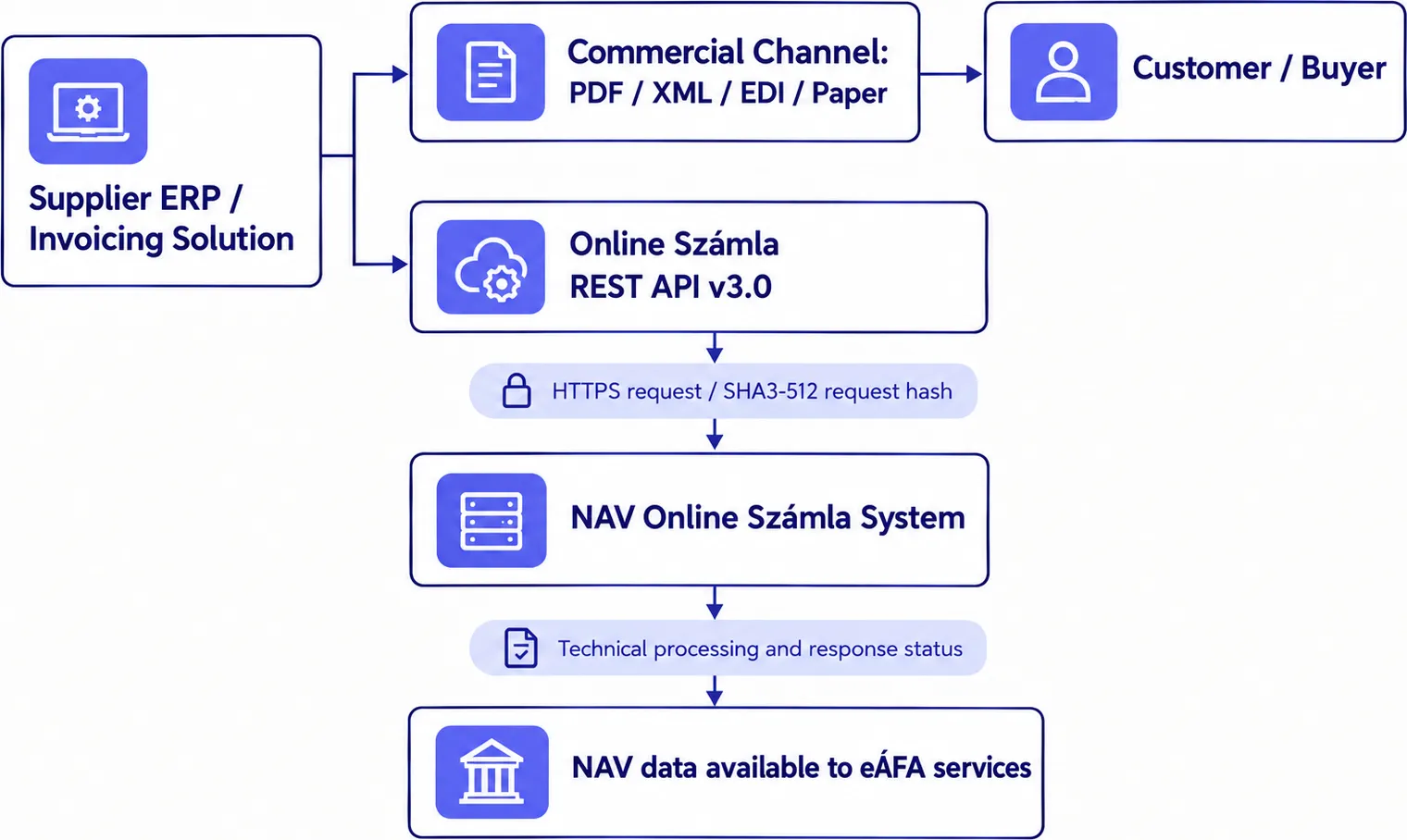
Commercial invoice exchange uses the parties' agreed delivery arrangements, subject to applicable legal requirements. Public procurement recipients must process qualifying EN 16931 invoices, but acceptance through a particular Peppol connection depends on the recipient's supported technical channels.
NAV's machine-to-machine interface uses HTTPS and registered technical-user credentials. The requestSignature value is calculated using SHA3-512, while other authentication and token-handling elements follow the applicable API specification. See NAV's official API samples. NAV processes submitted invoice data and returns the applicable technical response and transaction information. Suppliers must monitor processing outcomes, resolve rejected submissions and reconcile accepted data with their invoicing records. The platform does not issue a clearance token, and buyer delivery does not depend on prior NAV confirmation.
What penalties apply for invoicing and tax reporting non-compliance in Hungary?
Sanctions for non-compliance depend on the specific statutory breach, taxpayer legal form and offence history under Act CL of 2017 on the Rules of Taxation (Art.):
Offence | Taxpayer category | Statutory penalty or sanction | Legal basis |
|---|---|---|---|
Online Számla reporting failure, late submission or inaccurate data | Non-natural person (corporation) | General default fine of up to HUF 1,000,000 for a non-natural-person taxpayer where Section 220 applies. Specific reporting offences may be subject to separate statutory calculations, including Section 229 where applicable. | |
Online Számla reporting failure, late submission or inaccurate data | Natural person or sole trader | General default fine of up to HUF 400,000 for a natural-person taxpayer where Section 220 applies. A different penalty calculation may apply to offences governed by specific statutory provisions. | |
Failure to issue a mandatory invoice, simplified invoice or receipt | Taxpayer subject to duty | Default fine of up to HUF 2,000,000 for the invoice, receipt-issuance or record-retention breaches specified in Section 228(1). | |
Failure to respond to formal NAV electronic data reconciliation | Taxpayer receiving formal notice | HUF 300,000 default fine where the taxpayer fails to meet a formal electronic data-reconciliation obligation within the applicable 15-day period, subject to Sections 138/A and 229/B. | |
Repeated failure to issue required invoices, receipts or serious offences | Any taxable person | Business-premises closure for 12, 30 or 60 opening days where the offence, repetition and other conditions in Section 245 are satisfied. | |
Non-cash-register receipt reporting defaults | Taxpayer issuing covered receipts | Subject to general reporting penalties, mitigated by NAV's four-month non-penalisation transition through 31 December 2026. |
Voluntary correction, reasonable care and the circumstances of the breach may be relevant to NAV's assessment. Correction does not automatically eliminate liability or guarantee a reduced penalty. An Online Számla reporting failure does not automatically invalidate an invoice or suspend the buyer's payment obligation. Any contractual right to withhold payment must be assessed under the applicable agreement and civil law.
How can businesses prepare for Hungary's invoicing and reporting rules?
Businesses should first identify their applicable invoice-issuance, NAV reporting, VAT return and receipt obligations. The following five controls address the principal implementation risks:
Verify transaction scope and invoicing rules: Determine whether transactions involve non-household electricity, natural gas or water supplies where electronic-only invoicing is mandatory. For general commercial trade, establish clear recipient consent mechanisms before issuing electronic invoices.
Audit billing software and Online Számla connectivity: Ensure systems support the applicable NAV XML interface, maintain technical-user credentials, calculate SHA3-512 request signatures and monitor transmission outcomes. Document retry, correction and technical annulment procedures.
Establish compliant electronic archiving: Retain electronic invoices electronically for the applicable statutory period, generally at least eight years for accounting vouchers. Maintain authenticity, integrity, legibility, accessibility and the required supporting audit evidence.
Prepare for fiscalisation changes: Cash-register-obligated businesses should plan for authorised hardware-based EPG by 1 July 2028. Other receipt issuers should comply with the reporting requirement effective from 1 September 2026. Retail systems must also reflect applicable VAT-rate changes, including the 0% rate on qualifying medicines.
Prepare for ViDA: Assess relevant intra-EU transactions ahead of 1 July 2030. Directive (EU) 2025/516 introduces structured electronic invoices, revised issuance deadlines and transaction-level digital reporting. Relevant processes must accommodate the directive's ten-day invoicing rule and applicable reporting deadlines.
What are the key takeaways for compliance in Hungary?
Hungary requires invoice-data reporting to NAV for covered transactions but does not impose a general domestic B2B electronic invoicing mandate. Electronic-only invoicing applies to specified non-household utility supplies. Businesses subject to mandatory cash-register use must prepare for hardware-based electronic cash registers from 1 July 2028. From 1 July 2030, relevant intra-EU transactions will become subject to ViDA's structured electronic invoicing and transaction-level digital reporting rules. Businesses should assess the directive's transaction scope, issuance deadlines and reporting obligations separately from Hungary's existing domestic framework.
FAQ
No. General domestic B2B electronic invoicing is voluntary and format-neutral under Section 175 of the Áfa tv., requiring recipient consent. However, electronic-only invoicing is mandatory for non-household supplies of electricity, natural gas and water utility services. Separate Online Számla reporting applies to invoices within the statutory scope, regardless of commercial format. Software-generated invoices require automated reporting, while manual invoice forms and specified fiscal documents follow their applicable rules.