
This compliance guide was updated on 13 October 2026. Independent legal verification remains incomplete. It reflects the operational replacement of the legacy E.sąskaita portal with the SABIS public procurement platform, the mandatory electronic submission of invoices under oral public contracts effective 1 January 2025, the final phase of the i.EKA cash-register rollout on 1 May 2025 and the small-business scheme (SVS) exemption from i.SAF, and the statutory VAT rate restructuring enacted on 1 January 2026.
Is electronic invoicing mandatory in Lithuania?
Structured electronic invoicing is mandatory for covered public procurement (B2G) transactions in Lithuania, but it remains voluntary for commercial business-to-business (B2B) transactions. Under Article 79 of the Law on Value Added Tax, commercial invoices may be issued on paper or electronically. Electronic issuance generally requires the recipient's agreement. Lithuania does not operate a mandatory domestic B2B clearance system.
Instead of pre-clearing private invoices, Lithuania enforces digital compliance through comprehensive post-issuance tax reporting. Under the Law on Tax Administration, ordinary VAT-registered businesses must submit digital transaction data to the State Tax Inspectorate (Valstybinė mokesčių inspekcija or VMI) through the Smart Tax Administration System (Išmanioji mokesčių administravimo sistema or i.MAS). Its separate subsystems cover VAT invoice registers (i.SAF), reportable road-transport consignment notes (i.VAZ), and fiscal data from regulated cash registers (i.EKA). For the forthcoming EU cross-border requirements, consult the official ViDA directive.
How did Lithuania's digital tax system develop?
Lithuania launched i.MAS reporting in October 2016, introducing electronic VAT invoice registers through i.SAF and transport-data reporting through i.VAZ. This initiative allowed tax authorities to run automated cross-checks on purchase and sales data without interrupting commercial workflows.
Lithuania introduced public procurement e-invoicing requirements in July 2017 under the Law on Public Procurement. The framework also operates alongside the EU electronic-invoicing rules in Directive 2014/55/EU. Between July and September 2024, the government decommissioned its legacy public procurement portal, E.sąskaita, and migrated public sector billing to the modern SABIS system.
Point-of-sale reporting was introduced in phases between 1 January 2023 and 1 May 2025 under Government Resolution No. 1283 and VMI rules. Cash registers subject to the regime must meet the applicable i.EKA requirements. At the European level, Lithuania aligns with Council Directive (EU) 2025/516 on VAT in the Digital Age (ViDA), which allows Member States to introduce national B2B e-invoicing mandates and establishes mandatory intra-EU digital reporting from 1 July 2030.
What is the implementation timeline for electronic compliance in Lithuania?
Lithuania has progressively expanded its digital compliance framework across public procurement, transaction reporting, and point-of-sale fiscalisation.
Date | Legal status | Milestone | Affected entities |
|---|---|---|---|
1 July 2002 | In force | Law on Value Added Tax (No. IX-751) entered into force, subject to specific provisions taking effect on later dates. | Taxable persons within the law's scope. |
1 October 2016 | In force | Launch of i.MAS, introducing mandatory i.SAF invoice register and i.VAZ transport reporting. | Ordinary VAT-registered businesses and road freight consignors. |
1 July 2017 | In force | Mandatory B2G electronic invoice submission enacted under the Law on Public Procurement. | Public sector bodies and public procurement contractors. |
18 April 2019 | In force | EU deadline for central contracting authorities to receive standard-compliant e-invoices; sub-central authorities could receive an extension to 18 April 2020. | Contracting authorities within the directive's scope. |
1 January 2023 | In force | Initial i.EKA phase for qualifying computer-based cash-register users. | Businesses meeting the applicable device and historical turnover criteria. |
1 November 2023 | In force | Second i.EKA phase for qualifying electronic cash-register users. | VAT-registered operators meeting the relevant 2021 turnover and device criteria. |
1 May 2024 | In force | Further i.EKA rollout covering specified older cash-register models that could no longer be newly acquired from 2019. | Affected operators using the designated older models. |
1 July 2024 | In force | Deployment of the SABIS platform, initiating a two-month migration window from legacy E.sąskaita. | Contracting authorities, contracting entities, and public procurement contractors. |
1 September 2024 | In force | SABIS became the central system for public-sector invoice administration following migration from E.sąskaita. | Public buyers and suppliers, subject to applicable foreign-supplier submission arrangements. |
1 January 2025 | In force | Electronic submission via SABIS becomes mandatory for public procurement invoices under verbal contracts. | Public procurement contractors executing oral contracts (žodinės sutartys). |
1 May 2025 | In force | Final scheduled phase of the i.EKA rollout for cash registers subject to the new technical requirements. | Remaining cash-register users within the regulated scope. |
1 May 2025 | In force | Launch of the small-business scheme (SVS), exempting qualifying small enterprises from i.SAF registers. | Qualifying small businesses and eligible EU cross-border small enterprises. |
1 January 2026 | In force | Introduction of the 12% reduced VAT rate, replacing the 9% rate, and changes to the existing 5% rate's scope; catering remains generally subject to 21%. | Taxable persons supplying affected goods and services. |
1 July 2030 | Future enacted | EU ViDA implementation: mandatory intra-EU structured e-invoicing and digital transaction reporting. | Taxable persons conducting cross-border trade between EU Member States. |
Which laws govern e-invoicing and VAT reporting in Lithuania?
Lithuanian e-invoicing and digital reporting obligations are established through parliamentary legislation, government resolutions, and administrative orders issued by the tax authorities.
Law on Value Added Tax No. IX-751 (Lietuvos Respublikos pridėtinės vertės mokesčio įstatymas): Governs VAT rates (Article 19), registration thresholds (Article 71), invoice issuance and recipient consent (Articles 78 to 80), 10-year VAT invoice retention from the issue date (Article 78(7)), and VAT return deadlines (Articles 85 and 88). Amendments introduced under Law No. XV-287 of 17 June 2025 changed the reduced VAT rate framework from 1 January 2026.
Law on Public Procurement No. I-1491 (Lietuvos Respublikos viešųjų pirkimų įstatymas): Article 22(3) establishes mandatory electronic invoice issuance and reception for contracting authorities and suppliers, requiring compliance with European standard EN 16931. The public-sector invoice administration framework also relies on Article 6(4) of the Financial Accounting Act and the applicable SABIS rules published by NBFC.
Law on Tax Administration No. IX-2112 (Lietuvos Respublikos mokesčių administravimo įstatymas): Article 40 establishes general taxpayer duties. Article 40-1 concerns the minimum criteria for a reliable taxpayer; detailed i.MAS filing requirements arise under the applicable implementing rules. Article 96 governs late payment interest; Articles 139 and 140 address tax penalties and their determination, while statutory grounds for relief must be assessed under the relevant provisions, including Article 141.
VMI Order No. VA-55: Sets technical rules and statutory filing deadlines for submitting VAT invoice registers via i.SAF.
VMI Order No. VA-40: Establishes relevant cash-register technical requirements. The i.EKA fiscal-data submission rules, including reporting intervals, must be read alongside the separate reporting instrument, VMI Order No. VA-80.
VMI Order No. VA-36 of 1 April 2016: Governs pre-movement submission rules and statutory exclusions for road freight consignment notes in i.VAZ.
Council Directive (EU) 2025/516: The EU ViDA directive permits domestic e-invoicing mandates and introduces structured invoicing and transaction-level digital reporting for covered intra-EU transactions from 1 July 2030. Its 10-day period concerns invoice issuance, not a general 10-day reporting window.
Which authorities oversee tax and procurement compliance in Lithuania?
Central government ministries, the tax administration, public procurement supervisors, and national archival regulators manage digital compliance in Lithuania.
Authority | Role | Primary compliance area |
|---|---|---|
Ministry of Finance (Lietuvos Respublikos finansų ministerija) | Government ministry | Develops fiscal policy and proposes tax legislation; enacted laws are adopted through the legislative process. |
State Tax Inspectorate (Valstybinė mokesčių inspekcija or VMI) | Central tax authority | Administers national tax collection and operates i.MAS subsystems (i.SAF, i.VAZ, i.EKA, and i.SAF-T). |
National Centre for General Functions (Nacionalinis bendrųjų funkcijų centras or NBFC) | Public sector shared services agency | Manages, operates, and maintains the central public procurement invoicing platform, SABIS. |
Public Procurement Office (Viešųjų pirkimų tarnyba or VPT) | Procurement supervisory body | Supervises public procurement compliance and monitors adherence to statutory contract terms. |
Office of the Chief Archivist (Lietuvos vyriausiojo archyvaro tarnyba) | Archival regulatory authority | Establishes document retention periods and sets binding technical rules for electronic records storage. |
OpenPeppol AISBL | International standards body | Governs the multilateral Peppol network, transport protocols, and international participant identifiers. |
Which transactions are covered by Lithuania's e-invoicing rules?
The legal obligation to issue structured electronic invoices depends on whether the transaction involves a public sector contracting authority, a private commercial enterprise, or a retail consumer.
Transaction type | Issuance requirement | Reception requirement | Reporting requirement |
|---|---|---|---|
Domestic B2B | Voluntary in structured format; paper and PDF permitted. | Voluntary; requires prior buyer agreement under Article 79(11). | Mandatory monthly i.SAF register filing by the 20th day for ordinary filers. |
Domestic B2G | Structured e-invoicing for covered procurement, subject to exceptions. | Public buyers process compliant invoices through the applicable system. | SABIS processing; ordinary VAT reporting applies where required. |
Domestic B2C | Fiscal receipts where cash-register rules apply; no general structured B2C e-invoice mandate. | Consumer receipt rules apply. | i.EKA: real-time virtual fiscalisation or 24-hour security-module reporting, with disruption rules. |
Intra-EU cross-border | Lithuanian e-invoicing rules apply; ViDA changes take effect from 1 July 2030. | Subject to applicable EU and national rules. | FR0564 where required; FR0600 for ordinary VAT filers, PVM101 where applicable to SVS registrants. |
Third-country export/import | Applicable VAT invoicing and customs documentation rules. | Applicable importer and buyer documentation rules. | Customs declarations and import VAT accounting; i.SAF only for separately reportable VAT invoices. |
Foreign suppliers | Covered B2G invoices use permitted SABIS, Peppol or accepted alternative channels; B2B generally voluntary. | B2B by agreement. | i.SAF applies only when ordinary Lithuanian VAT registration creates that obligation. |
Statutory scope and exemptions
In commercial B2B trade, Article 79 of the Law on Value Added Tax grants equal legal validity to paper and electronic invoices. Businesses may agree to adopt structured formats, but a buyer cannot legally be forced to receive structured e-invoices without prior consent.
In public procurement (B2G), Article 22(3) of the Law on Public Procurement requires suppliers to issue, and public contracting authorities to receive, structured electronic invoices conforming to European standard EN 16931. Exceptions relating to classified or defence procurement must be assessed under the applicable legislation. Supplier-side routing also requires separate treatment for foreign operators under NBFC's published procedures. From 1 January 2025, invoices arising from covered oral public procurement contracts (žodinės sutartys) were brought into the applicable electronic administration workflow, subject to the relevant exceptions.
Retail businesses required to use cash registers must comply with the applicable certified security-module or virtual fiscalisation requirements under VMI's i.EKA framework. Activities exempt from cash-register use must be assessed separately. Issuing a full VAT invoice to a consumer is voluntary unless requested under statutory accounting conditions.
Under Article 71 of the Law on Value Added Tax, the domestic €45,000 VAT threshold is assessed using the applicable current- and preceding-calendar-year turnover rules. Non-established suppliers may need to register from their first taxable Lithuanian supply, subject to reverse-charge, special-scheme and other applicable exemptions. However, under the EU cross-border small-business scheme enacted on 1 May 2025, eligible EU businesses holding an EX identifier may benefit from registration relief provided their annual turnover does not exceed €45,000 in Lithuania and €100,000 across the EU.
What are the technical requirements for electronic invoicing in Lithuania?
Suppliers to the Lithuanian public sector must issue electronic invoices that comply with European semantic standard EN 16931. In commercial B2B transactions, businesses remain free to agree on bilateral formats.
Format or specification | Technical status | Applicable transaction scope | Technical version |
|---|---|---|---|
Peppol BIS Billing 3.0 | Mandatory via Peppol; primary standard in SABIS | Public procurement (B2G); cross-border public sector | 3.0 (UBL 2.1 syntax) |
EN 16931-compliant UBL 2.1 | Structured XML syntax for supported public procurement channels | Domestic public procurement (B2G) | UBL 2.1; applicable EN 16931 rules |
EN 16931 UN/CEFACT CII | European-standard syntax; SABIS acceptance requires confirmation | B2G, only where supported by the active channel | Applicable EN syntax release |
i.SAF XML schema | Structured file format for supported submissions | VAT invoice register reporting; manual entry also supported | Current VMI-published XSD |
PDF / Unstructured electronic | Permitted for commercial trade | Commercial B2B transactions (subject to agreement) | Not applicable |
Mandatory invoice content
Under Article 80 of the Law on Value Added Tax, an invoice must contain:
Date of issue.
A unique sequential invoice number.
Supplier's full name, registered address, and VAT identification number.
Customer's full name, registered address, and VAT identification number (if registered).
Date of supply of goods or completion of services, or date of advance payment (if different from invoice date).
Description, quantity, and unit price of supplied goods or services.
Taxable amount exclusive of VAT, alongside any discounts or rebates.
Applicable VAT rate(s).
Total VAT amount expressed in euros.
Mandatory statutory annotations where applicable:
Atvirkštinis apmokestinimas (Reverse charge) where the customer accounts for VAT.
'Self-billing' where the customer issues the invoice on the supplier's behalf.
Specific legal references to Directive 2006/112/EC or national exemptions for 0% intra-Community supplies or exempt activities.
Maržos apmokestinimo schema for margin scheme transactions.
Simplified VAT invoices are generally permitted for supplies not exceeding €100, subject to VAT Act Articles 79 and 80 and applicable exceptions. The separate €150 fuel-receipt rule concerns qualifying cash-register documentation and expense recognition. Required buyer identifiers and VAT fields depend on the invoice type and supplier's VAT scheme.
Issuance deadlines
For domestic supplies, invoices must be issued immediately upon delivery or completion of the service. For continuous or recurring monthly supplies, invoices must be issued no later than the 10th day of the month following the supply. For intra-EU supplies of goods and cross-border services subject to customer reverse charge, Article 79 sets the issuance deadline as no later than the 15th day of the month following the chargeable event. Under EU ViDA rules, this cross-border deadline will shorten to 10 days after the chargeable event from 1 July 2030. An advance-payment VAT invoice is required where receipt of the advance creates a VAT chargeable event, or where the supplier elects the applicable VAT treatment under Lithuanian law.
Electronic signatures and archiving
Qualified Electronic Signatures (QES) under the EU eIDAS Regulation are legally recognised in Lithuania but are not mandatory for commercial B2B invoices. Lithuanian VAT invoicing rules and the EU VAT Directive permit invoice authenticity, integrity and legibility to be supported by suitable business controls, reliable audit trails and recognised electronic transmission methods. Peppol Access Points and authenticated SABIS channels support secure transmission, but businesses must still maintain sufficient evidence of invoice authenticity, content integrity and legibility.
Under VAT Act Article 78(7), VAT invoices must be retained for 10 years from their issue date. Retention periods for other accounting records must be determined under the applicable accounting and archiving rules. Electronic VAT invoices may be stored outside Lithuania where the applicable rules are met and VMI has full electronic access to the records. Where invoice formats are converted for archiving, the business must preserve the information and evidence required by the applicable VAT and records-management rules. Disposal of the original structured file must not be assumed lawful without confirming those rules.
What electronic VAT reporting is required in Lithuania?
Lithuanian tax reporting is built on the Smart Tax Administration System (i.MAS), which captures transaction data through distinct subsystems alongside periodic VAT returns.
Reporting mechanism | Covered taxpayers | Data reported | Filing frequency | Submission deadline | Channel |
|---|---|---|---|---|---|
VAT Return (Form FR0600) | Persons subject to ordinary VAT reporting | Summary taxable supplies, input VAT, payable tax | Monthly | 25th day of following month | Electronic Declaration System (EDS) |
VAT Return (Form FR0600 - Quarterly) | Eligible businesses (turnover under €300,000 meeting statutory criteria) | Summary taxable supplies, input VAT, payable tax | Quarterly | 25th day of month following quarter | Electronic Declaration System (EDS) |
Small-business VAT return (PVM101) | SVS registrants with reportable transactions | Specified cross-border transactions and VAT liabilities | Monthly when triggered | 25th day of following month | Electronic Declaration System (EDS) |
Invoice register (i.SAF) | Ordinary VAT-registered legal entities required to report | Required issued and received VAT-invoice register fields | Monthly | 20th day of following month | i.MAS web service / portal |
Invoice register (i.SAF, half-yearly) | Qualifying natural persons with a half-year VAT period | Required issued and received VAT-invoice register data | Half-yearly | 20th day of the following half-year (20 July or 20 January) | i.MAS web service/portal |
Transport consignment (i.VAZ) | Persons responsible under VA-36 for reportable consignments | Required domestic road consignment data | Pre-dispatch | Before transport begins | i.MAS portal/web service; backup channels for outages |
EC Sales List (Form FR0564) | Taxable persons making intra-EU supplies | Recapitulative statement of intra-Community supplies | Monthly | 25th day of following month | Electronic Declaration System (EDS) |
Smart fiscalisation (i.EKA) | Users of regulated cash registers | Required fiscal and closure data | Device-dependent | Real-time for virtual devices; 24-hour security-module cycle; outage rules | i.EKA electronic interface |
Standard Audit File for Tax (SAF-T) | Taxpayers within the applicable SAF-T rules | Required accounting and transaction data | On request where required | Deadline set under applicable rules or request | Official VMI SAF-T submission channel |
Filing rules and statutory exemptions
The reporting deadline for i.SAF operates independently of the VAT return filing period. Legal entities filing Form FR0600 every quarter must still submit their i.SAF invoice registers monthly by the 20th day of the following month under VMI Order No. VA-55. Qualifying natural persons subject to a statutory half-year tax period submit i.SAF registers semi-annually. Taxable persons applying Lithuania's small-business scheme (SVS) are exempt from submitting i.SAF registers. For ordinary filers, nil returns are mandatory if no invoices were issued or received during the period.
Filing and payment deadlines must be calculated under the applicable Lithuanian VAT and tax-procedure rules, including any legally permitted adjustment when a deadline falls on a non-working day.
Consignment notes for domestic road transport must be registered electronically in i.VAZ prior to dispatch under VMI Order No. VA-36, subject to the specific transport conditions and statutory exclusions defined in paragraphs 4 and 11.
Cash registers using security modules must transmit the required fiscal data to i.EKA at least once every 24 hours under the applicable VMI data-submission rules, including Order VA-80. VMI permits a limited 72-hour interruption for qualifying technical failures; operators must restore normal data submission in accordance with the applicable outage procedures. Certified virtual cash registers require continuous online connectivity to execute fiscal operations.
Active VAT rates
Under Article 19 of the Law on Value Added Tax, restructured from 1 January 2026:
Standard rate (21%): Applies to all standard supplies of goods and services. Catering and restaurant services are taxed at the standard 21% rate.
Reduced rate (12%): Applies to specified regulated accommodation, qualifying regular-route passenger transport, and designated cultural event admissions.
Reduced rate (5%): Applies to qualifying medicines, medical aids, disability-support equipment, periodicals, books and specified publications, subject to statutory conditions.
How are electronic invoices exchanged in Lithuania?
Public procurement invoices and commercial tax reporting flow through separate government architectures in Lithuania.
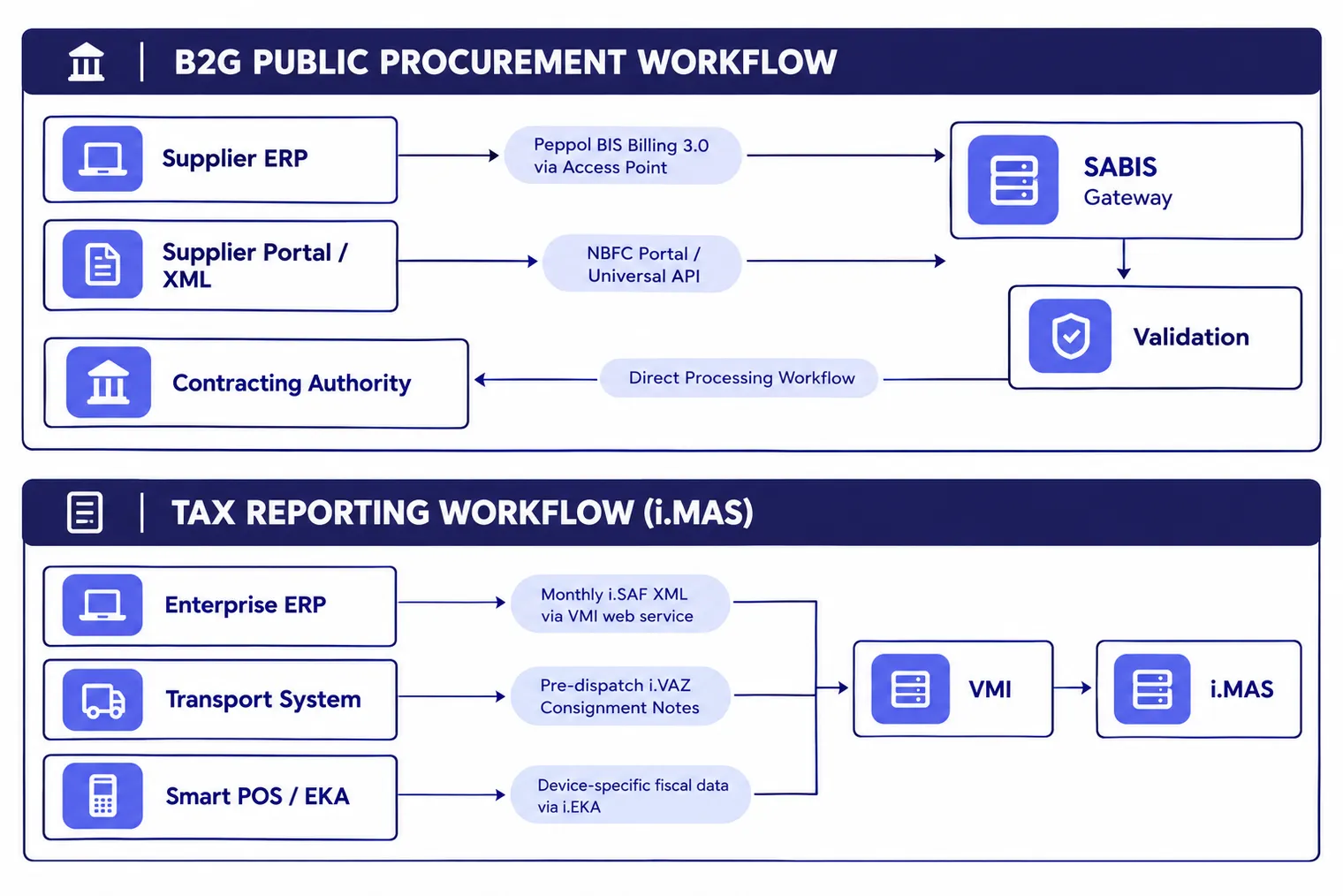
SABIS public procurement platform
The SABIS platform, administered by NBFC, is Lithuania's central public-sector invoice administration and processing system. SABIS provides portal, Peppol and universal system-integration channels, subject to the applicable supplier and buyer arrangements:
Peppol eDelivery Network: Automated system-to-system delivery through certified Peppol Access Points using the Peppol BIS Billing 3.0 standard.
SABIS Web Portal: Manual invoice entry or XML file upload via the authenticated web interface.
Universal Integration Interface: Direct integration is available through NBFC's published SABIS universal interface, which provides current specifications, schemas, testing guidance and integration requirements.
Foreign suppliers who cannot access the SABIS portal may use Peppol, provided the relevant buyer, supplier and contract references satisfy the platform's routing requirements. Under NBFC operational rules, where standard digital channels are technically unsuitable, foreign contractors may agree alternative submission methods with the contracting entity, such as email delivery.
Addressing and Peppol identifiers
Lithuania identifies legal entities using their 9-digit company code (JAR kodas), issued by the State Enterprise Centre of Registers (Registrų centras). In the international Peppol directory, Lithuanian organisations are routed using official ISO 6523 International Code Designators published by OpenPeppol:
Scheme 0200: Lithuanian Legal Entity Code (JAR code). Example: 0200:123456789.
Scheme 9937: Lithuanian VAT Identification Number. Example: 9937:LT123456789.
What are the penalties for e-invoicing and VAT non-compliance in Lithuania?
Non-compliance with Lithuanian invoicing, fiscalisation, or tax reporting rules triggers administrative fines for responsible company officers and corporate tax sanctions for the business.
Infraction | Liable party | Statutory penalty | Legal basis |
|---|---|---|---|
Failure to submit or late submission of tax declarations, reports, or accounting registers (i.SAF, i.VAZ) | Company manager, chief accountant, or liable person | Warning or administrative fine of €200 to €390 | |
Violations of cash register operating rules and receipt issuance | Retail merchant, cashier, or company manager | Administrative fines determined by circumstance | |
Accounting record violations and failure to maintain accounting registers | Company manager or chief accountant | Administrative fine for financial accounting non-compliance | |
Non-compliance with transfer-pricing documentation rules | Company manager | Administrative fine for transfer-pricing defaults | |
Understatement of tax identified during an official tax audit | Taxable legal entity | Corporate penalty of 20% to 100% of unpaid tax | |
Late payment of declared VAT liabilities | Taxable person | Statutory daily late payment interest (delspinigiai) | |
Non-compliant B2G invoice submission | Relevant supplier or submitting party | Correction or validation action may be required; payment effects depend on law and contract |
Penalty enforcement and operational risks
Administrative penalties under the Code of Administrative Offences (ANK) apply directly to individual managers and accountants. Article 187(2) specifically penalises the failure to provide tax declarations, reports, or accounting registers, including i.SAF and i.VAZ files, with fines ranging from €200 to €390. Cash register infractions fall under Articles 160 to 163, while transfer pricing and general accounting violations are governed separately by Articles 188 and 205.
Under Article 96 of the Law on Tax Administration, simple late payment of VAT incurs daily late payment interest set quarterly by the Minister of Finance. A separate corporate penalty of 20% to 100% of unpaid tax applies under Article 139 only when tax authorities uncover an understatement of tax during an audit. Penalty reductions or relief depend on the applicable statutory conditions, including the relevant penalty-assessment and exemption provisions. Voluntary correction does not automatically establish a right to relief.
An invoice failing the validation rules for its applicable SABIS submission channel may be rejected or require correction before the relevant workflow can proceed. A non-compliant invoice may delay administrative processing, but whether payment can be withheld or postponed depends on the governing legal and contractual requirements.
How can businesses prepare for Lithuania's e-invoicing requirements?
Businesses operating in Lithuania must align their accounting workflows with the public procurement mandate and recurring tax reporting schedules.
Review public procurement billing channels: Suppliers to covered public buyers should generate EN 16931-compliant invoices in a format accepted by the chosen SABIS channel. Assess Peppol, the portal or NBFC's universal interface, subject to foreign-supplier arrangements.
Incorporate oral public contracts: Include covered verbal procurement contracts (žodinės sutartys) in public-sector billing controls, using the permitted SABIS workflow or the relevant supplier-specific arrangements.
Prepare i.SAF register reporting: Ordinary VAT-registered businesses must submit the required invoice-register data by the 20th day of the following month. They may use manual entry, file uploads or VMI-supported web services.
Assess small-business scheme eligibility: Small enterprises registered under the SVS scheme should verify that their reporting systems reflect their exemption from i.SAF filings.
Maintain compliant fiscal devices: Operators subject to cash-register requirements must use certified devices. Security-module registers generally submit data within 24 hours; virtual fiscalisation has separate real-time connectivity requirements.
Apply updated VAT rates: Verify that enterprise master data correctly assigns the standard 21% rate to catering services and applies the 12% and 5% rates only to qualifying supplies under Article 19.
Prepare for cross-border ViDA reforms: Businesses engaged in intra-EU trade should monitor systems for the 1 July 2030 ViDA milestone, which requires structured electronic invoicing within 10 days of the chargeable event alongside digital transaction reporting.
Summary of compliance obligations in Lithuania
Lithuania combines mandatory public sector electronic invoicing with comprehensive post-issuance tax reporting. Domestic commercial B2B e-invoicing remains voluntary and generally requires recipient consent. Covered public procurement invoices follow EN 16931 and SABIS requirements, with permitted channels and relevant exceptions. Ordinary VAT registrants generally submit i.SAF registers by the 20th day of the following month. Separately, eligible goods movements require i.VAZ reporting, while regulated cash registers must follow their applicable i.EKA transmission rules. Preparation requires maintaining certified POS connectivity, validating ERP data against updated VAT rates, and planning for upcoming EU ViDA cross-border mandates taking effect on 1 July 2030.
FAQ
No, structured B2B e-invoicing is not mandatory for private commercial transactions. Invoices may be issued on paper or electronically. Electronic issuance generally requires the recipient's agreement under Article 79 of the Law on Value Added Tax. However, ordinary VAT-registered businesses must report transaction data monthly via i.SAF.