
This article was updated on 19 October 2026: Under Law 73-A/2025, the B2G structured electronic invoicing transition for micro, small and medium enterprises, as well as public entity suppliers, remains in effect through 31 December 2026. The temporary rule deeming PDF invoices to be electronic invoices for tax purposes also applies through 31 December 2026 under Law 73-A/2025 and AT Circular Letter 25101/2026. Madeira's 4% reduced VAT rate applies from 1 October 2024 under Regional Legislative Decree 6/2024/M, Article 21, as confirmed by AT Circular Letter 25045/2024. The monthly invoice communication deadline under Decree-Law 198/2012 remains the fifth day of the following month. The draft 2027 State Budget, Articles 77(2), 77(3) and 138(2), proposes extensions to accounting SAF-T, PDF acceptance and B2G transitions, though these were not enacted at the 19 October 2026 cut-off.
Is electronic invoicing mandatory in Portugal?
Structured electronic invoicing is not mandatory for general domestic business-to-business (B2B) or business-to-consumer (B2C) transactions in Portugal. Covered public-contract suppliers generally face mandatory e-invoicing under the Public Contracts Code, subject to statutory exclusions and the transition for micro, small, medium and public-entity suppliers through 31 December 2026. Separately, persons within Article 3(1) of Decree-Law 198/2012 must communicate covered fiscal-document data to the Portuguese tax authority (Autoridade Tributária e Aduaneira, AT) by the fifth day of the month following issuance.
Portugal primarily uses invoice-data reporting and fiscal software controls rather than a general domestic electronic-invoice clearance system. Delivering an invoice to a customer and communicating invoice data to the tax authority are two distinct legal obligations. Transmitting data to the national e-Fatura portal does not deliver the invoice to the commercial buyer.
Outside public procurement, paper and electronic invoices remain available, subject to recipient acceptance for electronic issuance. AT-certified software is mandatory where Article 4 of Decree-Law 28/2019 applies. ATCUD and QR-code obligations must be assessed separately according to document type, medium and statutory exceptions.
How did Portuguese e-invoicing and tax reporting develop?
Portugal established its electronic invoice-data reporting framework through Decree-Law 198/2012, enacted on 24 August 2012, which entered into force on 1 January 2013. The framework introduced periodic electronic communication of invoice data to AT, with SAF-T (PT)-based files and electronic transmission among the statutory reporting methods. The deadlines and channels subsequently changed. This created the e-Fatura database, allowing the tax authority to cross-reference transactions and offering consumers tax deductions for requesting invoices.
Public sector requirements followed European developments. Following Directive 2014/55/EU, Decree-Law 111-B/2017, as amended by Decree-Law 123/2018, established electronic-invoice reception and processing requirements for covered public contracting entities. The first covered public-authority group had to receive compliant invoices from 18 April 2019. The additional contracting-entity categories specified in Article 9(2) of Decree-Law 111-B/2017 followed on 18 April 2020.
For suppliers, mandatory structured business-to-government (B2G) issuance began for large enterprises on 1 January 2021. The obligation for micro, small and medium enterprises, as well as public entities acting as suppliers, was repeatedly postponed by successive State Budget laws, most recently until 31 December 2026 under Law 73-A/2025, Article 260(2).
In 2019, Decree-Law 28/2019 updated fiscalisation rules by introducing the ATCUD code and two-dimensional QR codes. Although originally scheduled for earlier implementation, Law 75-B/2020, Article 404(1)(b) suspended mandatory QR codes during 2021, making them mandatory from 1 January 2022. AT identifies 1 January 2023 as the mandatory ATCUD implementation date. The final deferral legislation must be recorded alongside Portaria 195/2020 before the legal commencement chain is certified.
At European level, the adoption of the VAT in the Digital Age (ViDA) package under Directive (EU) 2025/516 introduces harmonised digital reporting for cross-border intra-EU supplies from 1 July 2030. Portugal has not yet enacted universal domestic B2B structured e-invoicing to mirror this European system.
What is the compliance timeline for Portuguese e-invoicing?
The Portuguese invoicing and digital reporting timetable comprises enacted milestones alongside parliamentary proposals:
Date | Legal status or category | Milestone |
|---|---|---|
24 August 2012 | Enactment | Decree-Law 198/2012 enacted, establishing Portugal's invoice-data reporting framework. |
1 January 2013 | Legislation in force | Monthly invoice data communication to AT took effect under Decree-Law 198/2012. |
18 April 2019 | Operational mandate | The first contracting-authority categories covered by the statutory reception requirement had to receive compliant e-invoices under Decree-Law 123/2018. |
18 April 2020 | Operational mandate | Additional public contracting entities specified by Article 9(2) of Decree-Law 111-B/2017 required to receive and process compliant e-invoices under Decree-Law 123/2018. |
1 January 2021 | Operational mandate | Large enterprises entered the structured B2G e-invoicing obligation under Decree-Law 111-B/2017. |
1 January 2022 | Operational mandate | QR codes became mandatory for covered documents from 1 January 2022 under Decree-Law 28/2019 and Portaria 195/2020, following the 2021 suspension in Law 75-B/2020, Article 404(1)(b). |
1 January 2023 | Operational mandate | ATCUD became operationally mandatory from 1 January 2023 according to AT guidance. Portaria 195/2020 defines the framework; the final legislative deferral governing the start date remains to be documented. |
1 January 2023 | Legislation in force | Monthly invoice communication deadline moved to fifth day of following month under Decree-Law 198/2012. |
1 October 2024 | Legislation in force | Madeira reduced VAT rate lowered to 4% under Regional Legislative Decree 6/2024/M, Article 21. |
1 January 2026 | Legislation in force | State Budget Law 2026 took effect under Law 73-A/2025. |
31 December 2026 | Transitional deadline | Temporary rule deeming PDF invoices as electronic invoices expires under Law 73-A/2025. |
31 December 2026 | Transitional deadline | Transition permitting alternative B2G formats for SMEs expires under Law 73-A/2025. |
1 January 2027 | Future enacted obligation | Absent a later amendment, the statutory transition for covered micro, small, medium and public-entity contractors ends, making Article 299-B structured B2G invoicing applicable from 1 January 2027. The official 2027 Budget proposes a further extension. |
Periods from 2027 | Future enacted obligation | Accounting SAF-T applies to periods from 2027, first submitted in 2028 under Law 73-A/2025, Article 95(2), unless amended. |
31 December 2027 | Proposed legislation | Proposed extension of PDF deeming rule under Draft 2027 Budget Proposal. |
31 December 2027 | Proposed legislation | Proposed extension of SME B2G transition under Draft 2027 Budget Proposal. |
Periods from 2028 | Proposed legislation | Proposed postponement of accounting SAF-T submission under Draft 2027 Budget Proposal. |
1 July 2030 | Future enacted EU obligation | Digital reporting requirements for cross-border intra-EU transactions take effect under Directive (EU) 2025/516. |
Which laws govern e-invoicing and VAT reporting in Portugal?
Portuguese invoicing, digital reporting and fiscalisation rest on national codes, statutory decree-laws, ministerial orders and European directives:
Portuguese VAT Code (Código do IVA, CIVA): Governs fundamental invoice issuance, content, timing and VAT calculation. Principal provisions include Article 6 (place of supply), Article 18 (rates), Article 27 (payment deadlines), Article 29 (general invoice duty), Article 35-A (territorial invoicing scope), Article 36 (issuance deadlines and rules), Article 40 (simplified invoices), Article 41 (periodic returns) and Article 53 (small-enterprise exemption).
Decree-Law 28/2019: Consolidates rules regarding billing processing, certified software mandates (Article 4), electronic invoice authenticity, paper digitisation (Article 23) and ten-year archiving controls (Articles 19 to 24 and 28).
Decree-Law 198/2012: Article 3 governs communication of covered invoice, checking-document and receipt data; Article 3-A governs inventory communication. Goods-transport document controls are governed separately by the regime approved under Decree-Law 147/2003.
Public Contracts Code (Código dos Contratos Públicos, CCP): Regulates public procurement. Article 299-B mandates electronic invoice issuance for public contracts, whilst Article 128(3) sets out exclusions for simplified direct awards.
Decree-Law 123/2018: Amends Decree-Law 111-B/2017 to implement Directive 2014/55/EU, establishing mandatory electronic invoice reception for public contracting entities.
Portaria 289/2019: Establishes the EN 16931 implementation framework and eSPap's technical responsibilities. CIUS-PT schemas and accepted syntaxes require the applicable eSPap specification.
Portaria 195/2020: Regulates document series registration, series validation codes and the technical layout of the ATCUD and two-dimensional QR code.
Law 73-A/2025 (2026 State Budget): Extends the PDF deeming rule (Article 95(3)), the B2G SME invoice transition (Article 260(2)), inventory valuation rules (Article 95(1)) and accounting SAF-T timelines (Article 95(2)).
General Regime of Tax Infringements (Regime Geral das Infrações Tributárias, RGIT): Defines administrative tax offences, procedural rules and mitigation mechanisms under Articles 29, 30, 32, 117, 119, 123 and 128.
Directive (EU) 2025/516 (ViDA): Modernises the European VAT framework, establishing digital reporting requirements for cross-border intra-Community transactions from 1 July 2030.
Which authorities oversee e-invoicing and VAT reporting in Portugal?
Compliance responsibilities are distributed across tax administration, public procurement and shared administration bodies:
Institution | Role | Primary responsibility |
|---|---|---|
Autoridade Tributária e Aduaneira (AT) | Tax and customs authority | Oversees VAT administration, audits, software certification, document series validation (ATCUD) and the e-Fatura reporting system under the Ministry of Finance. |
Entidade de Serviços Partilhados da Administração Pública (eSPap) | Public sector shared services entity | Operates the national public procurement electronic invoicing portal (FE-AP) and coordinates technical specifications (CIUS-PT) for public administration. |
Instituto dos Mercados Públicos, do Imobiliário e da Construção (IMPIC) | Public procurement regulator | Oversees the Portuguese public procurement framework and the application of the Public Contracts Code. |
Which transactions are covered by Portuguese invoicing rules?
Portuguese law distinguishes between the obligation to issue an invoice to a customer, the obligation to use structured electronic formats and the obligation to communicate invoice data to the tax authority:
Transaction type | Issuance requirement | Reception requirement | Reporting requirement |
|---|---|---|---|
Domestic B2B | Invoice generally required under Article 29 CIVA, subject to exceptions; no general structured-format mandate identified. | Subject to recipient acceptance where applicable. | Covered documents must be communicated monthly where Article 3(1) of DL 198/2012 applies. |
Domestic B2G | Structured e-invoice under Article 299-B CCP, subject to exclusions; micro/SME/public contractors have a transition through 31 December 2026. | Mandatory for covered contracting entities under DL 123/2018. | Portuguese invoice-data reporting applies where the issuer and document fall within Article 3 of DL 198/2012. |
Domestic B2C | Invoice generally required under Articles 29 and 40 CIVA, with simplified invoices, statutory dispensations and alternative documents. | No general structured-invoice endpoint; customer delivery or electronic-delivery dispensation follows Decree-Law 28/2019, Article 8. | Covered consumer-document data must be reported monthly by in-scope issuers under Article 3 of DL 198/2012. |
Intra-EU supplies | Portuguese invoice required where Articles 35-A and 36 CIVA apply; no general structured-format mandate identified. | Governed by customer's national legislation. | Portuguese VAT return and applicable recapitulative statement; AT invoice-data reporting where Article 3 applies. ViDA intra-EU digital reporting begins for covered transactions from 1 July 2030. |
Third-country supplies | Portuguese invoicing rules apply where required by Articles 35-A and 36 CIVA; structured format is not generally mandated. | Governed by destination jurisdiction. | Applicable VAT return and customs export evidence, plus Article 3 invoice-data communication where Portuguese invoicing and reporting rules apply. |
What are the B2B invoicing rules in Portugal?
Under Article 29(1)(b) CIVA, taxable persons must generally issue invoices for supplies of goods, services and advance payments, subject to the statutory exceptions. Under Article 36(1)(a) CIVA, invoices are generally due by the fifth working day after VAT becomes chargeable; Article 36(1)(b)–(c) provides different deadlines for specified intra-EU services and advance payments.
Ordinary domestic B2B transactions are not generally required to use structured XML. Paper and electronic invoices are available, subject to recipient acceptance where applicable. Authenticity, integrity, certified-software, ATCUD and QR-code controls apply according to their individual legal scopes under Decree-Law 28/2019.
What are the B2G invoicing requirements and exemptions?
Contractors performing covered public contracts must issue compliant electronic invoices under Article 299-B CCP, subject to supplier transitions and statutory exclusions. EN 16931 and the current eSPap national specification govern the applicable structured implementation.
While large enterprises have been subject to this obligation since 1 January 2021, Law 73-A/2025, Article 260(2) extends the transition for micro, small and medium enterprises, as well as public entity suppliers, through 31 December 2026. Under current enacted law, structured B2G electronic invoicing becomes mandatory for these remaining suppliers from 1 January 2027, unless the proposed extension in the 2027 State Budget is enacted.
Statutory exclusions from public sector electronic invoicing apply to:
Contracts declared secret or accompanied by special security measures under Article 299-B(2) CCP.
Simplified direct-award contracts (ajuste direto simplificado) under Article 128(3) CCP.
When must businesses issue B2C invoices in Portugal?
Under Article 29(1)(b) CIVA, an invoice is generally required even without a consumer request, subject to statutory dispensations and the alternative-document arrangements in Article 40(5)–(7). Under Article 40(1) CIVA, simplified invoices are permitted for the following qualifying transaction categories:
€1,000 for goods supplied by retailers or itinerant sellers to non-taxable customers.
€100 for other eligible supplies, with a separate simplified-invoice category for Article 53-exempt suppliers under Article 40(1)(c).
Consumers are not obliged to receive structured electronic files. They can review and validate invoices registered under their tax number (Número de Identificação Fiscal, NIF) directly via the AT e-Fatura consumer portal.
Who qualifies for Portugal's small-enterprise VAT exemption?
Businesses qualifying for the small-enterprise exemption under Article 53(1) CIVA generally remain subject to invoicing duties. They issue invoices without charging VAT and include the wording IVA - regime de isenção.
The domestic Article 53(1) exemption applies to taxable persons established in Portugal whose turnover in the preceding calendar year does not exceed €15,000, excluding export activities. Where the immediate-exit rule applies, turnover above €18,750 in the calendar year ends exemption treatment from the relevant transaction, with the notification obligations in CIVA Article 58(2), (4) and (5).
Under Decree-Law 35/2025 and Article 53(2) CIVA, eligible taxable persons established in another EU Member State may access the exemption if their Union-wide turnover does not exceed €100,000, having registered with an EX suffix in their Member State of establishment.
Do foreign suppliers have Portuguese invoicing and reporting obligations?
The territorial application of Portuguese invoicing rules is governed by Article 35-A CIVA. Foreign suppliers are not automatically subject to Portuguese invoice-format and e-Fatura reporting rules solely because they supply goods or services to Portuguese customers. The place of supply, permanent establishment intervention and reverse-charge rules must be evaluated:
For general-rule intra-EU B2B services, Article 6(6)(a) CIVA normally places the supply where the business customer is established. The invoice must contain the applicable reverse-charge wording where the recipient is liable for VAT.
Non-resident suppliers liable for Portuguese VAT generally require an appropriate compliance arrangement and may need VAT registration. The place-of-supply rule, establishment status, reverse charge, OSS/IOSS and cross-border SME eligibility must be assessed for each transaction before determining registration and reporting duties.
Foreign contractors performing an in-scope Portuguese public procurement contract are subject to the structured B2G e-invoicing rules under the Public Contracts Code.
What are the technical requirements for electronic invoices in Portugal?
An electronic invoice in Portugal is defined as an invoice issued and received in any electronic format under Decree-Law 28/2019. Its authenticity of origin, integrity of content and legibility must be guaranteed from issuance until the end of the retention period.
Are PDF invoices legally accepted in Portugal?
Under Article 95(3) of Law 73-A/2025 and AT Circular Letter 25101/2026, PDF invoices are legally deemed to be electronic invoices for all tax purposes through 31 December 2026.
The temporary PDF deeming provision must be distinguished from the permanent rules for authenticity and integrity. Article 12(2) of Decree-Law 28/2019 expressly recognises qualified electronic signatures, qualified electronic seals and qualifying EDI agreements. Expiry of the PDF deeming rule does not itself prove that a QES is the sole valid method.
Which electronic invoice formats does Portuguese B2G require?
For public contracts, electronic invoices must comply with European standard EN 16931 and the Portuguese national specification CIUS-PT under Portaria 289/2019.
The official eSPap FE-AP guide, version 1.4, dated 3 November 2020 documents UBL 2.1. This historical specification does not establish the current production schemas, validation artefacts or technical onboarding requirements. The specification defines schemas for invoices and credit notes, with debit notes processed through the invoice schema. Mandatory business content under Article 299-B CCP includes:
Unique invoice and process identifiers.
Contracting authority and supplier identification, including tax numbers.
Contract reference and public commitment number (compromisso).
Delivery particulars and line-item breakdowns.
Applicable VAT rates, exemptions and totals.
Payment terms and banking instructions.
When are QR codes and ATCUD required on Portuguese invoices?
Under Decree-Law 28/2019 and Portaria 195/2020, invoices issued by certified billing software must include two specific fiscal controls:
Unique document code (ATCUD): Combines the validated series code and sequential document number in the format ATCUD:ValidationCode-SequentialNumber. The relevant document series must be validated by AT before use.
Two-dimensional QR code: Required on visual representations of documents within the applicable certified-software and fiscal-document scope. The code contains specified fiscal data for AT and consumer verification, subject to the applicable technical requirements.
For covered structured documents, QR-code display requirements differ between the machine-readable payload and any visual representation. ATCUD must be carried in accordance with the applicable document and technical rules.
How long must Portuguese invoices be archived?
Under Decree-Law 28/2019, Article 19, books, records and supporting documents must be retained in good order for ten years, subject to special provisions or longer tax assessment periods.
Key statutory archiving requirements under Decree-Law 28/2019, Articles 20 to 28 include:
Native electronic invoices and documents must be retained exclusively in electronic form, in chronological order, without alteration, allowing unrestricted access and exact data export by the AT.
Electronic records and backups may be hosted in Portugal or within another EU Member State. Storage outside the EU requires prior authorisation from the AT under Article 21.
Paper documents may be digitised under Article 23 of Decree-Law 28/2019 using compliant image and integrity controls. Paper originals may be destroyed after the Article 23 controls and any acquisition-invoice conditions are met. Destruction by third-party archive providers must also satisfy the taxpayer-confirmation rules in Article 24(3).
What electronic VAT reporting is required in Portugal?
Portugal's electronic reporting rules include invoice data, VAT returns, inventories and future accounting SAF-T. Intra-EU recapitulative statements follow RITI Article 30, generally by day 20 monthly or quarterly, with a €50,000 intra-EU goods threshold affecting frequency. Goods-transport reporting is a separate regime not fully verified here:
Reporting mechanism | Covered taxpayers | Frequency | Submission deadline | Transmission channel |
|---|---|---|---|---|
Monthly invoice data communication | Persons covered by Decree-Law 198/2012, Article 3(1), assessed with Article 35-A CIVA and the Portuguese VAT scope rules. | Monthly | 5th day of the following month under DL 198/2012. | Web service, SAF-T (PT) export or direct portal entry (restricted). |
Nil-issuance communication | In-scope taxpayers issuing no covered documents during the month, except qualifying exclusive users of AT's electronic green-receipt functionality. | Monthly | 5th day of the following month under DL 198/2012. | Direct notification via Portal das Finanças. |
Periodic VAT return (Monthly) | Taxpayers with prior-year turnover of €650,000 or more, or by election under Article 41 CIVA. | Monthly | 20th day of the second month; June return due 20 September. | Electronic submission via Portal das Finanças. |
Periodic VAT return (Quarterly) | Generally, taxpayers below €650,000 prior-year turnover, except those filing monthly by election or statutory requirement under Article 41(2)–(8) CIVA. | Quarterly | 20th day of the second month; Q2 return due 20 September. | Electronic submission via Portal das Finanças. |
Union and Non-Union OSS | Taxpayers registered for the EU One Stop Shop scheme. | Quarterly | End of the month following the calendar quarter. | Electronic submission via Portal das Finanças. |
Import One Stop Shop (IOSS) | Taxpayers registered for distance sales of imported goods up to €150. | Monthly | End of the month following the calendar month. | Electronic submission via Portal das Finanças. |
Annual inventory communication | Taxpayers in scope of Article 3-A of Decree-Law 198/2012, with the 2025 and 2026 valuation dispensations in Law 73-A/2025, Article 95(1). | Annual | Generally 31 January for calendar-year inventory, with the rule for non-calendar tax periods under Article 3-A(2). | Electronic XML submission via Portal das Finanças. |
Annual accounting SAF-T | Taxpayers within the accounting SAF-T submission framework under Portaria 31/2019, subject to its statutory scope and the future commencement in Law 73-A/2025. | Annual | Periods from 2027, first filed in 2028 under Law 73-A/2025, Article 95(2). Individual filing dates follow Portaria 31/2019, Article 3(1), subject to later amendment. | Electronic submission under the accounting SAF-T procedures in Portaria 31/2019, Article 3, subject to the applicable commencement and technical requirements. |
When must invoice data be reported through e-Fatura?
Under Article 3(1) of Decree-Law 198/2012, persons subject to the Portuguese reporting regime must communicate data from covered invoices, goods/service-checking documents and receipts to AT.
The deadline is the fifth day of the month following the month of issuance. The obligation covers both B2B and B2C invoices and is not conditional on whether the customer provided a tax identification number.
Under Article 3(9) of Decree-Law 198/2012, in-scope taxpayers issuing no covered documents must notify AT by day five of the following month. AT FAQ 4958 confirms an exception for qualifying exclusive electronic green-receipt users.
Article 3(1) establishes three communication channels:
Automated real-time electronic transmission via web service.
Monthly export and upload of the normalised XML file structured from SAF-T (PT).
Direct manual entry into Portal das Finanças.
Under Article 3(3), taxpayers that are legally required to produce the SAF-T (PT) audit file are restricted to the first two methods and cannot use manual portal entry.
For self-billing transactions, Article 3(10) provides that the purchaser may communicate invoice data on behalf of the supplier only when this is expressly provided for in the prior self-billing agreement concluded under Article 36(11)(a) CIVA.
When are Portuguese VAT returns and payments due?
Under Article 41 of the Portuguese VAT Code, periodic VAT returns must be filed electronically through Portal das Finanças:
Monthly filing: Applies to taxpayers whose turnover in the preceding calendar year was €650,000 or more. The return is due by the 20th day of the second month following the month to which it relates, except for the June return, which is due by 20 September.
Quarterly filing: Generally applies below €650,000 prior-year turnover, subject to mandatory-monthly exceptions and the monthly election under Article 41 CIVA. Returns are generally due by the 20th day of the second following month; second-quarter returns are due by 20 September.
Under Article 27(1) CIVA, periodic VAT is generally payable by the 25th day of the second following month. Article 27(10) extends June monthly and second-quarter payments to 25 September.
What are the VAT rates in mainland Portugal, Madeira and the Azores?
Portuguese VAT rates differ across mainland Portugal and the autonomous island regions:
Territory | Standard rate | Intermediate rate | Reduced rate | Legal basis |
|---|---|---|---|---|
Mainland Portugal | 23% | 13% | 6% | |
Autonomous Region of the Azores | 16% | 9% | 4% | |
Autonomous Region of Madeira | 22% | 12% | 4% |
In Madeira, Regional Legislative Decree 6/2024/M, Article 21 reduced the VAT rate from 5% to 4% from 1 October 2024, as confirmed by AT Circular Letter 25045/2024. The intermediate (12%) and standard (22%) rates remained unchanged.
How are electronic invoices and tax data transmitted in Portugal?
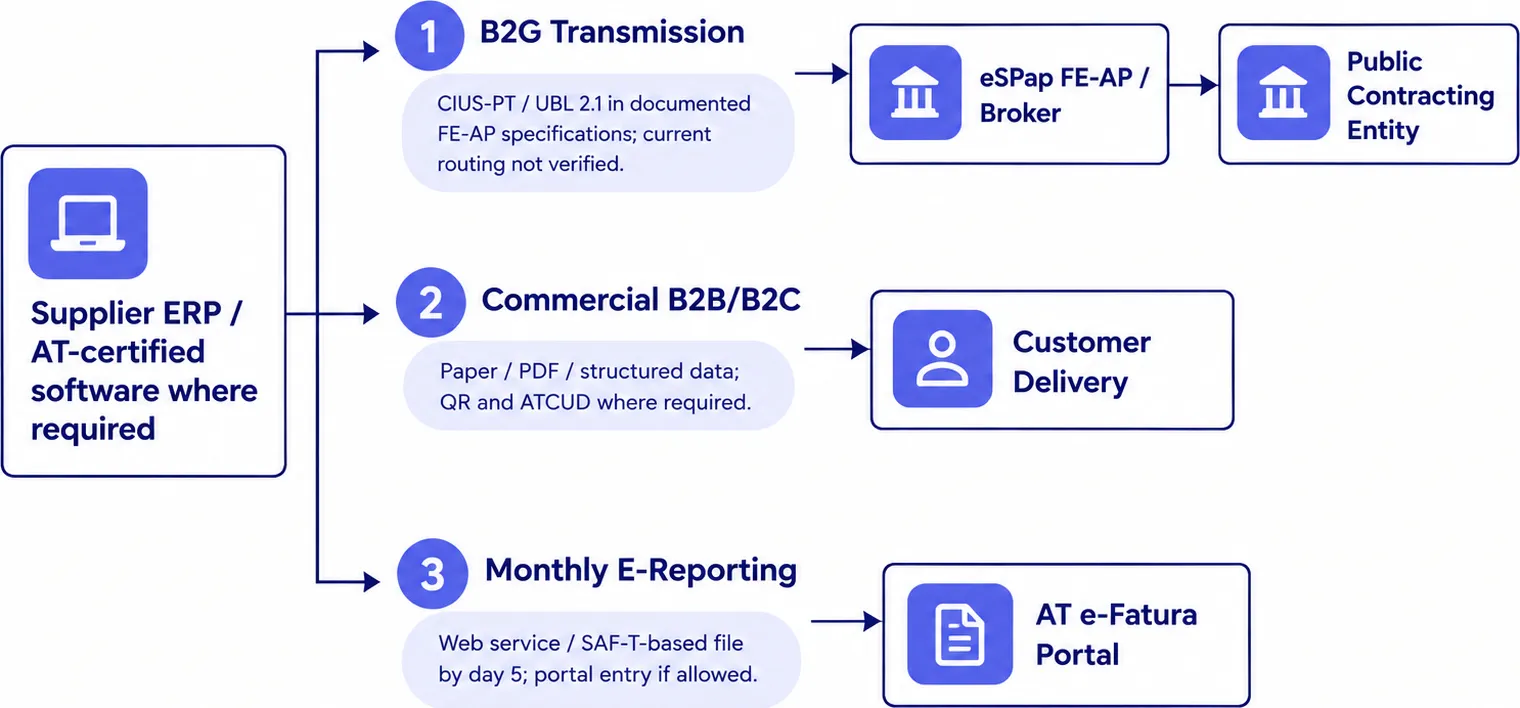
Portugal's technical compliance architecture separates commercial and B2G invoice exchange from tax administration reporting:
When must invoicing software be AT-certified?
Under Decree-Law 28/2019, Article 4, businesses must use invoicing software certified by the AT if any of the following alternative conditions are met:
Turnover in the preceding calendar year exceeded €50,000.
The business uses billing software to issue invoices.
The business is required to keep organised accounting or has elected to do so.
Certified invoicing software must meet the applicable AT integrity and certification specifications. In-scope systems must also be capable of exporting the prescribed SAF-T (PT) file under Article 11(5) of Decree-Law 28/2019. Specific signature-chaining behaviour must be verified against the current software-certification technical specification.
How do suppliers transmit B2G invoices through FE-AP?
For public sector invoicing, suppliers and intermediaries connect to the national electronic invoicing portal for public administration (FE-AP), managed by eSPap, or to specific brokers designated by individual contracting bodies.
The official eSPap FE-AP guide, version 1.4, dated 3 November 2020 documents AS2 and web-service integration. The current availability and specifications of these methods remain unverified.
The inspected FE-AP guide describes schema and business-rule validation, status messaging and public-body routing. Current response-message types and workflow states must be confirmed against the operative eSPap specification before implementation.
How is invoice data communicated to Portugal's tax authority?
Under Article 3(1)–(3) of Decree-Law 198/2012, invoice data is sent to AT by real-time transmission, SAF-T-based file or manual portal entry where allowed. The communication includes prescribed identifiers and tax values; it does not deliver the invoice to the buyer.
What are the penalties for e-invoicing and VAT non-compliance in Portugal?
Penalties for non-compliance with invoicing, reporting and software requirements are governed by the General Regime of Tax Infringements (Regime Geral das Infrações Tributárias, RGIT):
Offence | Liable taxpayer | Statutory provision | Verification status |
|---|---|---|---|
Failure or delay in submitting tax declarations or communications | Taxable persons subject to reporting duties | Monetary range subject to regulatory verification | |
Failure or delay in communications required by Articles 3 and 3-A of Decree-Law 198/2012 | Natural or legal persons issuing covered documents | Monetary range subject to regulatory verification | |
Omissions or inaccuracies in tax declarations, communications or invoices | Taxable persons issuing incorrect documents | Monetary range subject to regulatory verification | |
Failure to issue an invoice, or late issuance beyond statutory deadlines | Taxable persons supplying goods or services | Monetary range subject to regulatory verification | |
Failure to require or retain invoices for the period prescribed by law | Taxable persons acquiring goods or services | Monetary range subject to regulatory verification | |
Failure to use AT-certified invoicing software when legally required | Businesses meeting statutory certification triggers | Monetary range subject to regulatory verification | |
Persons transacting or using non-compliant software, within Article 128(3) | Software developers, suppliers and users | Monetary range subject to regulatory verification |
Regulatory verification outstanding: The current RGIT penalty ranges, offender-specific calculations and applicable relief conditions have not been verified for publication. This penalty table must remain subject to the article's BLOCK release gate.
Can Portuguese tax penalties be reduced or waived?
The RGIT establishes procedures for mitigating or waiving fines:
Dispensation of fines: RGIT Article 29 establishes distinct dispensation routes. Article 29(1) applies the specified five-year history conditions; Article 29(2)–(4) sets out separate no-effective-tax-loss, correction and defence-period requirements.
Fine reductions: Article 30 RGIT provides reductions subject to specified procedural stages, regularisation and payment conditions. The complete effective 2026 conditions and calculations remain NOT VERIFIED in the Research Pack.
Special mitigation: Article 32 RGIT provides for special mitigation and, where the statutory conditions are met, admonition. The applicable procedural and minimum-amount rules require verification before calculating relief.
In addition to applicable RGIT fines, failures may result in AT scrutiny and corrective action. Any effect on a customer's input VAT deduction depends on the specific invoice defect and the applicable substantive VAT deduction rules; it is not an automatic consequence of late reporting.
How can businesses prepare for Portuguese invoicing rules?
To establish compliance with Portuguese invoicing, fiscalisation and tax reporting obligations, businesses should complete the following steps:
Check certification triggers: Under Article 4 of Decree-Law 28/2019, use AT-certified software where prior-year turnover exceeds €50,000, invoicing software is used, or organised accounting is required or elected.
Configure ATCUD and QR controls: Validate in-scope document series with AT before use. Apply ATCUD identifiers and QR-code displays to the relevant document types and representations under Portaria 195/2020.
Set up AT reporting: Transmit covered document data by the fifth day of the following month using a permitted Article 3 channel. If no covered documents are issued, submit the Article 3(9) notification unless an AT-recognised exception applies.
Prepare for B2G structured invoicing: Identify covered contractors and exemptions, including public-entity suppliers and the transition. Obtain current eSPap validation and routing specifications before production testing.
Review digital invoice workflows ahead of 2027: Assess electronic invoice distribution. With the temporary PDF deeming rule under Law 73-A/2025 set to expire on 31 December 2026, evaluate permanent authenticity and integrity mechanisms, such as qualified electronic seals and structured EDI channels.
Set up territorial VAT rates: Configure 23%/13%/6% for mainland Portugal, 16%/9%/4% for the Azores, and 22%/12%/4% for Madeira, subject to supply classification. Madeira's reduced rate follows DLR 6/2024/M, Article 21.
Maintain compliant archives: Preserve electronic invoices and supporting records in accordance with Decree-Law 28/2019, Articles 19 to 21, generally for ten years or longer where required. Confirm EU storage rules and obtain prior AT authorisation where non-EU storage is permitted.
Track the annual accounting SAF-T mandate: Prepare general ledgers for annual accounting SAF-T reporting, enacted for tax periods from 2027 under Law 73-A/2025, while monitoring parliamentary debates on the draft 2027 Budget for possible postponement.
What are the key compliance takeaways for businesses in Portugal?
Portugal separates invoice delivery from tax reporting. General domestic B2B and B2C transactions are not subject to a universal structured-invoice mandate in the legislation reviewed, while covered public contracts have their own B2G rules. Certified software, ATCUD and QR controls apply according to statutory scope.
In-scope taxpayers must communicate covered document data by the fifth day of the following month. Article 3(9) also requires nil-issuance notification, subject to the applicable AT exceptions. Businesses should assess AT-certified software triggers, configure applicable e-Fatura reporting and maintain legally compliant archives, generally for ten years.
FAQ
No general structured e-invoicing mandate applies to ordinary domestic B2B transactions in the legislation reviewed. Businesses can use compliant paper or electronic invoices, with recipient acceptance for electronic issuance. Persons within Article 3 of Decree-Law 198/2012 must report covered document data by the fifth day of the following month.