
This article was updated on 19 October 2026. From 1 January 2026, the statutory transmission deadline under OUG 120/2021 Article 10(7), as amended by OUG 89/2025, is five working days from invoice issuance, and Romania-established taxable persons must transmit invoices for covered supplies located in Romania to non-established taxable persons registered for Romanian VAT, subject to the statutory exceptions. From 1 June 2026, Law 88/2026 enacted specific rules for CNP-identified individuals, special-regime farmers, cultural institutes and transactions where no tax identifier is provided. Standard VAT changed to 21% and reduced VAT to 11% on 1 August 2025 under Law 141/2025.
What is Romania's electronic invoicing framework and digital tax strategy?
Romania requires structured e-invoicing through RO e-Factura for qualifying B2G transactions from 1 July 2022, domestic B2B supplies from 1 July 2024 and B2C invoices from 1 January 2025, subject to statutory exceptions. Invoices must be transmitted to the national clearance system, RO e-Factura, which is administered by the Ministry of Finance through the National Centre for Financial Information (CNIF) under OUG 120/2021 Article 3.
Romania's digital tax framework combines mandatory electronic invoice transmission and validation through RO e-Factura with separate electronic tax reporting. Electronic invoicing through RO e-Factura operates alongside periodic VAT returns on form 300, recapitulative statements on form 390, Standard Audit File for Tax (SAF-T) reporting through declaration D406 and fiscal cash registers. Each mechanism serves a distinct legal purpose. Transmission through RO e-Factura fulfils the system-submission requirement for an in-scope invoice when the relevant legal conditions are met. It does not replace invoice issuance, VAT return or SAF-T reporting obligations.
The national mandate applies primarily to taxable persons established in Romania within the meaning of Fiscal Code Article 266(2). Specific provisions also cover supplies whose place of supply is in Romania when made by Romania-established taxable persons to non-established taxable persons registered for Romanian VAT. While the system architecture aims to improve tax transparency and close the VAT gap, businesses must carefully distinguish between mandatory legal obligations and voluntary operational choices.
How did Romania's e-invoicing framework and EU derogation develop?
Romania established the statutory foundation for its national e-invoicing system on 4 October 2021 through OUG 120/2021. The system initially operated on a voluntary basis for commercial transactions, alongside a targeted regime for high-tax-risk product categories. Mandatory electronic invoicing commenced in the public sector on 1 July 2022, when Law 139/2022 Article II required economic operators established in Romania to issue and transmit electronic invoices for qualifying B2G procurement contracts through RO e-Factura.
To extend mandatory electronic invoicing to domestic B2B transactions, Romania sought authorisation from the Council of the European Union to derogate from Articles 218 and 232 of the EU VAT Directive (Directive 2006/112/EC). Under Council Implementing Decision (EU) 2023/1553, Romania was authorised to derogate from VAT Directive Articles 218 and 232 for covered transactions between taxable persons established in Romania, including by removing the ordinary recipient-acceptance requirement. Under Article 4(2) of Council Implementing Decision (EU) 2023/1553, the authorisation applies from 1 January 2024 until the earlier of 31 December 2026 or the date from which Member States are required to apply relevant national provisions adopted following EU amendments to VAT-invoicing rules, particularly Articles 218 and 232 of the VAT Directive. The eventual expiry of this specific decision does not, of itself, mean Romania's domestic mandate will terminate, because Directive (EU) 2025/516 Article 1 permits Member States to impose domestic e-invoicing mandates on established taxpayers without individual derogations from 14 April 2025.
Following the EU authorisation, the Romanian Parliament enacted Law 296/2023, introducing a two-stage roll-out for domestic B2B transactions. From 1 January to 30 June 2024, Law 296/2023 Article LIX(1) required covered established taxpayers to transmit issued invoices to RO e-Factura during the transitional reporting period, while commercial invoice exchange continued separately. The second stage took effect on 1 July 2024 under OUG 115/2023 Article LXVIII point 14, making RO e-Factura mandatory for covered B2B invoices. Under OUG 120/2021 Article 4(6), the Ministry-sealed XML is the electronic invoice original. Subsequent legislation expanded the system to B2C transactions from 1 January 2025 under OUG 138/2024, amended transmission deadlines from 1 January 2026 under OUG 89/2025, and refined statutory exemptions from 1 June 2026 under Law 88/2026.
What is the implementation timeline for Romanian e-invoicing and reporting?
Romania implemented its e-invoicing and digital reporting mandates through phased legislative stages, beginning with public procurement and expanding to commercial transactions.
Date | Milestone | Business impact |
|---|---|---|
4 October 2021 | Enactment of OUG 120/2021 | Established the RO e-Factura national clearance platform for voluntary use and public procurement preparation. |
1 July 2022 | Mandatory B2G electronic invoicing under Law 139/2022 Article II | Established contractors must transmit structured e-invoices for covered public procurement contracts through RO e-Factura. |
29 November 2022 | Publication of Order 4092/2022 amending RO_CIUS | Amended the national technical specification identifier to CIUS-RO:1.0.1 and updated semantic validation rules. |
25 July 2023 | Council Implementing Decision (EU) 2023/1553 adopted | Authorised covered domestic B2B e-invoicing without recipient acceptance, subject to the earlier-of-two-dates rule ending no later than 31 December 2026. |
1 January 2024 | Transitional B2B reporting begins under Law 296/2023 | Covered established suppliers are required to transmit issued invoices through RO e-Factura during the transitional reporting phase. |
1 July 2024 | Full domestic B2B mandate applies under OUG 115/2023 | RO e-Factura becomes mandatory for covered B2B invoices; separate 15% invoice-value contraventions apply to qualifying issuer and recipient breaches. |
5 December 2024 | Publication of OUG 138/2024 | Published amendments introducing procurement CPV codes and revised B2B/B2C fiscal-receipt exclusions, applicable from 1 January 2025. |
1 January 2025 | Mandatory B2C transmission takes effect under OUG 138/2024 | Established suppliers must transmit covered domestic B2C invoices to RO e-Factura, excluding qualifying fiscal receipts. |
14 April 2025 | ViDA domestic mandate provision takes effect under Directive (EU) 2025/516 | Permits EU Member States to operate domestic e-invoicing mandates without individual derogations from the Council. |
1 July 2025 | B2C penalties take effect under OUG 69/2024 Article II | Monthly fines apply to established suppliers failing to transmit covered B2C invoices within statutory deadlines. |
1 August 2025 | VAT rate restructuring applies under Law 141/2025 | Standard VAT increased to 21% and general reduced VAT adjusted to 11% under Fiscal Code Article 291. |
1 September 2025 | Small enterprise VAT threshold adjusted under OG 22/2025 | Annual VAT registration exemption threshold increased to 395,000 lei for eligible businesses under Article 266(2)(a). |
1 January 2026 | Five-working-day deadline applies under OUG 89/2025 Article X | Five-working-day transmission deadline applies; covered supplies by Romania-established suppliers to non-established Romanian VAT-registered buyers also enter scope. |
9 March 2026 | Repeal of specified RO e-TVA provisions under OUG 13/2026 | Repealed compliance-notification articles 5, 8 and 16 of OUG 70/2024 regarding pre-filled VAT returns. |
1 June 2026 | Statutory amendments take effect under Law 88/2026 Article III | Updated thirteen-zero, CNP supplier, special farmer and cultural institute provisions, including related optional-register exceptions. |
31 December 2026 | Nominal expiry date of Council Implementing Decision (EU) 2023/1553 | Nominal final date of EU derogation, subject to Article 4(2) conditions and general ViDA mandate permissions. |
1 July 2030 | EU ViDA intra-EU reporting applies under Directive (EU) 2025/516 | Principal EU electronic invoicing and digital reporting reforms apply to specified intra-EU transactions from 1 July 2030. |
Which primary laws govern e-invoicing and VAT reporting in Romania?
Electronic invoicing and tax reporting in Romania are governed by a combination of primary emergency ordinances, parliamentary acts, tax codes and ministerial orders.
OUG 120/2021 (Ordonanța de urgență nr. 120/2021): The foundational primary law governing the administration, operation and implementation of the RO e-Factura national electronic invoicing platform, as approved and amended by Law 139/2022.
Law 296/2023: Implemented fiscal measures introducing the phased B2B mandate, establishing transitional reporting under Article LIX and scheduling the full mandate under Article LXX.
OUG 115/2023: Amended OUG 120/2021 under Article LXVIII, establishing the 1 July 2024 full B2B mandate, the 15% invoice contraventions and the 24-hour technical outage relief rule under Article LXXI.
OUG 69/2024: Amended the Article 13^2 contravention regime under Article II points 4–7, including B2C offences and taxpayer-size fine bands for late transmission.
OUG 138/2024: Mandated Common Procurement Vocabulary (CPV) codes for procurement contracts and amended Article 10(1) and Article 10^1(2) to clarify exclusions for qualifying fiscal cash-register receipts.
OUG 89/2025: Established the five-working-day transmission deadline under Article 10(7) and brought domestic supplies to non-established VAT-registered buyers into mandatory transmission scope under Article 10(1^1).
Law 88/2026: Amended OUG 120/2021 from 1 June 2026, establishing rules for CNP-identified suppliers, special-regime farmers, cultural institutes and thirteen-zero consumer identification.
Fiscal Code (Law 227/2015): Controls core tax definitions, including VAT taxable person establishment under Article 266, statutory rates under Article 291, the small business exemption under Article 310, invoice issuance deadlines under Article 319(16), invoice storage under Article 319(35), and periodic VAT return rules under Articles 322 and 323.
ANAF Order 174/2026: Governs declaration form 300, establishing reporting frequencies, instructions and deadlines for periodic VAT returns.
ANAF Order 591/2016: Governs declaration form 390, establishing monthly filing deadlines for recapitulative statements on intra-EU transactions.
ANAF Order 1783/2021: Establishes the technical and procedural framework for SAF-T reporting through declaration D406, including ordinary filing periods and deadlines.
Order 1366/2021 and Order 4092/2022: Established the original RO_CIUS specifications in 2021 and amended the specification identifier and validation rules in 2022. Current production requirements require separate confirmation.
Which authorities oversee e-invoicing and tax administration in Romania?
The administration and enforcement of Romania's digital tax framework are divided between national policy ministries, technical system administrators and the tax authority.
Institution | Role | Primary compliance responsibility |
|---|---|---|
Ministry of Finance (Ministerul Finanțelor) | System owner and policy maker | Owns the RO e-Factura system, prepares primary tax legislation and issues ministerial orders under OUG 120/2021 Article 3(1). |
National Centre for Financial Information (CNIF) | Technical system administrator | Develops, maintains and operates the technical infrastructure of the RO e-Factura clearance platform under OUG 120/2021 Article 3(2). |
National Agency for Fiscal Administration (ANAF) | Tax administration and enforcement | Administers VAT returns, audits declaration D406 SAF-T reports, operates the Virtual Private Space (SPV) and assesses statutory penalties. |
Romanian Standards Association (ASRO) | National standards body | Publishes and maintains the Romanian adoption of the European standard for electronic invoicing, SR EN 16931-1. |
Competent public audit bodies | Public procurement control | The Court of Accounts, Ministry of Finance and other legally authorised bodies may establish and sanction breaches of the B2G public-budget payment restriction under Article 13^1(4). |
Which transactions are covered by Romania's e-invoicing rules?
Romania's e-invoicing framework covers domestic business-to-government (B2G), business-to-business (B2B) and business-to-consumer (B2C) transactions, subject to precise statutory conditions and exemptions.
Transaction type | Issuance obligation | Reception obligation | Reporting obligation | Effective date |
|---|---|---|---|---|
Domestic B2G | Mandatory transmission through RO e-Factura for established contractors | Public recipient receives the e-invoice; own-budget payments require compliance with the statutory B2G invoicing obligation | Covered by clearance; separate VAT returns apply | 1 July 2022 |
Domestic B2B | Mandatory transmission through RO e-Factura for established suppliers | Recipient must observe RO e-Factura receipt and recording rules; receiving and recording non-compliant invoices may attract a 15% fine | Form 300 and SAF-T D406 as applicable | 1 July 2024 |
Domestic B2C | Mandatory transmission through RO e-Factura for established suppliers | Consumers need not receive invoices through RO e-Factura; suppliers must deliver B2C invoices directly unless the recipient is in the optional register | Form 300 where applicable; separate cash-register obligations under OUG 28/1999 | 1 January 2025 |
Supplies to non-established buyers | Mandatory transmission through RO e-Factura for established suppliers | Romania-established supplier must also deliver the issued invoice directly to the non-established recipient under Fiscal Code Article 319 | Applicable VAT returns under Romanian registration | 1 January 2026 |
Natural-person farmers (special regime) | Exempt from mandatory RO e-Factura transmission | Suppliers exempt from transmitting unless farmer opts into register | Other tax obligations require separate assessment | 1 June 2026 |
Foreign cultural institutes | Exempt from mandatory RO e-Factura transmission | Suppliers exempt from transmitting unless institute opts into register | Other VAT or reporting obligations require separate assessment | 1 June 2026 |
How are domestic B2B and B2G supplies regulated?
Under OUG 120/2021 Article 2(1)(m) and Law 139/2022 Article II, Romania-established economic operators must issue and transmit electronic invoices through RO e-Factura for procurement-based B2G transactions within the statutory definition, subject to exceptions including classified contracts and specified state-security procurement under Article 6. Invoices issued for covered procurement must include the corresponding CPV codes under OUG 120/2021 Article 4(2^1), as amended by OUG 138/2024.
For domestic B2B supplies, taxable persons established in Romania within the meaning of Fiscal Code Article 266(2) must transmit electronic invoices through RO e-Factura for all in-scope transactions where the place of supply is in Romania, pursuant to OUG 120/2021 Article 10(1). Under OUG 138/2024 Article I point 2, the law excludes qualifying fiscal cash-register receipts meeting the statutory conditions for simplified invoices, as well as certain intra-EU supplies of goods where the buyer communicates a VAT identification number issued by another Member State.
Which rules govern B2C transactions and individual identifiers?
Since 1 January 2025, taxable persons established in Romania have been required under OUG 120/2021 Article 10^1(2), as amended by OUG 138/2024, to transmit invoices issued for domestic B2C supplies through RO e-Factura. The statutory exclusion applies specifically to fiscal cash-register receipts that meet the conditions for simplified invoices. It does not create a blanket exemption for all simplified invoices. Under OUG 120/2021 Article 10^1(4), suppliers must also deliver issued B2C invoices to recipients under Fiscal Code Article 319 unless those recipients are enrolled in the optional register.
From 1 June 2026, Law 88/2026 Article III point 1 governs B2C identification. When a supply is made to a natural person who does not provide a tax identification code or chooses to identify using their Personal Numeric Code (Cod Numeric Personal or CNP), the supply is treated as B2C unless the individual is registered in the optional RO e-Factura register. Where the consumer provides no tax identification code, the supplier must enter a numeric code of thirteen zeros (0000000000000) in the buyer identification field. Furthermore, under OUG 120/2021 Article 10^10, enacted by Law 88/2026 Article III point 8, suppliers or service providers identified fiscally by CNP are exempt from the mandatory provisions listed in Article 10^10(1), including the specified B2B and B2C transmission requirements. They may opt into RO e-Factura.
What statutory exemptions apply to specific taxpayers and operations?
Romanian legislation provides the following material exclusions from RO e-Factura. Separate historical rules also applied to certain non-profit organisations, political parties and religious bodies between 1 July 2024 and 30 June 2025 under Article 10^6:
Special agricultural regime: Under OUG 120/2021 Article 10^7, enacted by Law 88/2026, natural-person farmers who apply the special agricultural scheme under Fiscal Code Article 315^1 are not required to transmit invoices through RO e-Factura. Romania-established suppliers delivering goods or services to these farmers are exempt from transmitting invoices through the system unless the farmer has enrolled in the optional register.
Foreign cultural institutes: Under OUG 120/2021 Article 10^5(2), (6), as amended by Law 88/2026, cultural institutes and centres of other states operating in Romania under intergovernmental agreements are exempt from mandatory participation. Suppliers delivering to these institutes are not required to transmit invoices through RO e-Factura unless the institute opts into the system.
Invoices outside VAT scope: Under OUG 120/2021 Article 10^3, voluntarily issued invoices for operations outside the scope of VAT or for amounts not included in the taxable base are exempt from mandatory transmission where no statutory obligation to issue an invoice exists under Fiscal Code Article 319.
Diplomatic and international bodies: Supplies made by persons identified in Fiscal Code Article 294(1)(j)–(n) fall within the exemption in OUG 120/2021 Article 10^5(1), subject to its statutory conditions. Supplier-side exceptions for supplies to those persons are addressed separately in Article 10^5(5).
What rules apply to cross-border transactions and foreign entities?
From 1 January 2026, OUG 120/2021 Article 10(1^1), as inserted by OUG 89/2025, requires taxable persons established in Romania to transmit invoices through RO e-Factura for domestic supplies made to non-established taxable persons who are registered for VAT in Romania. The obligation falls on the Romania-established supplier, who must also transmit the issued invoice to the non-established recipient in accordance with Article 10(1^2) and Fiscal Code Article 319.
Non-established suppliers should assess whether they have a Romanian fixed establishment and whether the optional regime under OUG 120/2021 Article 13 applies. Their complete mandatory position remains unverified and must not be inferred from Romanian VAT registration alone.
What are the electronic invoicing requirements in Romania?
For in-scope transactions, Romania-established suppliers must prepare structured invoices that meet the applicable national requirements and transmit them through RO e-Factura. The system performs statutory structural validation and applies the Ministry of Finance electronic seal to accepted invoices.
What are the statutory issuance and transmission deadlines?
Romanian law distinguishes between the deadline for issuing an invoice and the deadline for transmitting it to RO e-Factura.
Obligation | Statutory deadline | Legal provision |
|---|---|---|
General invoice issuance | No later than the 15th day of the month following the month in which the chargeable event occurs | |
Invoicing advance payments | No later than the 15th day of the month following the month in which advance payment was received | |
RO e-Factura transmission | Five working days from invoice issuance, but no later than five working days from statutory issuance deadline | OUG 120/2021 Article 10(7), amended by OUG 89/2025 |
B2C transmission | Five working days, subject to specific B2C transmission rules | OUG 120/2021 Article 10^1(2^1), amended by OUG 89/2025 |
Under OUG 120/2021 Article 10(7), as amended from 1 January 2026, the transmission deadline is calculated in working days in accordance with Council Regulation (EEC, Euratom) No 1182/71.
Which invoice formats and semantic standards apply?
The statutory RO e-Factura framework uses the Romanian Core Invoice Usage Specification, RO_CIUS, based on SR EN 16931-1. The currently accepted production validation rules and specification version require confirmation against current official technical documentation.
Under Ministry of Public Finance Order 1366/2021, the accepted technical syntaxes are:
Universal Business Language (UBL 2.1).
UN/CEFACT Cross Industry Invoice (CII 16B).
In the original 2021 specification, the formal specification identifier was defined as:urn:cen.eu:en16931:2017#compliant#urn:efactura.mfinante.ro:RO_CIUS:1.0.0.2021.
On 29 November 2022, Ministry of Finance Order 4092/2022 Article I amended the specification identifier to:urn:cen.eu:en16931:2017#compliant#urn:efactura.mfinante.ro:CIUS-RO:1.0.1.
While Order 4092/2022 represents the legally amended specification in the statutory record, businesses must ensure their systems validate against the active schemas applied by the live RO e-Factura production environment. Simply generating a standard UBL or CII document does not guarantee compliance if national business rules or required fields are omitted. For example, qualifying procurement invoices must include CPV codes under OUG 120/2021 Article 4(2^1). Where an invoice is issued to a natural person who provides no tax identification code, the supplier uses the thirteen-zero identifier under Law 88/2026 Article III point 1.
What rules govern invoice storage and the electronic original?
Under OUG 120/2021 Article 4(6), as approved by Law 139/2022, for invoices processed through RO e-Factura, the Ministry-sealed XML is the statutory electronic invoice original. A PDF or printout is a readable representation and must not be treated as a substitute for the required system-issued XML.
Rules governing invoice storage include:
Storage formats: Under Fiscal Code Article 319(35), invoices may be stored on paper or in electronic format, regardless of the form in which they were originally issued or made available. Where invoices are stored electronically, the application of Law 135/2007 on electronic archiving is not mandatory.
Tax authority access: Under Fiscal Code Article 319(37), taxable persons storing relevant electronic invoices outside Romania must allow competent Romanian tax authorities online access to inspect, download and use those records, subject to the statutory conditions.
Preservation limits: Fiscal Code Article 319(35) permits storage in paper or electronic form, while OUG 120/2021 Article 4(6) identifies the Ministry-sealed XML as the electronic original. Businesses should preserve that XML pending confirmation of the applicable retention, conversion and disposal rules. Complete retention periods remain unverified.
What electronic VAT and SAF-T reporting is required in Romania?
Romania enforces separate electronic reporting obligations for periodic VAT liabilities, intra-EU trade and comprehensive accounting data.
Reporting system | Form name | Covered taxpayers | Reporting frequency | Ordinary filing deadline |
|---|---|---|---|---|
Periodic VAT return | Form 300 | Taxable persons registered for VAT under Article 316 | Monthly | By the 25th day of the following month |
Periodic VAT return | Form 300 | Eligible quarterly VAT taxpayers | Quarterly | By the 25th day of the month after the quarter |
Periodic VAT return | Form 300 | Approved semi-annual VAT filers | Semi-annual | By the 25th day of the month after the semester |
Periodic VAT return | Form 300 | Approved or specified annual filers | Annual | By 25 January of the following year |
EU recapitulative statement | Form 390 | Taxpayers with reportable intra-EU supplies, acquisitions or services | Monthly (in active months) | By the 25th day of the following month |
SAF-T general accounting | Form D406 | Covered taxpayer categories under Annex 5 | Monthly or quarterly | Last calendar day of the following month |
SAF-T asset register | Form D406 | D406 filers required to report assets under the applicable annex | Annual | Due by statutory financial statement deadline |
SAF-T inventory records | Form D406 | D406 filers required to report inventories under the applicable annex | On demand | Within the deadline established by tax authorities |
How must taxpayers submit periodic VAT returns and recapitulative statements?
Under ANAF Order 174/2026 Article 2 and Annex 2 and Fiscal Code Articles 322 and 323, VAT-registered persons must submit form 300 according to their assigned tax period. For monthly filers, the return is due by the 25th day inclusive of the following month. Where the filing deadline falls on 25 December, the statutory deadline moves to 21 December or the last preceding working day.
For intra-EU transactions, taxable persons registered under Fiscal Code Articles 316 or 317 must submit form 390 (Declarația recapitulativă) for each calendar month in which VAT becomes chargeable for intra-EU supplies, acquisitions or cross-border services. Under ANAF Order 591/2016 Annex 2 and Fiscal Code Article 325, form 390 must be filed by the 25th day inclusive of the month following the reporting period.
With respect to pre-filled VAT returns (RO e-TVA), OUG 13/2026 Article IV repealed Articles 5, 8 and 16 of OUG 70/2024 concerning compliance notifications and specific procedural differences. This repeal eliminated specific notification rules without dismantling the broader electronic VAT return structure.
What are the SAF-T filing obligations under declaration D406?
Romania requires specified taxpayer categories to submit SAF-T data through declaration D406 under ANAF Order 1783/2021. The reporting obligation and commencement date depend on the taxpayer category and exceptions listed in Annex 5.
For taxpayers within scope, the ordinary D406 filing frequency generally follows the VAT reporting period, with quarterly reporting also applying to specified semi-annual, annual and non-VAT-registered taxpayers under Annex 4:
Monthly VAT filers submit D406 on a monthly basis.
Quarterly, semi-annual or non-VAT taxpayers submit D406 on a quarterly basis.
Under ANAF Order 1783/2021 Annex 4, the ordinary filing deadline is the last calendar day of the month following the reporting period. Distinct filing rules apply to specific sections of the audit file:
D406 assets (Active): Submitted annually by the statutory deadline for submitting annual financial statements.
D406 inventories (Stocuri): Submitted only upon a formal request from the tax authority, within the timeline specified in that request (which cannot be shorter than 30 calendar days under statutory rules).
Taxpayer phasing and category-specific commencement rules derive from Annex 5 of Order 1783/2021.
How does cash-register fiscalisation operate alongside e-invoicing?
Businesses subject to OUG 28/1999 must comply with the applicable fiscal cash-register and receipt rules. The specific device, reporting and exception requirements should be confirmed against the current legislation.
The B2B and B2C electronic invoicing rules under OUG 120/2021 expressly exclude fiscal receipts that satisfy the legal conditions for simplified invoices. Where a retail transaction is documented through a qualifying simplified fiscal receipt, transmission through RO e-Factura is not required. Where an ordinary invoice is issued instead of a qualifying exempt fiscal receipt, the supplier must assess whether it falls within the relevant RO e-Factura mandate and whether another statutory exception applies.
The small business VAT exemption threshold is 395,000 lei under OG 22/2025 and Fiscal Code Article 310(1), applicable to persons established in Romania under Article 266(2)(a). This threshold governs eligibility for the special VAT exemption scheme under Article 310. It is not a general RO e-Factura turnover exemption, which must be assessed under the separate invoicing provisions.
How are electronic invoices exchanged and processed in Romania?
In-scope invoices are transmitted through RO e-Factura for statutory system processing. Separate supplier-to-recipient delivery may also be required, including under Article 10(1^2) for specified non-established buyers and Article 10^1(4) for B2C recipients.
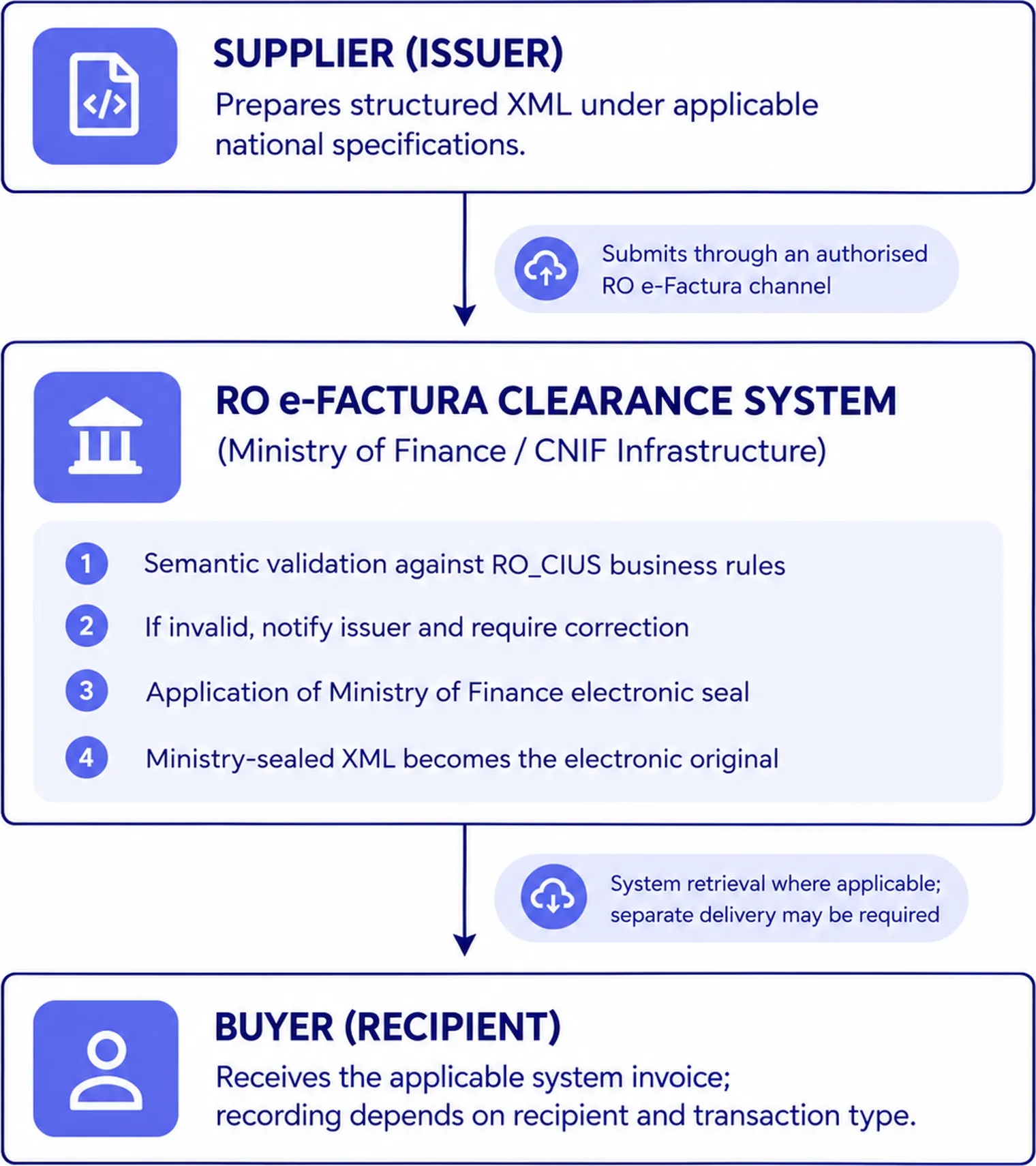
The clearance workflow follows established statutory stages:
Invoice creation: The supplier prepares structured XML using the applicable Romanian specification. Order 1366/2021 and Order 4092/2022 establish historical UBL 2.1 and CII 16B requirements; current production validation rules must be confirmed separately.
Transmission: The supplier submits the XML file through an authorised RO e-Factura channel, using the current official access procedure. For invoices subject to Article 10(7), transmission is due within five working days of issuance and no later than five working days after the statutory issuance deadline under Fiscal Code Article 319(16).
Automated validation: RO e-Factura validates the file structure and mandatory fields. If the transmitted invoice fails the statutory structural requirements, the issuer receives an error message and must correct and resubmit the XML through RO e-Factura.
Electronic sealing: When the invoice meets the structural requirements, RO e-Factura applies the Ministry of Finance electronic seal. Under OUG 120/2021 Article 4(6), the sealed XML is regarded as the original electronic invoice.
Recipient delivery: The sealed XML file is made available to the recipient in the RO e-Factura system. Romania-established B2B recipients should obtain the Ministry-sealed XML for applicable accounting records and avoid receiving and recording invoices issued in breach of Article 10(1).
What penalties apply to RO e-Factura non-compliance in Romania?
Romanian law establishes separate offences for breaches of mandatory RO e-Factura use, late transmission and the receipt and recording of certain non-compliant B2B invoices. Public procurement is subject to additional payment restrictions.
Offence | Taxpayer category | Statutory penalty | Legal basis |
|---|---|---|---|
Issuer breach of mandatory Article 10(1) RO e-Factura use | Taxable persons established in Romania | Fine equal to 15% of the total invoice value | |
Recipient receives and records an in-scope B2B invoice issued without Article 10(1) compliance | Taxable persons established in Romania | Fine equal to 15% of the total invoice value | |
Failure to transmit B2B invoices within statutory deadlines | Legal persons classified as large taxpayers | 5,000 to 10,000 lei for the relevant calendar-month contravention | |
Failure to transmit B2B invoices within statutory deadlines | Legal persons classified as medium taxpayers | 2,500 to 5,000 lei for the relevant calendar month contravention | |
Failure to transmit B2B invoices within statutory deadlines | Other legal persons and individuals | 1,000 to 2,500 lei for the relevant calendar-month contravention | |
Failure to transmit B2C invoices within statutory deadlines | Legal persons classified as large taxpayers | 5,000 to 10,000 lei for the relevant calendar month contravention | |
Failure to transmit B2C invoices within statutory deadlines | Legal persons classified as medium taxpayers | 2,500 to 5,000 lei for the relevant calendar month contravention | |
Failure to transmit B2C invoices within statutory deadlines | Other legal persons and individuals | 1,000 to 2,500 lei for the relevant calendar-month contravention | |
Breach of transmission rules by specified enforcement bodies | Enforcement bodies, including judicial bailiffs and ANABI | 5,000 to 10,000 lei per invoice | |
Public-budget payment made without compliance with the statutory B2G invoicing requirement | Relevant B2G public recipients | Fine of 500 to 1,000 lei |
What fines apply to B2B invoicing offences?
Under OUG 120/2021 Article 13^2(1)(a), (b) and (2), as amended by OUG 115/2023, a sanction equal to 15% of the total invoice value applies to two separate contraventions:
The issuance and supply of in-scope domestic B2B invoices by an established taxable person without transmitting them through RO e-Factura.
The receipt and recording in accounting records by an established recipient of a B2B invoice that was issued by an established supplier without complying with RO e-Factura transmission requirements.
The competent tax bodies establish and apply these 15% fines under Article 13^2(4). The specific penalty rule must also be read with the applicable general contravention provisions, as required by Article 13^3.
How are monthly transmission delays and B2C breaches penalised?
Failure to meet the statutory RO e-Factura transmission deadlines may attract the taxpayer-size fines under Article 13^2(1)(c), (d) and (3), as amended by OUG 69/2024 Article II points 4–7. The offence is assessed by reference to deadlines falling within a calendar month.
For each applicable contravention under Article 13^2(1)(c) or (d), the statute groups invoices whose transmission deadlines fall within a calendar month. The following taxpayer-size fine bands apply:
Large taxpayers: 5,000 lei to 10,000 lei.
Medium taxpayers: 2,500 lei to 5,000 lei.
Other legal persons and individuals: 1,000 lei to 2,500 lei.
For B2C invoices, non-compliance attracts the identical tiered monthly fine scale from 1 July 2025 under OUG 69/2024 Article II point 5.
Under OUG 115/2023 Article LXXI, the transmission obligation is suspended during verified national system outages of at least 24 hours. Once the platform returns to operational status, taxpayers must resume transmissions.
What consequences apply to public procurement payments?
For qualifying B2G procurement invoices issued by Romania-established economic operators, public-sector recipients are prohibited under OUG 120/2021 Article 13^1 and Law 139/2022 Article II from making payments from their budgets unless the invoice has been processed through RO e-Factura. Relevant public recipients that make payments from their own budgets in breach of Article 13^1(1) face fines of 500 to 1,000 lei. Separate provisions govern the recovery of unlawful public payments. This statutory restriction concerns payments from the public recipient's own budget. The RO e-Factura provisions reviewed do not establish a general automatic contractual payment-withholding right for private B2B buyers.
How can businesses prepare for Romania's e-invoicing requirements?
To align operational workflows with Romanian tax law, businesses should implement structured compliance checks across systems and partner data:
Determine taxpayer and transaction scope: Establish whether your business qualifies as an established taxable person under Fiscal Code Article 266(2). Review transaction categories to determine whether supplies fall under B2G, B2B, B2C, or specific statutory exemptions such as special-regime farming under Article 10^7 or exempt cultural institutes under Article 10^5.
Review counterparty master data: Verify customer tax identification codes. Where domestic supplies are made to non-established taxable persons registered for Romanian VAT, ensure systems accommodate the transmission rule under OUG 120/2021 Article 10(1^1). For retail B2C transactions where consumers provide no tax code, configure billing systems to input the statutory thirteen-zero code (0000000000000) pursuant to Law 88/2026.
Configure required semantic standards: Configure billing software for structured XML conforming to SR EN 16931-1 and the applicable Romanian specification. Orders 1366/2021 and 4092/2022 provide the historical legal specification chain; current production validation rules require confirmation. Public procurement billing must incorporate CPV codes under OUG 120/2021 Article 4(2^1).
Implement transmission workflows: Implement an authorised RO e-Factura submission process and verify current access requirements. Transmit covered invoices within five working days of issuance, and no later than five working days after the statutory issuance deadline, under OUG 120/2021 Article 10(7).
Establish accounts payable reception controls: Configure accounts payable controls to identify B2B invoices issued by Romania-established suppliers without Article 10(1) compliance, and prevent their receipt and recording in breach of Article 13^2(1)(b).
Maintain archiving controls: Preserve Ministry-sealed XML originals securely and maintain the statutory authenticity, integrity and access controls. Fiscal Code Article 319(35)–(37) governs storage and tax-authority access, while complete retention and disposal requirements remain subject to verification.
What are the key compliance takeaways for businesses in Romania?
Romania operates a digital tax framework combining mandatory RO e-Factura transmission and validation for covered invoices with separate electronic VAT and SAF-T reporting obligations. Romania-established taxable persons must issue and transmit qualifying B2G, domestic B2B and B2C invoices through RO e-Factura, subject to statutory exceptions. The system validates and seals accepted XML files, while accounting and recipient obligations depend on the transaction type.
Businesses must maintain a strict operational boundary between invoicing and reporting. Covered invoices must meet the statutory issuance, content and RO e-Factura transmission requirements, including the five-working-day deadline and its outer limit. Businesses must separately file form 300, form 390 or D406 where the applicable rules require each declaration.
Relevant breaches may attract 15% invoice-value fines or taxpayer-size fines for late transmission. Businesses should verify counterparty data, apply receipt controls, preserve Ministry-sealed XML originals and confirm current technical rules. Unresolved retention and foreign-supplier requirements still require legal review.
FAQ
Mandatory B2G electronic invoicing took effect on 1 July 2022 under Law 139/2022 Article II and OUG 120/2021 Article 2(1)(m). Romania-established economic operators must issue and transmit electronic invoices through RO e-Factura for qualifying B2G transactions, subject to the statutory classified-contract and security exceptions in Article 6.