Is electronic invoicing mandatory in Slovenia?
Electronic invoicing is mandatory for business entities supplying Slovenian public-sector budget users, but it is not yet universally compulsory for commercial transactions between private businesses. Under Article 44 of the Payment and Public Finance Services Act (ZPJS), businesses supplying budget users under a contract or purchase order must issue structured electronic invoices through approved channels into the UJP gateway, subject to the exclusions in ZPJS Article 50.
For domestic business-to-business (B2B) transactions, electronic invoicing remains voluntary during 2026. However, Parliament has enacted the Act on the Exchange of Electronic Invoices and Other Electronic Documents (ZIERDED), which establishes a mandatory reciprocal structured e-invoice exchange regime taking effect on 1 January 2028.
Alongside invoice exchange, Slovenia enforces distinct digital tax reporting mechanisms. Taxable persons identified for value added tax (VAT) must submit electronic output and input VAT ledgers for each applicable VAT period under amended Article 85.b of the Value Added Tax Act (ZDDV-1). Furthermore, businesses receiving cash or payment card payments must comply with real-time receipt fiscalisation under the Fiscal Verification of Invoices Act (ZDavPR).
How did Slovenia's e-invoicing and digital reporting rules evolve?
Slovenia began digitalising its public procurement invoicing over a decade ago. Under Article 19 of ZOPSPU-A, enacted in December 2013, budget users were required to receive e-invoices from 1 January 2015, establishing the Public Payments Administration (UJP) as the single national exchange point.
Cash transaction controls were introduced when ZDavPR launched operational fiscalisation on 2 January 2016. This system required businesses accepting cash or debit and credit cards to verify receipts electronically with the tax authority before delivery to the customer.
In public procurement, technical standards progressed on 1 October 2020, when UJP upgraded its gateway to support the e-SLOG 2.0 national standard alongside European syntaxes aligned with Directive 2014/55/EU.
Significant legislative updates occurred in late 2024 and late 2025. Parliament passed ZDDV-1O, introducing electronic VAT ledgers from 1 July 2025. On 23 October 2025, Parliament adopted both ZPJS, updating public finance and public-sector invoicing rules, and ZIERDED, setting the statutory foundation for commercial B2B e-invoicing from 1 January 2028. At EU level, the enacted EU VAT in the Digital Age (ViDA) package outlines staged cross-border digital reporting reforms, with implementation phases planned for 2028, 2030 and 2035.
What is the compliance timeline for e-invoicing and digital reporting in Slovenia?
Slovenia's compliance rules follow distinct implementation schedules across public procurement, tax reporting, cash controls and commercial transactions.
Date | Legal status | Milestone | Business impact | Official sources |
|---|---|---|---|---|
1 January 2015 | In force | Public-sector e-invoice mandate begins | Budget users receive e-invoices; suppliers submit via designated routes | |
2 January 2016 | In force | Operational cash fiscalisation begins | Issuers of invoices paid in cash or payment cards must verify data | |
1 October 2020 | In force | Transition to e-SLOG 2.0 standard | UJP moved from legacy e-SLOG 1.6 variants to e-SLOG 2.0; EN 16931-compliant syntaxes are also used in B2G exchange | |
1 January 2025 | In force | SME VAT exemption reform takes effect | Domestic SME threshold €60,000, with conditional current-year tolerance up to €66,000; EU cross-border SME rules also apply | |
1 July 2025 | In force | Mandatory electronic VAT ledgers | Taxpayers transmit output and deduction ledgers for each tax period | |
21 November 2025 | In force | Current ZPJS statute takes effect | Regulates modern public-sector invoicing, UJP routing and reception fines | |
6 December 2025 | In force | ZIERDED enters into force | Enacts legal framework; substantive B2B obligations deferred to 2028 | |
1 January 2026 | In force | Vending-machine reporting becomes mandatory | Operators covered by the invoice-issuance exemption report qualifying vending-machine sales to FURS, subject to Article 14. a exceptions | |
1 January 2026 | In force | Monthly VAT period for VAT groups | Approved VAT groups must file DDV-O returns on a calendar-month basis | |
1 April 2027 | Future enacted | Provider provisions in ZIERDED apply | E-path service providers become subject to regulatory operating rules | |
1 October 2027 | Future enacted | Statutory e-path provider register established | UJP must establish the national register of e-path providers meeting statutory entry conditions | |
1 January 2028 | Future enacted | Domestic B2B e-invoicing mandate applies | Covered domestic businesses must exchange structured e-invoices; Article 9 also requires each to select at least one e-path provider, with a UJP route for users of the tax application | |
1 July 2030 | Enacted EU timetable | ViDA digital reporting phase scheduled | EU cross-border B2B digital reporting scheduled under Commission guidance |
Which laws govern e-invoicing and VAT reporting in Slovenia?
Slovenia's digital tax architecture is defined by several primary legislative acts published in the Official Gazette of the Republic of Slovenia (Uradni list Republike Slovenije).
Payment and Public Finance Services Act (ZPJS): Published in Official Gazette 85/2025, item 3030, this statute regulates payment services for budget users. Articles 43 to 50 govern the submission and reception of e-invoices in the public sector, establish UJP as the central single entry and exit point, specify accepted technical syntaxes, define statutory exclusions, and set administrative fines in Article 60.
Act on the Exchange of Electronic Invoices and Other Electronic Documents (ZIERDED): Published in Official Gazette 85/2025, item 3032, this act creates the framework for commercial B2B e-invoicing. While in force since 6 December 2025, its general exchange duties apply from 1 January 2028. It sets format standards (Article 5), exchange channels and compulsory e-path provider selection (Article 9), the free FURS application for low-volume users (Article 11), consumer protections (Article 8), and statutory penalties (Articles 24 and 25).
Value Added Tax Act (ZDDV-1): Governs VAT rates, tax liability, invoices and return filings. Key recent obligations stem from the ZDDV-1O amendment in Official Gazette 104/2024, which introduced electronic output and deduction VAT ledgers under Article 85.b and reformed small-business exemption thresholds under Articles 94 and 94.b.
Fiscal Verification of Invoices Act (ZDavPR): Enacted in Official Gazette 57/2015, this act requires real-time fiscalisation of invoices settled in cash or payment card. It was amended by ZDavPR-B in Official Gazette 40/2023, obliging sellers to deliver receipts in paper or electronic form, and by ZDavPR-C in Official Gazette 100/2024, introducing electronic sales reporting for automated vending machines.
EU legal framework: Public procurement rules reflect Directive 2014/55/EU. Future cross-border reporting expectations reference EU legislation including Directive (EU) 2025/516 as part of the ViDA package.
Which authorities oversee e-invoicing and VAT reporting in Slovenia?
Compliance oversight is divided between government ministries, the tax administration, public payment authorities and standardisation bodies.
Authority | Official role | Operational system and responsibilities |
|---|---|---|
Ministry of Finance (Ministrstvo za finance) | Policy and regulation | Prepares primary tax legislation and decrees governing VAT, public payments and e-invoicing |
Financial Administration of the Republic of Slovenia (FURS) | Tax administration | Operates eDavki for VAT filings, administers electronic VAT ledgers, manages cash fiscalisation and vending reporting |
Public Payments Administration (UJP) | Public payment infrastructure | Acts as single entry and exit point for budget-user e-invoices; will maintain the statutory register of e-path providers, to be established from 1 October 2027 |
Market Inspectorate of the Republic of Slovenia | Consumer market supervision | Supervises specified consumer e-invoice safeguards under ZIERDED from their applicable date |
Chamber of Commerce and Industry of Slovenia (GZS) | Standards publication | Publishes official specifications and documentation for national e-SLOG invoice standards |
OpenPeppol | Private international network governance | Governs Peppol network standards, including Participant Identifier schemes and electronic address codes |
Which transactions are covered by Slovenia's e-invoicing rules?
The obligation to issue, receive or report electronic invoices depends strictly on transaction type, the status of the recipient and the payment method used.
Transaction type | Issuance requirement | Reception requirement | Reporting requirement | Mandatory date | Key exceptions |
|---|---|---|---|---|---|
Domestic B2G | Mandatory structured e-invoice under ZPJS Article 44 | Contracting authorities must receive qualifying formats under Article 48 | Standard VAT return and transaction ledgers | 1 January 2015 (historical); 21 November 2025 (current ZPJS) | Cash sales, specified health-insurance claims, certain security procurement, selected treasury and financial documents (Article 50) |
Domestic B2B | Voluntary in 2026; mandatory structured exchange from 2028 | Mandatory reciprocal reception from 2028 under ZIERDED Article 7 | DDV-O return, monthly/quarterly VAT ledgers, cash fiscalisation | 1 January 2028 (mandatory exchange) | Article 3: specified mass-issued documents for VAT-exempt financial services; Article 4 coordinates public-sector scope with ZPJS |
Domestic B2C | Issued on paper or electronically; sending e-invoices to consumers requires prior express agreement under ZIERDED | Consumer consent required; paper delivery on request | Cash fiscalisation for cash/card; vending data from 2026 | Current for fiscalisation; 1 January 2028 for ZIERDED B2C | Statutory non-cash transfers; Article 14.a vending exclusions |
Intra-EU supplies | Standard VAT invoicing; not covered by the 2028 domestic ZIERDED mandate solely because one party is Slovenian | Subject to buyer agreement and destination Member State rules | RP-O recapitulative statement, DDV-O, VAT ledgers | Current VAT law; ViDA 1 July 2030 timetable | Statutory VAT exemptions, non-taxable transactions |
Third-country trade | Standard customs and commercial documentation rules apply | Voluntary electronic format subject to commercial agreement | Import VAT reporting, periodic DDV-O return filings | Current tax law | Standard international trade procedures |
Foreign suppliers | Foreign-established suppliers are not generally bound by the domestic B2G issuance duty solely by being foreign suppliers | Contracting authorities must receive qualifying European invoices | Depends on Slovenian VAT registration and nexus | Current (for public reception under Article 48) | Procurement contracts outside statutory scope |
How do public-sector B2G rules apply?
Under ZPJS Article 44, business entities and individuals conducting registered business who supply public budget users must issue structured electronic invoices. In parallel, contracting authorities governed by ZPJS Article 48 are legally obligated to receive and process compliant electronic invoices for procurement, concession and public-private partnership contracts. The reception duty covers compliant EN 16931 e-invoices from domestic and foreign economic operators in the transactions specified by Article 48; it does not itself impose the domestic issuance rule on foreign suppliers.
These obligations are subject to the specific exclusions in ZPJS Article 50, which excludes specified sensitive defence procurement, defined health-insurance billing, certain treasury documents, cash sales and mass-issued documents for VAT-exempt financial services. Contracting authorities cannot reject qualifying electronic invoices solely for format reasons, although ZPJS Article 48(5) preserves the right to raise substantive contractual disputes regarding delivered goods, services or pricing.
What are the future commercial B2B rules?
Under ZIERDED Article 7(1), business entities defined in ZIERDED Article 2, including business-register entities and natural persons carrying out business activities, must exchange structured e-invoices for mutual domestic supplies starting 1 January 2028. This requirement applies reciprocally to both issuance and reception. The law provides a narrowly stated exclusion in Article 3 for specified mass-issued documents substituting for invoices for VAT-exempt financial services; Article 4 defers to ZPJS where it governs public-sector exchange. Meeting national VAT small-business exemption thresholds does not exempt an entity from the 2028 B2B structured e-invoicing exchange mandate.
Which rules apply to consumer transactions?
Slovenian law does not impose universal structured e-invoicing for retail consumers. However, when budget users issue e-invoices to consumers under ZPJS Article 47, or when private businesses do so under ZIERDED Article 8 from 1 January 2028, structured e-invoices may only be sent with the consumer's prior express agreement, which the business must be able to prove. A human-readable visualisation must accompany the file, and the consumer retains the statutory right to request paper delivery at any time.
What are the technical requirements for electronic invoices in Slovenia?
Complying with Slovenian e-invoicing rules requires businesses to use permitted structured formats and exchange channels, select an e-path provider where required, and meet applicable retention duties.
Which invoice formats are accepted in Slovenia?
For the current B2G duty and the future domestic B2B mandate, an e-invoice must be in a permitted structured data format. An unstructured PDF file sent by email does not qualify as a valid structured e-invoice for public procurement or for the future B2B mandate.
Format or syntax | Legal status | Applicable scope | Technical standard and version |
|---|---|---|---|
e-SLOG | Permitted national standard option | Current B2G exchange and future 2028 commercial B2B | e-SLOG 2.0 standard published by GZS |
EN 16931-compliant syntaxes | Permitted European standard option | Current B2G exchange and future 2028 commercial B2B | Semantic standard implemented via UBL 2.1 or UN/CEFACT CII |
UBL 2.1 XML | Accepted syntax | Public procurement via UJP and future B2B | OASIS Universal Business Language XML schema |
UN/CEFACT CII | Accepted syntax | Public procurement via UJP and future B2B | XML syntax conforming to European Commission standard list |
Other international standards | Conditionally permitted | Future 2028 B2B exchange under ZIERDED Article 5 | Only where the parties have agreed in advance in their contract; not a general B2G format alternative |
Unstructured PDF | Not a structured e-invoice | Voluntary private-sector invoicing where accepted; not sufficient for the B2G or 2028 B2B structured mandates | Does not satisfy statutory structured e-invoicing mandates |
Under ZPJS Article 45 and ZIERDED Article 5, businesses exchanging structured invoices can use e-SLOG or syntaxes conforming to EN 16931 and included in the applicable European Commission implementing decision. Other internationally established standards are permitted for B2B transactions only when trading partners enter into an advance contractual agreement.
What transmission channels are authorised in Slovenia?
Electronic invoices must be transmitted across secure, authorised channels. Transmission routes differ between public-sector and private-sector transactions.
Public-sector transmission (B2G): Under ZPJS Articles 43 and 46, UJP is the central entry and exit point for budget-user e-invoices. Senders may use the UJPeRačun portal (limited to 100 invoices a year), contracted service providers or Peppol. Permitted UJP integrations are also available to providers.
Future commercial transmission (B2B): From 1 January 2028, ZIERDED Article 9 authorises three primary transmission channels: e-path providers entered in the UJP register, the Peppol network through certified access points, or direct connections with both parties' agreement and the applicable safeguards in Article 17. Article 9(3) also requires each business to select at least one e-path provider; UJP fulfils this role for eligible FURS-application users.
Prohibition of ordinary email: Under ZIERDED Article 9(1), e-mail is not a permitted channel for exchanging e-invoices between business entities and e-path providers. The statutory wording is not confined to unencrypted e-mail; consumers may still receive e-invoices by e-mail under Article 8(4).
Routing identifiers: FURS assigns Slovenian entities an eight-digit tax number. A Slovenian VAT identification number consists of the prefix SI followed by that number. The address or identifier used for e-invoice delivery depends on the selected exchange network and service provider. For Peppol, the Electronic Address Scheme includes code 9949 for Slovenian VAT numbers. Peppol remains optional.
How do invoice archiving obligations apply in Slovenia?
When storing electronic invoices, businesses must ensure the authenticity of origin, integrity of content and readability throughout the mandatory retention period.
Under ZIERDED Article 18(1), commercial issuers and recipients must archive e-invoices in accordance with national VAT and accounting legislation. Article 18(2) provides that e-invoices sent or received using the tax authority's application will remain accessible to users for five years, but this five-year access period does not replace statutory retention duties. Article 18(3) also calls for e-path providers to delete successfully delivered documents unless longer retention is agreed under Article 18(4).
Under ZDDV-1 Article 86, invoices must generally be retained for ten years after the end of the year to which they relate. Invoices concerning immovable property must be kept for twenty years after that year. The authenticity, integrity and readability of electronic invoices must remain assured throughout the applicable period.
What electronic VAT and fiscal reporting is required in Slovenia?
Slovenia requires periodic VAT returns and electronic output and input VAT ledgers, while cash fiscalisation and vending-machine reporting follow separate rules.
Reporting mechanism | Obligated taxpayers | Reportable transactions | Frequency | Submission deadline | Filing channel |
|---|---|---|---|---|---|
DDV-O (Standard VAT return) | VAT-registered taxable persons | Aggregate taxable sales, purchases, VAT deductions | Monthly or quarterly, as assigned under Article 89 | Last working day of the following month | |
DDV-O (With intra-EU transactions) | Taxpayers required to file an RP-O report | General VAT return containing reportable intra-EU trade | By the applicable VAT period, with the RP-O reporting exception | 20th day of the following month | |
RP-O (Recapitulative statement) | Taxpayers with transactions requiring RP-O under VAT law | Recapitulative statement of intra-EU supplies | Monthly | 20th day of the following month | |
PD-O (Domestic reverse charge) | Suppliers of domestic reverse-charge supplies under Art. 76.a | Construction, waste and specified domestic supplies | Monthly | End of the following month | |
Output VAT ledger | Taxable persons registered for VAT in Slovenia | Detailed transaction records of output VAT supplies | Each tax period | By the applicable DDV-O return deadline | |
Input deduction VAT ledger | VAT-identified taxable persons required to submit input deduction ledgers | Detailed transaction records supporting VAT deductions | Each tax period | By the applicable DDV-O return deadline | |
Cash fiscalisation | Businesses receiving payments in cash or payment cards | Real-time transaction confirmation of cash receipts | Transaction-level | At issuance where online confirmation applies; statutory fallback procedures require separate handling | FURS fiscalisation service |
Vending-machine reporting | Operators covered by the statutory invoice-issuance exemption, excluding Article 14.a exceptions | Individual sales data from automated machines | Transaction-level | Upon completion of sale and payment | FURS electronic interface |
Cross-border EU SME report | Eligible Slovenian SMEs using the EU cross-border exemption | Quarterly turnover in Slovenia and each other Member State | Quarterly | Last day of the month following the calendar quarter; separate 15-working-day report if the EU turnover ceiling is exceeded | FURS electronic portal |
VATR-PRA | Taxpayers applying to adjust their input VAT deduction percentage | Application to adjust the deductible proportion | Annual | 30 September for the previous year | |
DDV-ObrPN | Eligible taxpayers claiming flat-rate VAT compensation | Annual flat-rate compensation calculation | Annual | 31 January for the previous year | |
DDV-SezPR | Cash-accounting traders | Annual list of unpaid invoices as at 31 December | Annual | 31 January, subject to the applicable filing calendar and non-working-day rules |
How do electronic VAT ledgers operate?
Since 1 July 2025, VAT-identified taxable persons must electronically submit output and input VAT ledgers for each applicable VAT period under amended Article 85.b of ZDDV-1. These ledgers contain detailed transaction-level data supporting the output VAT charged and the input deductions claimed.
Ledgers must be submitted electronically for each tax period by the statutory deadline applicable to the taxpayer's DDV-O return. Under ZDDV-1 Article 85.b(4), if a submitted DDV-O return differs from electronic ledgers that were already filed, the taxpayer is required to send corrected ledgers immediately and no later than three working days following DDV-O submission.
What are the submission deadlines for VAT returns and recapitulative statements?
Standard VAT reporting rules are administered via FURS eDavki:
Standard DDV-O filing: For VAT periods not subject to the earlier RP-O-related filing deadline, the DDV-O return must be submitted by the last working day of the month following the end of the tax period. Under amended Article 89(10) of ZDDV-1, approved VAT groups must file on a monthly basis from 1 January 2026.
Intra-EU filing exception: If a taxpayer conducts reportable intra-EU transactions requiring a recapitulative statement (RP-O), official FURS filing guidance requires the DDV-O return to be submitted by the 20th day of the following month.
RP-O recapitulative statement: When reportable intra-EU supplies or adjustments occur, the taxpayer must submit form RP-O electronically by the 20th day of the following month.
PD-O domestic reverse-charge statement: Under FURS submission calendar guidance, taxable persons supplying construction services and other domestic reverse-charge supplies listed in Article 76.a must submit form PD-O monthly by the end of the following month.
VAT rates and thresholds: Official FURS VAT guidance confirms the standard VAT rate of 22% alongside reduced rates of 9.5% and 5%, determined by supply classification under ZDDV-1. Under amended Article 94, small domestic businesses benefit from a VAT registration threshold of €60,000, with a current-year tolerance permitting continued exemption up to €66,000. For cross-border EU SMEs, Article 94.b establishes a €100,000 annual EU-wide turnover limit.
How does cash fiscalisation and vending-machine reporting work?
Businesses issuing invoices paid in cash or by card must comply with ZDavPR fiscal verification where the law applies. Normally, the billing system sends prescribed invoice data to FURS for confirmation before the invoice is delivered; statutory contingency procedures apply if online verification is unavailable. Confirmed invoices carry the required EOR and ZOI identifiers and other prescribed receipt details. Under Article 12(2) as amended by ZDavPR-B, receipts may be supplied in paper or electronic form.
From 1 January 2026, ZDavPR-C requires sellers operating automated vending machines exempt from ordinary invoice issuance to report sales data electronically to FURS. Data must be transmitted no later than when the sale is concluded and payment received, subject to the exclusions and contingency processes in Articles 14.a–14.d, including obligations to report and identify each relevant machine.
How are electronic invoices and tax reports transmitted in Slovenia?
Slovenia's digital architecture maintains separate technical pathways for invoice exchange and tax authority reporting.
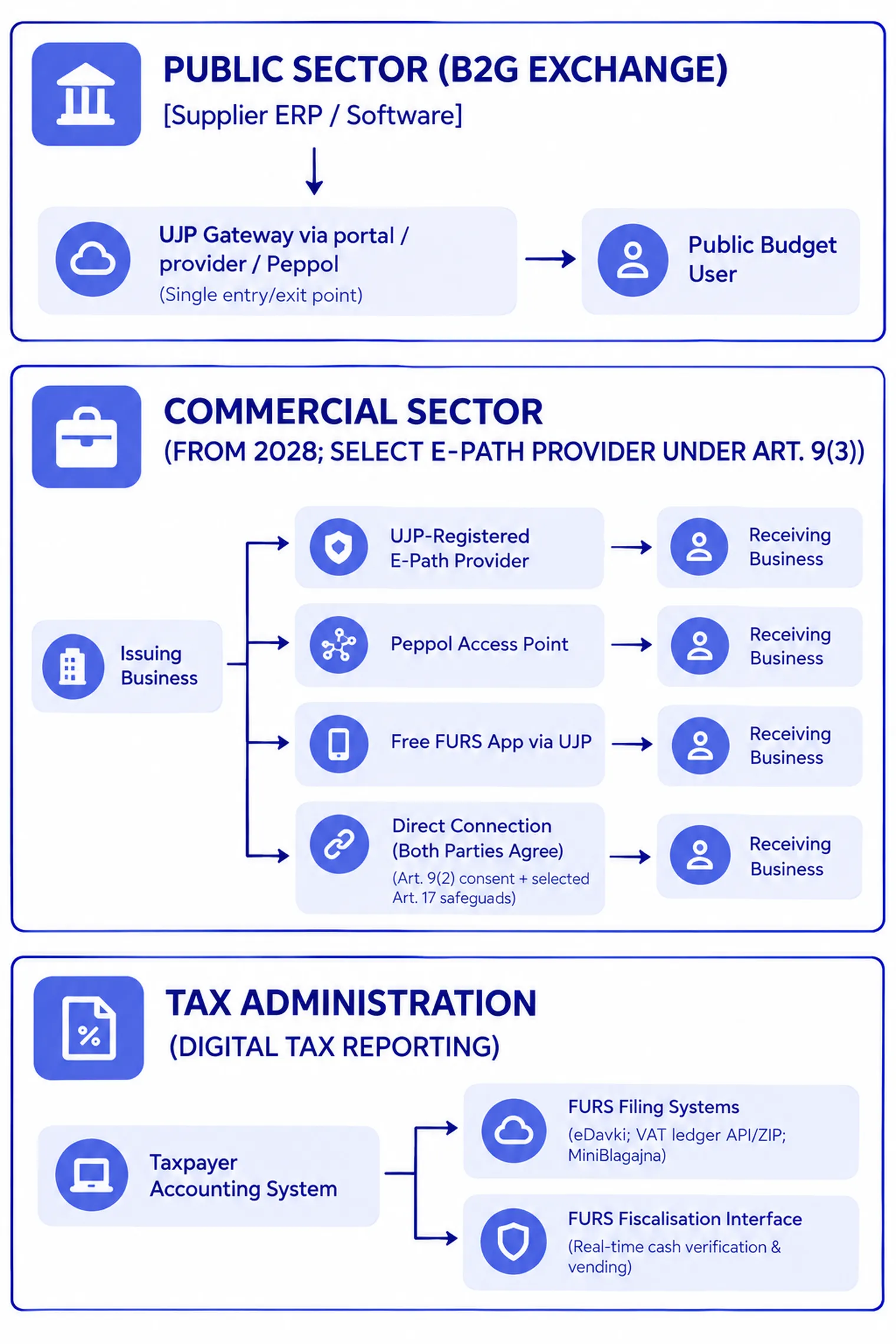
In the public sector, UJP functions as a centralised hub, routing structured XML invoices between commercial suppliers and public authorities. In contrast, future B2B e-invoicing under ZIERDED operates as a decentralised exchange model. Businesses may use registered e-path providers, Peppol or mutually agreed direct connections, while each business must select an e-path provider under Article 9(3). For eligible low-volume issuers, the free FURS application will exchange invoices through UJP. VAT ledgers can reach FURS through eDavki uploads, approved web services or MiniBlagajna; fiscal data use separate interfaces, without requiring government clearance of commercial B2B invoices prior to delivery.
What are the penalties for e-invoicing and VAT non-compliance in Slovenia?
Statutory penalties are established across different legislative acts, distinguishing public procurement violations from future commercial e-invoicing breaches.
Offence category | Responsible entity | Statutory fine range | Legal basis |
|---|---|---|---|
Unlawful refusal to receive or process a compliant public-sector e-invoice | Contracting entity covered by ZPJS Article 48 | €2,500 to €10,000 | |
Same public-sector reception offence | Responsible officer of contracting authority | €1,000 to €4,100 | |
Failure to exchange B2B e-invoices, or breach of specified channels/provider duties (generally from 2028) | Legal person | €1,000 to €3,000 | |
Same covered B2B exchange or channel offence (generally from 2028) | Sole trader or registered business individual | €500 to €1,500 | |
Same covered B2B exchange or channel offence (generally from 2028) | Responsible person of business entity | €100 to €500 | |
Breach of consumer consent or delivery rules (from 2028) | Legal person | €500 to €1,500 | |
Same consumer offence (from 2028) | Sole trader or registered business individual | €100 to €500 | |
Same consumer offence (from 2028) | Responsible person of business entity | €50 to €250 |
ZIERDED applies its provider chapter from 1 April 2027 and most other provisions, including B2B exchange and consumer duties, from 1 January 2028. The penalties listed above relate only to the specified offences and relevant commencement dates. Other VAT and cash-fiscalisation penalties are governed separately by ZDDV-1 and ZDavPR.
Regarding commercial rights, ZPJS Article 48(5) preserves a buyer's right to raise legitimate contractual disputes regarding underlying supplies. Article 48(5) preserves substantive grounds to reject or dispute an invoice. Payment, default interest and the effect of technical errors are separate contract and payment-law questions not established by that provision.
How can businesses prepare for Slovenia's e-invoicing rules?
Businesses operating in Slovenia must manage current public-sector and reporting mandates while establishing systems for upcoming commercial obligations.
Assess supplier and contracting status: Identify whether your business supplies public-sector budget users. For covered supplies, verify an approved route to UJP (portal, contracted provider or Peppol), a supported structured format and whether an Article 50 exclusion applies.
Implement electronic VAT ledgers: Ensure enterprise resource planning (ERP) software exports detailed output and deduction VAT ledgers matching DDV-O return periods. If a filed DDV-O return conflicts with ledgers already submitted, correct those ledgers immediately and at the latest within three working days after filing the return.
Audit cash and payment card systems: Verify that retail and point-of-sale systems maintain real-time fiscalisation connectivity to FURS. If operating automated vending machines, ensure telemetry or software updates report sales data electronically under the 2026 rules.
Prepare ERP systems for structured B2B standards: Review financial software to ensure it can generate and process structured syntaxes, including e-SLOG 2.0 and European standard UBL/CII formats, before mandatory B2B exchange applies on 1 January 2028.
Evaluate transmission routes: Select at least one e-path provider as required by Article 9(3), then choose a permitted transmission channel. Consider Peppol, mutually agreed direct interfaces and the free FURS application for eligible low-volume businesses.
Establish compliant archiving workflows: Configure electronic document management systems to retain legally required invoice data and evidence of authenticity, integrity and readability for the applicable VAT and accounting periods, regardless of the chosen compliant archiving technology.
What are the key compliance takeaways for businesses in Slovenia?
Slovenia enforces an active structured e-invoicing mandate for public procurement and detailed electronic tax reporting for registered businesses. For covered B2G supplies, domestic suppliers must send compliant structured e-invoices into UJP through an approved route, subject to the statutory Article 50 exclusions.
Businesses must submit electronic output and input VAT ledgers under Article 85.b of ZDDV-1 and file periodic DDV-O returns. Where ZDavPR applies, cash and card invoices require fiscal verification subject to statutory exclusions and fallback rules. Vending-machine sales reporting applies only to operators and transactions covered by ZDavPR-C.
For the private commercial sector, structured e-invoicing between businesses becomes mandatory on 1 January 2028 under the enacted ZIERDED statute. Finance and technology teams should use the intervening period to configure structured XML capabilities, select an e-path provider and compliant transmission channels, including the free FURS application where eligible, and ensure alignment across invoicing and tax reporting workflows.
FAQ
No. Domestic B2B electronic invoicing is not mandatory during 2026. However, Parliament has enacted ZIERDED, which requires covered businesses to exchange structured electronic invoices for mutual supplies performed in Slovenia starting 1 January 2028.