
This article was updated on 8 october 2026 to reflect Germany's mandatory B2B e-invoicing framework under the Growth Opportunities Act (Wachstumschancengesetz), including the phased implementation timetable through 2028, the legal definition of electronic invoices, EN 16931 requirements, accepted invoice formats and the latest guidance on Germany's digital VAT compliance framework.
Germany has overhauled its value-added tax framework by extending mandatory electronic invoicing - building upon Business-to-Government (B2G) e-invoicing, which has been in place for several years - to domestic Business-to-Business (B2B) transactions. Enacted under the Growth Opportunities Act (Wachstumschancengesetz), the reform legally redefines electronic invoices, abandoning plain PDFs in favour of structured semantic formats that comply with European standard EN 16931.
The nationwide B2B roll-out follows a phased timetable. Since 1 January 2025, all businesses established in Germany must be technically equipped to receive structured electronic invoices without requiring buyer consent. Mandatory issuance follows in progressive waves: larger enterprises with an annual turnover exceeding €800,000 must issue compliant e-invoices from 1 January 2027, before the obligation extends to all remaining domestic enterprises on 1 January 2028.
While Germany does not currently operate a central pre-clearance model, the Ministry of Finance is actively preparing a decentralised electronic reporting system (elektronisches Meldesystem) to capture transactional data in real time, serving as Germany's national bridge to the mandatory European digital reporting rules scheduled under ViDA for 2030.
Introduction & digital tax strategy
Germany is undergoing one of the most substantial transformations of its commercial billing and tax compliance landscape in modern history. The federal government has moved to replace paper and unstructured digital formats with machine-readable, structured electronic invoices across all domestic commercial sectors.
The primary driver behind this digital shift is twofold: closing the persistent national VAT-gap and modernising business-to-business processes across the continent's largest economy. Estimates from the European Commission consistently highlight billions of euros lost annually to VAT fraud, carousel schemes, and administrative calculation errors. By transitioning transactions into structured digital records, the German tax administration (Finanzverwaltung) establishes the structural baseline necessary to verify tax deductions automatically.
Germany's strategy diverges from the centralised clearance models pioneered in Latin America and southern Europe. Instead of requiring companies to route every invoice through a government validation portal before dispatch, the German legislature has prioritised a decentralised model. Businesses exchange structured documents directly or through private networks, preserving operational speed while establishing standard data syntax.
This B2B transformation does not start from scratch; it builds upon years of mandatory B2G e-invoicing. The public sector rollout introduced distinct German specifics, such as the creation of dedicated invoice submission portals (originally split between the ZRE and OZG-RE, now consolidated into the OZG-RE), the introduction of the mandatory Leitweg-ID for routing within public administration, and the establishment of the national XRechnung CIUS alongside accepted ZUGFeRD profiles. While B2G introduced these rigorous public-sector routing and formatting requirements (including managing Leitweg-IDs that are not stored in a single official directory), the B2B mandate broadens structured invoicing across the entire commercial economy.
Crucially, unlike centralised clearance models that dictate rigid transmission channels or government portals, Germany's B2B framework imposes no restrictions or limitations on the transmission method. Businesses are entirely free to exchange invoices via standard email, secure SFTP, or networks like Peppol. The sole legal requirement focuses strictly on the format: invoices must be structured and fully compatible with European standard EN 16931. This format-driven, channel-agnostic approach, combined with the phased rollout beginning with mandatory reception in January 2025 followed by progressive issuing obligations, allows companies flexibility in how they upgrade their existing billing infrastructure.
This regulatory framework acts as the indispensable first phase of a broader two-tier project. Structured electronic invoicing establishes the standardised business records that will subsequently feed into a future, nationwide electronic transaction reporting platform (elektronisches Meldesystem). Through this staged implementation, Germany balances immediate administrative feasibility for small and medium-sized enterprises with long-term digital tax oversight.
Historical evolution & EU/global context
Germany's digital compliance journey began in the public procurement sector before reaching private-sector commerce. Understanding how these earlier initiatives unfolded illustrates why the current B2B mandate is structured around European norms rather than proprietary domestic interfaces.
The public sector foundation (B2G)
The origin of German electronic invoicing stems from European Union Directive 2014/55/EU (the so-called European legislation on eInvoicing), which mandated that public contracting authorities across all EU member states accept electronic invoices compliant with a common European standard. Germany transposed this directive through the E-Government Act (E-Government-Gesetz) and the Federal E-Invoicing Ordinance (E-Rechnungsverordnung).
Because Germany operates as a federal republic with 16 autonomous states (Bundesländer), the public sector rollout became structurally fragmented. At the federal level, mandatory electronic invoicing for suppliers to the federal administration (Bund) took effect on 27 November 2020, initially utilising two federal gateways: the Zentrale Rechnungseingangsplattform des Bundes (ZRE) and the Onlinezugangsgesetz-konforme Rechnungseingangsplattform (OZG-RE), which have since been consolidated into a single unified platform under the OZG-RE. Concurrently, the states developed their own distinct procurement portals and varying submission thresholds, with several states adopting Peppol infrastructure while others retained web upload portals.
To bridge this operational divergence, the Coordination Agency for IT Standards (Koordinierungsstelle für IT-Standards - KoSIT) established XRechnung. This purely structured XML format served as the official German Core Invoice Usage Specification (CIUS) under European standard EN 16931, proving that automated public sector billing was functionally viable at scale.
The pivot to mandatory domestic B2B
While public procurement demonstrated the strength of structured data, private enterprise transactions remained heavily reliant on unstructured PDF files sent by email. To modernise this private sector exchange, the German Federal Ministry of Finance requested a formal derogation from Articles 218 and 232 of the EU VAT Directive (Directive 2006/112/EC) in November 2022.
The European Commission granted this Council Implementing Decision on 25 July 2023 (Council Implementing Decision (EU) 2023/1551), authorising Germany to apply special measures derogating from the VAT Directive:
It permitted Germany to eliminate the long-standing legal requirement that the invoice recipient must consent to receiving an electronic invoice.
It allowed Germany to accept only invoices issued in a structured electronic format as valid tax invoices for domestic B2B transactions.
Armed with this EU authorisation, the German legislature drafted the Growth Opportunities Act (Wachstumschancengesetz). Following parliamentary debate between the Bundestag and the Bundesrat, the final compromise legislation cleared the Bundesrat on 22 March 2024 and was promulgated in the Federal Law Gazette (Bundesgesetzblatt) on 27 March 2024.
Alignment with the EU ViDA package
Germany's domestic legal reform directly anticipates the European Commission's VAT in the Digital Age (ViDA) initiative. ViDA aims to standardise digital reporting requirements across the European single market, establishing mandatory e-invoicing for intra-Community supplies and introducing near real-time digital transaction reporting by 1 July 2030.
By adopting European standard EN 16931 as its national baseline, Germany ensures that domestic accounting software, Enterprise Resource Planning (ERP) systems, and transmission networks will interoperate smoothly with cross-border European reporting requirements when ViDA enters into force.
Complete compliance timeline
While the primary focus of the current German e-invoicing framework is the B2B mandate, the legal foundation began with public procurement (B2G), where public authorities were gradually mandated to accept structured e-invoices from contractors.
The German B2B mandate is structured around a phased implementation schedule spanning 2025 to 2028, ensuring that businesses have sufficient operational leeway to upgrade systems.
Date | Legal milestone & compliance obligation | In-scope business sector |
April 2017 | Federal E-Invoicing Ordinance (ERechV) promulgated. Establishes the legal framework for electronic invoicing in federal public procurement pursuant to EU Directive 2014/55/EU. | Federal public administration and government contractors. |
27 November 2018 | Federal B2G reception obligation. Federal authorities legally required to receive and process electronic invoices. | Suppliers to federal public authorities (Bund). |
27 November 2019 | Sub-central & sectoral B2G reception obligation. Obligation extends to sub-central federal authorities, sectoral contractors, and concessionary bodies. | Contractors supplying sub-central public entities. |
27 November 2020 | Federal B2G issuance obligation. Complete rollout taking effect for suppliers to issue electronic invoices to federal public bodies (with exemptions for direct orders up to €1,000). | All contractors supplying the federal public sector. |
25 July 2023 | European Council grants Germany a derogation from Articles 218 and 232 of Directive 2006/112/EC via Council Implementing Decision (EU) 2023/1551. | European Union / Federal Republic of Germany. |
27 March 2024 | Promulgation of the Growth Opportunities Act (Wachstumschancengesetz) in the Federal Law Gazette (BGBl. I 2024, No. 108). | All commercial businesses established in Germany. |
15 October 2024 /15 October 2025 | BMF administrative guidance and updates. The Federal Ministry of Finance (BMF) issues its initial administrative circular in October 2024, followed by its definitive, authoritative updated guidance (BMF-Schreiben zur Einführung der obligatorischen elektronischen Rechnung bei Umsätzen zwischen inländischen Unternehmern ab dem 1. Januar 2025, ref. III C 2 - S 7287-a/23/10001 :007) on 15 October 2025, detailing final procedural application rules and compliance standards. | German tax administration, taxpayers, software developers. |
1 January 2025 | Mandatory reception capability enters into force. Every German business must be capable of receiving and processing structured e-invoices compliant with EN 16931. Recipient consent for structured e-invoices is legally eliminated. | All domestic taxable persons (inländische Unternehmer) carrying out B2B transactions. |
19 September 2025 | ZRE and OZG-RE platform consolidation. Federal invoice submission portals consolidated into a single unified platform under the OZG-RE. | Suppliers interacting with federal public administration. |
Until 31 December 2026 | Transitional issuance window. Issuers may continue providing paper invoices or unstructured electronic invoices (such as standard PDFs), subject to mutual recipient agreement. | All domestic businesses issuing domestic B2B invoices. |
1 January 2027 | Mandatory issuance for large enterprises. Businesses with a total turnover in calendar year 2026 exceeding €800,000 must issue compliant structured electronic invoices for domestic B2B supplies. Traditional EDI arrangements remain permitted under transitional criteria. | Businesses with previous-year total turnover > €800,000. |
1 January 2028 | Full nationwide mandatory issuance. All businesses established in Germany, irrespective of turnover, must issue compliant structured electronic invoices for domestic B2B transactions. End of general paper and PDF transitional allowances. | All domestic taxable enterprises (including SMBs and micro-enterprises). |
1 January 2028 | Strict EDI compliance. Electronic Data Interchange (EDI) invoices may continue only if they comply with the statutory definition of an e‑invoice. In practical terms, the format must either comply with EN 16931 or be interoperable with it such that the legally required invoice information can be correctly and completely extracted. | All EDI-dependent enterprises and industrial networks. |
1 July 2030 (Projected) | EU ViDA cross-border digital reporting requirements. Introduction of harmonised Digital Reporting Requirements (DRR) for intra-EU B2B transactions. Expected deployment of Germany's connected national transaction reporting system. | All cross-border EU traders and domestic taxable persons. |
Legal framework
The legal architecture underpinning Germany's electronic invoicing regime is codified directly within primary tax legislation and administrative law:
1. The federal framework: E-Government Act (EGovG) and E-Invoicing Ordinance (ERechV)
Governing federal public-sector procurement (B2G), the E-Government Act (E-Government-Gesetz, EGovG) and the Federal E-Invoicing Ordinance (E-Rechnungsverordnung, ERechV), enacted pursuant to EU Directive 2014/55/EU, mandate that suppliers to federal contracting authorities must issue electronic invoices and must, in principle, use the XRechnung standard for electronic invoicing. Alternatively, any other data exchange standard may be used provided it fully complies with the European standard for electronic invoicing (EN 16931). Specific exemptions to the e-invoicing obligation apply, such as for direct orders under €1,000.
These federal rules operate in parallel with the UStG B2B rules. Furthermore, because procurement rules can vary at the state and local levels, B2G requirements may also arise under Länder- (state) and municipality-level implementing rules, which can differ from the federal ERechV framework and involve their own portals and procedures.
2. Legislative basis for B2B: The Growth Opportunities Act (Wachstumschancengesetz)
Adopted by the Bundestag on 17 November 2023 and passed by the Bundesrat on 22 March 2024, this omnibus economic bill serves as the legislative vehicle that introduced Germany’s mandatory domestic B2B e-invoicing. It was officially published in the Federal Law Gazette on 27 March 2024 (Bundesgesetzblatt, BGBl. 2024 I Nr. 108 vom 27.03.2024) and amended the VAT invoicing provisions in the Umsatzsteuergesetz (UStG), with the revised framework effective from 1 January 2025.
3. The German Value Added Tax Act (Umsatzsteuergesetz - §§ 14 and 27(38) UStG)
The Wachstumschancengesetz directly amended Section 14 and Section 27 of the German VAT Act (Umsatzsteuergesetz, UStG):
Section 14(1), sixth sentence, UStG (definition of an electronic invoice): The law establishes a statutory distinction between an “electronic invoice” (elektronische Rechnung) and an “other invoice” (sonstige Rechnung). An invoice is recognised as an electronic invoice only if it is issued, transmitted, and received in a structured electronic format that enables electronic processing and either complies with the European standard EN 16931, or, where mutually agreed between parties, enables the correct and complete extraction of the required EN 16931 data elements. All paper invoices, image files, and ordinary PDFs are classified legally as “other invoices” rather than e‑invoices for VAT purposes.
Section 14(2) UStG (mandatory domestic B2B issuance requirement): Sets out the statutory obligation for taxable persons established in Germany to issue a structured electronic invoice for supplies carried out to other domestic taxable persons for their businesses.
Section 27(38) UStG (transitional issuance provisions): Establishes the exact legal parameters for the phased implementation of the issuing obligation: businesses with 2026 total turnover exceeding €800,000 must issue e‑invoices from 1 January 2027, with the general domestic B2B issuing obligation applying from 1 January 2028. It also provides temporary relief for paper invoices, PDFs, and existing EDI arrangements through the end of 2027, subject to its conditions.
4. BMF guidance and GoBD
The Federal Ministry of Finance (BMF) provides the key administrative interpretation through circulars (BMF-Schreiben), regularly updated FAQs, and the German standard for digital record-keeping and audit (Grundsätze zur ordnungsmäßigen Führung und Aufbewahrung von Büchern, Aufzeichnungen und Unterlagen in elektronischer Form sowie zum Datenzugriff, or short, GoBD).
Notably, on 15 October 2024, the Federal Ministry of Finance issued its initial procedural circular (published in the Federal Tax Gazette Bundessteuerblatt BStBl I 2024, p. 1320), followed by its definitive, authoritative administrative guidance (BMF-Schreiben zur Einführung der obligatorischen elektronischen Rechnung bei Umsätzen zwischen inländischen Unternehmern ab dem 1. Januar 2025, ref. III C 2 - S 7287-a/23/10001 :007), updating the implementation guidance on mandatory e‑invoicing.
The BMF’s regularly updated e‑invoice FAQ, which clarifies scope, receipt/issue obligations, formats, transmission channels, exemptions, and the relationship between UStG and ERechV.
The GoBD rules (the German standard for digital record-keeping and audit), which govern orderly electronic recordkeeping, retention, auditability, and data access. These are especially relevant to retaining the authoritative structured invoice data, not merely a human‑readable rendering.
The guidance addresses matters such as hybrid formats including ZUGFeRD, use of different delivery channels, small-value invoices, tickets, exempt supplies, corrections, validation, and archiving.
5. European Standard EN 16931 and Directive 2014/55/EU
EN 16931 is the European semantic data model defined under European Directive 2014/55/EU and maintained by the European Committee for Standardisation (CEN). It is the central technical legal benchmark under Section 14(1) sentence 6 UStG and the foundation for accepted structured formats such as XRechnung, ZUGFeRD/Factur‑X (in qualifying profiles), and Peppol BIS Billing 3.0.
Regulatory authorities, operational infrastructure, and other key actors
Several public authorities and standardisation bodies govern, administer, and maintain the German e-invoicing ecosystem:
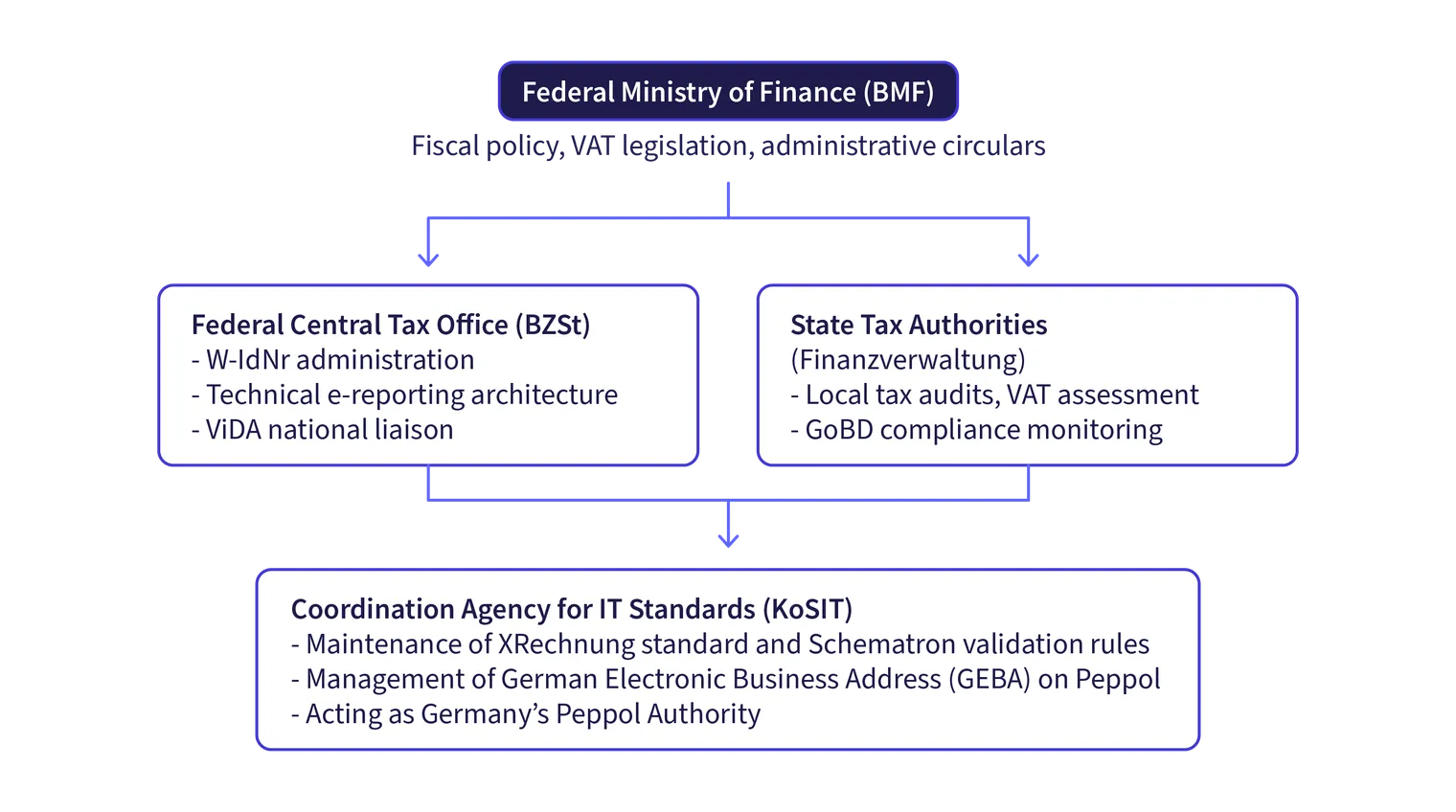
Federal Ministry of Finance (Bundesministerium der Finanzen - BMF)
The BMF (Bundesministerium der Finanzen, or Federal Ministry of Finance) holds supreme administrative responsibility for the federal tax code. It designs VAT policy, drafts national legislation, and issues binding administrative decrees that guide how the 16 federal state tax offices (Länder) apply the German VAT Act. The BMF also co-led the consolidation of federal invoice-receipt platforms onto OZG‑RE.
State tax Authorities (Finanzverwaltung der Länder)
While federal ministries set VAT law, tax collection and audit enforcement in Germany are principally carried out at the state level. Local tax offices (Finanzämter) assess compliance in audits, including verifying whether invoices meet statutory VAT deductibility criteria.
Federal Central Tax Office (Bundeszentralamt für Steuern - BZSt)
The BZSt (Bundeszentralamt für Steuern, or Federal Central Tax Office), a federal authority within the BMF’s portfolio, oversees specific central federal tax-administration functions, including cross-border information exchange and VAT-related functions, and assigns the national Business Identification Number (Wirtschafts-Identifikationsnummer - W-IdNr).
The BZSt may be assigned an operational role in operating the upcoming national digital reporting architecture; however, the final legal and technical design has not yet been enacted.
Coordination Office for IT Standards (Koordinierungsstelle für IT-Standards - KoSIT)
Operating on behalf of the IT Planning Council (IT-Planungsrat), KoSIT (Koordinierungsstelle für IT-Standards, the Coordination Office for IT Standards) maintains the semantic specifications of XRechnung. It develops and publishes regular updates to the national Schematron business rules, ensuring that German e-invoice schemas remain aligned with EN 16931 updates.
KoSIT also operates the German Peppol Authority. In that role, it governs Germany’s participation in the Peppol network, including the onboarding and supervision of German Peppol Access Points and Service Metadata Publishers, and implementation of the relevant national Peppol specifications and policy requirements. KoSIT also maintains the GEBA (German Electronic Business Address) specification, a W‑IdNr.-based addressing scheme designed for use as a Peppol participant identifier. Individual participant registrations and endpoint records are managed by Peppol service providers/SMPs, while the underlying W‑IdNr. is allocated by the BZSt.
Forum for Electronic Invoicing Germany (Forum elektronische Rechnung Deutschland – FeRD)
FeRD (Forum elektronische Rechnung Deutschland, or Forum for Electronic Invoicing Germany) is the German industry forum that develops and maintains the ZUGFeRD specification - the German hybrid PDF/A‑3 plus structured XML invoice format - jointly aligned with the French Factur‑X format through cooperation with France’s FNFE‑MPE. It publishes the ZUGFeRD specifications, schemas, profiles, and supporting implementation material.
Federal invoice submission portals: OZG‑RE and ZRE
OZG‑konforme Rechnungseingangsplattform (OZG‑RE) is the active central federal invoice-receipt platform. Following the federal consolidation on 19 September 2025, it became the single platform for receipt of electronic invoices across the federal administration; ZRE was decommissioned for invoice receipt and shut down at the end of 2025.
The earlier ZRE had been operated by ITZBund, while OZG‑RE was operated by the Procurement Office of the Federal Ministry of the Interior (Beschaffungsamt des BMI, BeschA). The consolidation was jointly designated by the BMI and BMF.
Leitweg-ID allocation
Leitweg‑IDs, routing IDs used specifically in German B2G e-invoicing, are assigned decentrally by federal and state issuing bodies. Suppliers normally obtain the identifier directly from the contracting authority or invoice recipient. There is no single nationwide operational issuer or comprehensive public directory of all Leitweg‑IDs.
KoSIT maintains the Leitweg‑ID specification as part of the XRechnung standard, including its structure and validation rules, but does not allocate individual Leitweg‑IDs.
The Leitweg‑ID is normally populated in BT‑10 (Buyer reference) in an XRechnung. It enables routing within public-sector invoice-receipt systems and is relevant to B2G invoicing; it is not a general requirement for domestic B2B e‑invoicing.
Scope of the mandate
The German e-invoicing framework applies across both public procurement (B2G) and commercial transactions (B2B), governed by distinct statutory baselines and timelines.
Public procurement (B2G scope)
The B2G e-invoicing mandate applies to all suppliers and contractors providing goods or services to public contracting authorities:
In-scope entities
Any commercial enterprise, small business, or contractor supplying federal, state (Länder), or municipal public administration bodies.
In-scope transactions
All public-sector contracts exceeding statutory thresholds (such as federal direct orders above €1,000), requiring structured e-invoices compliant with EN 16931 (primarily XRechnung or accepted ZUGFeRD profiles).
Exemptions
Specific procurement exceptions under the Federal E-Invoicing Ordinance (ERechV) and corresponding state-level ordinances, including classified contracts or low-value direct orders.
Commercial transactions (B2B scope)
1. In-scope entities
The B2B mandate applies to all taxable persons established in Germany for VAT purposes. Under Section 14(2) UStG, an enterprise is established in Germany if it has:
Its registered corporate headquarters (Sitz) in Germany; or
Its central management (Geschäftsleitung) located in Germany; or
A domestic permanent establishment (Betriebsstätte) that participates directly in the underlying transaction.
If an enterprise possesses only a purely formal VAT registration in Germany without a permanent commercial establishment, it is considered non-established and remains outside the mandatory domestic issuance rules.
2. In-scope transactions
Mandatory e-invoicing strictly governs taxable and tax-exempt domestic Business-to-Business (B2B) supplies of goods and services where:
Both the supplier and the customer are established in Germany; and
The transaction has its legal place of supply within Germany; and
The supply is not subject to specific statutory exclusions.
3. Excluded and exempted transactions
The legislation explicitly carves out several categories from the mandatory structured e-invoicing requirement:
Business-to-Consumer (B2C) sales: Transactions involving non-taxable private individuals do not require structured e-invoices.
Cross-border supplies: Both intra-Community supplies and export transactions to third countries remain outside the domestic mandate. These continue to follow existing invoicing arrangements until the EU ViDA regulations take effect in 2030.
Small-value invoices (Kleinbetragsrechnungen): Invoices whose total gross amount does not exceed €250 (regulated under Section 33 of the VAT Implementation Ordinance - Umsatzsteuer-Durchführungsverordnung / UStDV) are exempt from mandatory structured e-invoicing. They may continue to be issued as paper or standard PDF documents.
Passenger transport tickets: Travel tickets issued in accordance with Section 34 UStDV may continue to be provided in conventional paper or PDF formats.
Specific VAT-exempt services: Supplies that are tax-exempt under Section 4 Nos. 8 to 29 UStG (such as certain financial, banking, insurance, and medical services) are generally exempt from the statutory obligation to issue invoices under Section 14(2) UStG. Consequently, they do not trigger mandatory structured e-invoicing unless an invoice is voluntarily issued.
The status of small businesses (Kleinunternehmer)
Businesses applying the small-business regime under § 19 UStG must be technically capable of receiving structured e‑invoices from 1 January 2025. However, invoices issued by such Kleinunternehmer are exempt from the domestic B2B obligation to issue structured e‑invoices under § 34a UStDV. They may continue to issue “other invoices”, including paper and PDF invoices, even after 1 January 2028. Their invoices will continue to display no stated VAT amount pursuant to Section 19 UStG.
Note that if a business ceases to qualify for the § 19 small-business regime, it would then become subject to the normal issuing rules for in-scope domestic B2B supplies.
Further note that the issuer exemption in § 34a UStDV applies to the domestic B2B VAT e‑invoicing obligation. It does not, by itself, exempt a Kleinunternehmer from separate B2G e‑invoicing requirements imposed under federal, state or municipal procurement rules.
Transaction classification | Mandatory structured e-invoice required? | Current legal framework & exceptions |
Domestic B2B supplies | Yes, generally | Mandatory reception active since 1 January 2025; mandatory issuance phased across 2027-2028. |
Domestic B2G supplies | Yes, generally | Governed by federal and state (Länder) public procurement rules and ordinances (E-Rech-VO); XRechnung is the principal federal standard, with qualifying EN 16931-compliant alternatives accepted. |
Domestic B2C supplies | No | Excluded from the B2B e-invoicing mandate. Note: Under the Federal Cabinet-approved draft law, businesses with annual turnover over €100,000 must replace open cash boxes with electronic registers from 2028, and paper receipts for small transactions will be replaced by digital receipts. |
Cross-border B2B (within the EU, i.e. intra-Community) | No (domestic mandate) | Excluded from Germany’s domestic B2B mandate; digital reporting and structured e‑invoicing requirements will become mandatory under EU ViDA on 1 July 2030 for relevant intra‑EU B2B transactions. |
Third-country export supplies | No (domestic mandate) | Not within the domestic B2B scope; governed by standard commercial export documentation. |
Small-value invoices not exceeding €250 | No | Explicitly exempt under Section 33 UStDV (Kleinbetragsrechnungen). |
Passenger transport tickets | No | Explicitly exempt under Section 34 UStDV (Fahrausweise). |
Tax-exempt supplies | No (where covered by the statutory exception) | The domestic mandate does not apply to invoices for tax-exempt supplies under Section 4 nos. 8–29 UStG. |
Invoices issued by Kleinunternehmer under Section 19 UStG | No | They must be capable of receiving e‑invoices from 1 January 2025, but are permanently exempt from the obligation to issue structured e‑invoices under Section 34a UStDV. |
Germany's e-invoicing requirements
Germany’s e‑invoicing landscape combines two related but separate regimes:
Domestic B2B invoicing: VAT-law rules in the German VAT Act (Umsatzsteuergesetz, UStG), supported by BMF guidance.
B2G invoicing: Federal and Länder public-procurement rules. At the federal level, the key framework is the E‑Government Act and the Federal E‑Invoicing Ordinance (ERechV). Requirements can differ for Länder and municipal authorities.
The transition to structured electronic invoicing alters how billing data is created, exchanged, validated, and preserved under German law.
Redefining the electronic invoice
For B2G transactions, federal authorities principally accept XRechnung and qualifying EN 16931-compliant alternatives; the public authority’s applicable federal, Land, or municipal rules and submission channel must be followed.
On the other hand, for the domestic B2B regime, under amended Section 14(1) UStG, an electronic invoice is no longer defined by its transmission medium (such as an email attachment). The legal definition rests entirely on its structured data and ability to be processed electronically.
An e-invoice must be issued, transmitted, and received in a structured electronic format that enables electronic processing and either:
Complies with the European standard EN 16931 and its permitted syntaxes; or
is an alternative format agreed between the parties that is completely interoperable with EN 16931, enabling the automatic and electronic extraction of all statutory VAT information required under the German VAT Act.
Any document not meeting these requirements is legally categorised as an “other invoice” (sonstige Rechnung). A standard PDF, a scanned document, a Word file, or a paper printout all constitute “other invoices”, rather than e‑invoices under the B2B VAT definition.
For an in-scope domestic B2B supply, an “other invoice” will no longer satisfy the general e‑invoice issuance requirement once the relevant transition period has ended, making it legally equivalent to failing to issue an invoice.
This remains subject to statutory exemptions - for example, for small-value invoices, certain tax-exempt supplies and invoices issued by Kleinunternehmer - and does not replace B2G-specific requirements.
Transmission and receipt
For federal B2G transactions, invoices must be submitted through the channels accepted by the federal invoice-receipt platform, currently OZG‑RE. Available methods include web submission, manual upload, Peppol and email, but the applicable recipient requirements, including - crucially - the Leitweg-ID, must be observed. Other public authorities may use different Länder- or local portals and rules.
For B2B invoice exchange, the revised BMF circular of 15 October 2025 confirms flexible transmission channels for the B2B VAT regime:
Email: The transmission of a structured XML or hybrid file via standard email satisfies the legal requirement. A normal email inbox is sufficient to meet the mandatory reception rule in force since 1 January 2025; a dedicated mailbox, while possibly recommended for operational ease, is not legally required. A business cannot refuse an e-invoice simply because it arrived by standard email.
Platforms & portals: By agreement, businesses may use web portals, cloud storage download links, shared storage, APIs, EDI, or comparable channels to exchange documents.
Peppol network: While Peppol is not legally mandated for private-sector B2B transactions, it is a permitted interoperability delivery network.
Elimination of buyer consent
While buyer consent was eliminated in the public sector (B2G) years ago through mandatory reception rules introduced between 2018 and 2020, the Growth Opportunities Act now extends this principle to commercial trade.
For domestic B2B invoices, prior to 2025, Section 14(1) UStG required the invoice recipient to agree to receiving an electronic invoice. Under the amended law, buyer consent is abolished for all compliant structured e-invoices.
An enterprise established in Germany must accept a structured e-invoice provided by a supplier. If a buyer refuses to accept a compliant structured file, the supplier is legally deemed to have fulfilled its invoicing obligation, leaving the buyer unable to demand a paper substitute.
Consent remains relevant for an “other” electronic invoice, such as a standard PDF, during periods or situations in which use of an “other invoice” remains permitted.
Digital archiving and GoBD compliance
Electronic invoices must be retained in accordance with the Principles for the Proper Maintenance and Retention of Books, Records, and Documents in Electronic Form (Grundsätze zur ordnungsmäßigen Führung und Aufbewahrung von Büchern, Aufzeichnungen und Unterlagen in elektronischer Form sowie zum Datenzugriff - GoBD) and the VAT retention rules:
Original structured data preservation: The legally binding record is the structured XML dataset. Storing a printed paper copy or an extracted visual PDF rendering does not satisfy German tax retention rules. The underlying XML file must be preserved digitally in its native form.
Integrity and immutability: Archival storage must guarantee that data cannot be altered, overwritten, or deleted undetected throughout the statutory 8-year retention period (calculated from the end of the calendar year in which the invoice was issued). This period was reduced from ten years for records whose retention period had not expired on 31 December 2024.
Machine readability & indexing: The records must remain accessible and readable by tax auditors at all times, supporting full text indexing and automatic data access (Datenzugriff under the Z1, Z2, and Z3 audit methods).
Hybrid format archiving (ZUGFeRD): For hybrid invoices, the original hybrid PDF/A‑3 file with its embedded XML must be archived in the form received as a single unit. For VAT purposes, the structured data takes strict legal precedence in the event of discrepancies where the visual and structured representations conflict, but the complete received document remains the archival record.
Germany's e-reporting roadmap & ViDA alignment
A frequent source of market confusion is the distinction between Germany's active domestic B2B e-invoicing mandate and a future electronic transaction reporting system (elektronisches Meldesystem). Germany has introduced structured e‑invoicing in advance of, but separately from, any domestic real-time digital reporting regime.
Current reporting framework
Germany currently operates no real-time invoice clearance or domestic transaction reporting platform for B2B invoices. Suppliers do not need to submit domestic B2B invoices to the tax authorities for clearance prior to sending them to customers, nor are they required to upload domestic invoice extracts to a central tax portal at the time of issuance.
VAT compliance continues to operate via established periodic filing procedures:
Advance VAT returns (Umsatzsteuer-Voranmeldungen), submitted monthly or quarterly via the ELSTER portal.
Annual VAT returns (Umsatzsteuer-Jahreserklärungen).
Recapitulative statements (Zusammenfassende Meldungen - ZM) for relevant cross-border intra-Community transactions, submitted to the BZSt.
Future national reporting system
Structured electronic invoicing was deliberately introduced first to lay the groundwork for a future electronic VAT reporting system. However, the German government has not yet enacted the legislation for that system or announced its final technical model, operating authority, reporting flow, or domestic start date.
The BMF and other stakeholders are considering how invoice and transaction data could be reported digitally to the tax administration. Potential approaches may include decentralised reporting through certified service providers or e‑invoicing platforms, but Peppol, a five-corner model, and a specific service-provider model have not been officially selected or mandated.
ViDA alignment
Under the EU VAT in the Digital Age (ViDA) package, digital reporting requirements and structured e‑invoicing for relevant cross-border intra‑EU B2B transactions apply from 1 July 2030. Germany will need to implement the required cross-border reporting capability by that date.
A domestic German reporting system may be introduced separately, but its timing remains unconfirmed. If Germany has a domestic digital reporting system in place, it must be aligned with the EU ViDA framework by 1 January 2035.
Technical architecture & transmission channels
Unlike centralised models that mandate a single government platform, Germany uses a decentralised technical model:
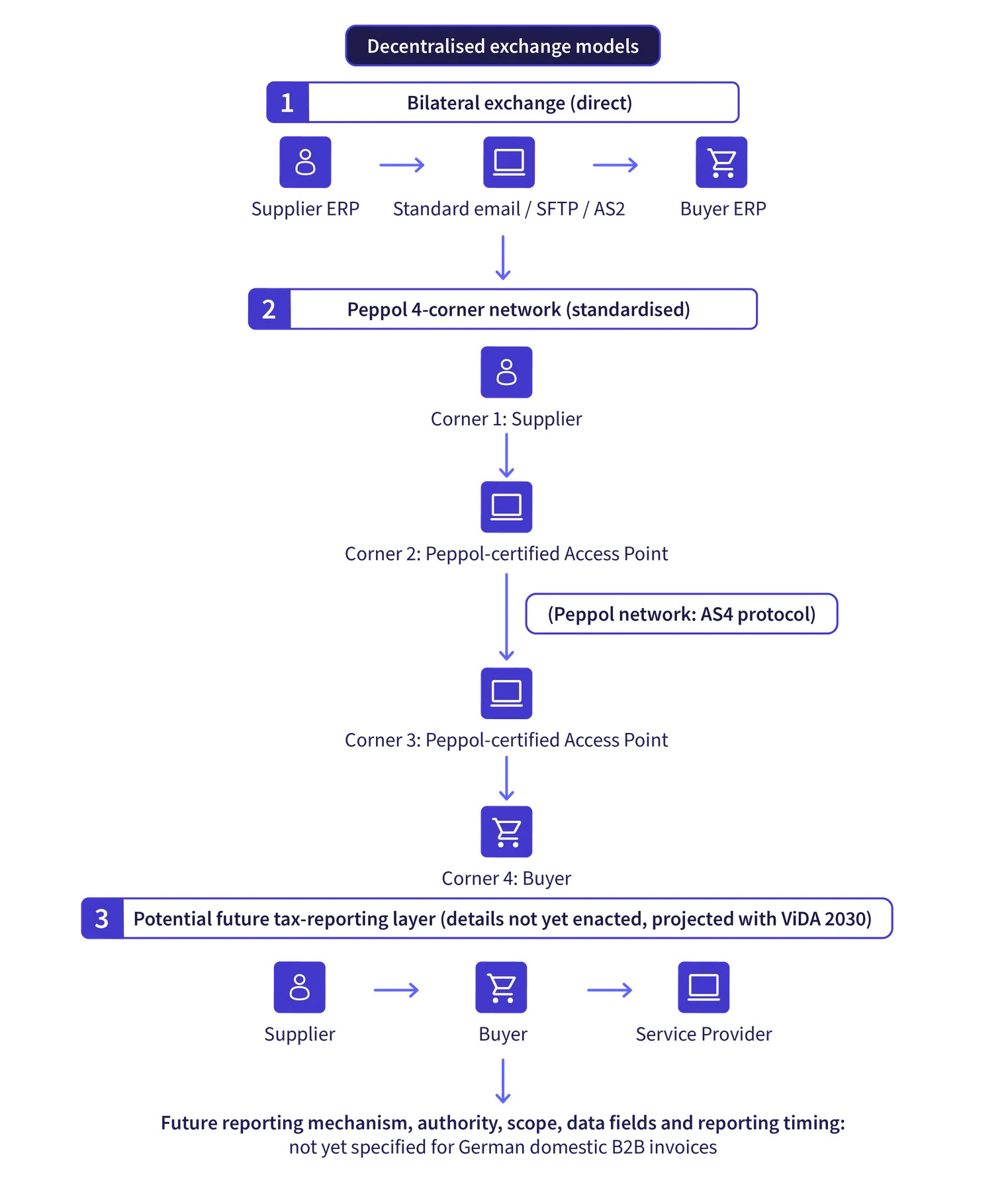
Note: Germany’s current B2B e-invoicing legislation does not establish a domestic digital reporting obligation or a government clearance platform. The federal government has linked the e-invoicing rollout to the prospect of a later reporting system, and EU VAT in the Digital Age rules make future cross-border digital reporting highly relevant from 2030. Nonetheless, the eventual German domestic reporting model, including whether it uses a five-corner-style architecture, direct taxpayer reporting, service-provider reporting, Peppol infrastructure, or another channel, has not yet been legally determined.
Bilateral direct exchange
Enterprises may exchange structured invoices via bilateral communication paths:
Direct email transmission: Structured invoices, including compliant XML files or hybrid formats containing embedded structured data, may be delivered by email. The German rules do not mandate a particular email-security protocol, although parties may adopt appropriate security measures contractually or operationally.
Point-to-point connections: Trading partners may agree on direct electronic channels, such as SFTP, AS2, APIs, EDI connections or supplier portals, provided the transmitted invoice satisfies the applicable structured-format requirements.
The Peppol 4-corner network
The Peppol network offers a resilient infrastructure for German B2B exchange. Instead of establishing thousands of individual point-to-point connections, an enterprise can connect to a single accredited Peppol Access Point (Corner 2), which routes invoices securely across the network to the recipient's Access Point (Corner 3) using standard AS4 transport protocols. As indicated above, Peppol is not, however, the exclusive or legally mandated transmission channel for German domestic B2B invoices.
The German Electronic Business Address (GEBA)
To resolve routing challenges within the Peppol network, the Coordination Agency for IT Standards (KoSIT) developed the German Electronic Business Address (GEBA).
Legal baseline: GEBA is founded on the German Business Identification Number (Wirtschafts-Identifikationsnummer - W-IdNr) regulated under Section 139c of the Fiscal Code of Germany (Abgabenordnung - AO). The W-IdNr is a unique, permanent identifier issued by the Federal Central Tax Office (BZSt) to every economic entity operating in Germany.
Addressing scheme: GEBA is officially registered internationally under the ISO/IEC 6523 identification scheme using identifier prefix 0246 and has been incorporated into the Peppol identifier scheme following its publication by KoSIT's XStandards Einkauf (XSE) in December 2025.
Granular routing: In addition to identifying the legal entity, GEBA allows companies to append sub-identifiers for specific operating branches, production plants, or accounts payable departments, ensuring that incoming invoices route automatically to the correct accounting workflow.
Interoperability: GEBA operates alongside existing routing identifiers, such as the Leitweg-ID (used in German public sector B2G billing) and Global Location Numbers (GLN), ensuring complete backwards compatibility.
Accepted invoice formats
For B2B e-invoicing, German law does not prescribe a single proprietary invoice format. Businesses may use a structured electronic format that either complies with EN 16931 or, where agreed by the parties, enables the correct and complete extraction of all information required under the UStG into an EN 16931-compliant or interoperable format.
In comparison, while B2B allows flexibility in choosing between standard EN 16931 formats (like XRechnung or qualifying ZUGFeRD profiles), public procurement (B2G) is often more restrictive regarding portal compatibility.
In practice, the German market relies on three primary formats:
1. XRechnung (Pure XML)
XRechnung is the electronic invoicing standard developed by KoSIT specifically for the German public sector. It is an application profile (CIUS) of EN 16931 and is delivered exclusively as a structured XML file without a visual presentation layer. It serves as the mandatory baseline for federal B2G procurement, where submission portals like OZG-RE generally require it or strict EN 16931 XML equivalents.
XRechnung supports two underlying syntaxes:
UBL (Universal Business Language): XML syntax widely used across Europe and within the Peppol network.
CII (Cross Industry Invoice): XML syntax developed by UN/CEFACT.
While initially created for Business-to-Government (B2G) transactions, XRechnung is fully valid for domestic B2B transactions under Section 14(1) UStG.
2. ZUGFeRD (Hybrid PDF/A-3 + XML)
ZUGFeRD (Zentraler User Guide des Forums elektronische Rechnung Deutschland) is a hybrid format developed by the Forum for Electronic Invoicing Germany (FeRD) in close collaboration with the French partner FNFE-MPE, where Factur-X serves as the technically identical twin of ZUGFeRD..
Dominant in Germany and France, and endorsed for cross-border trade between these two nations and Switzerland, a ZUGFeRD file consists of two integrated components:
A visual, human-readable document in PDF/A-3 format (an ISO standard for long-term archiving).
A machine-readable XML file (zugferd-invoice.xml or factur-x.xml) embedded directly inside the PDF/A-3 container.
To comply with the B2B mandate, a ZUGFeRD invoice must be issued using version 2.0.1 or higher and must use a qualifying profile. The qualifying profiles are:
BASIC: While technically permissible under the mandate, this profile does not contain the full EN 16931 semantic data set. Because it is generally not accepted in B2G portals and carries a risk of rejection in B2B transactions, its use is not recommended.
EN 16931 (previously described as “Comfort”): Fully corresponds to the semantic requirements of EN 16931 and is the recommended profile for seamless compliance.
Extended: Extends EN 16931 to accommodate complex, industry-specific business requirements.
Important: The lower ZUGFeRD profiles (MINIMUM and BASIC-WL) do not satisfy the legal requirements of EN 16931. Invoices issued under these profiles do not qualify as electronic invoices under Section 14(1) UStG and are legally treated as “other invoices”.
B2G vs. B2B context: While ZUGFeRD (in applicable profiles) is ideal and widely adopted for B2B trade, lower profiles and hybrid formats are frequently unsupported or rejected by public-sector (B2G) submission portals, which predominantly expect pure XML (XRechnung). As such, ZUGFeRD should not be assumed acceptable unless the specific authority and channel accept it in a compliant profile.
3. Electronic Data Interchange (EDI) formats
Electronic Data Interchange (EDI) systems based on legacy standards, such as EDIFACT, ODETTE, or VDA, are widespread throughout German automotive, manufacturing, and retail supply chains.
The legislature accommodated these existing investments under Section 27(38) UStG and the BMF guidance:
Until 31 December 2027: Existing EDI arrangements may continue to be used, even if they do not strictly mirror the EN 16931 data model, provided both trading partners agree.
From 1 January 2028: EDI formats remain permissible, but they must either conform directly to the semantic model of EN 16931 or allow the accurate and complete extraction of all mandatory VAT data into an EN 16931-compliant or interoperable output.
Technical format | File architecture | Compliance status under EN 16931 | Primary use case & operational notes |
XRechnung | Pure XML (UBL or CII) | Fully compliant (official German CIUS) | Mandatory for federal B2G public procurement; fully compliant for B2B. |
ZUGFeRD (Profile EN 16931 / Extended) | Hybrid (PDF/A-3 with embedded XML) | Fully compliant (from version 2.0.1) | Ideal for B2B; offers human visual readability alongside automated XML extraction. Note: Not consistently accepted in B2G public portals, some of which require pure XML (XRechnung). Please check with your contracting party to be certain. |
ZUGFeRD (MINIMUM / BASIC-WL profiles) | Hybrid (PDF/A-3 with embedded XML) | Non-compliant (lacks required EN 16931 semantic fields) | Legally classified as “other invoices”; invalid for mandatory B2B after transitions. |
Peppol BIS Billing 3.0 | Pure XML (UBL) | Fully compliant | Standard format for cross-border European exchange and domestic Peppol routing. |
Legacy EDI (EDIFACT / VDA) | Structured text | Permissible under transitional rules | Permitted through 2027 under the transitional rule; permitted from 2028 only if it complies with EN 16931 or enables correct and complete extraction of the required UStG information into an EN 16931-compliant or interoperable format. |
Standard PDF / Word / Scans | Unstructured digital / paper | Non-compliant | Treated as “other invoices”; invalid for domestic B2B issuance after 2026/2027. |
Penalties & fiscal non-compliance risks
The Growth Opportunities Act does not establish an isolated catalogue of administrative fines specifically labelled for e-invoicing. Instead, non-compliance triggers structural consequences within the general German VAT Act, the Fiscal Code of Germany (Abgabenordnung - AO), and established tax case law.
1. Disallowance of input VAT deduction (Vorsteuerabzug)
The most severe financial risk falls on the invoice recipient. Under Section 15(1) No. 1 UStG, an enterprise may claim an input VAT deduction only if it holds a legally valid invoice issued in accordance with Section 14 and Section 14a UStG.
Once mandatory issuance takes effect:
If a supplier provides a non-compliant format (such as a paper invoice, a plain PDF, or a sub-standard XML file) after its mandatory issuance deadline, that document is legally an “other invoice”.
Where an e-invoice is required and the supplier instead issues an “other invoice”, the invoice generally does not entitle the recipient to input-VAT deduction, subject to the applicable transitional rules and the nature of the error.
A corporate tax audit (Betriebsprüfung) may result in amendment of the VAT assessment. Where the statutory conditions for interest under section 233a AO are met, additional-payment interest (Nachzahlungszinsen) is generally calculated at 0.15% per month (1.8% per year)..
2. Administrative fines under the VAT Act (Bußgelder)
Germany’s Growth Opportunities Act does not create a separate e-invoicing penalty schedule. Section 26a(1) No. 1 and Section 26a(2) UStG establish that an individual who intentionally or recklessly fails to issue an invoice, or fails to issue an invoice within the statutory six-month deadline under Section 14(2) UStG, may commit an administrative regulatory offence (Ordnungswidrigkeit).
Because issuing an invalid format does not constitute issuing a lawful invoice under the revised Section 14(1) UStG, persistent failure to deliver a compliant structured electronic invoice may expose corporate officers to administrative fines of up to €5,000 per violation.
3. Civil law payment withholding rights (Zurückbehaltungsrecht)
In commercial transactions governed by the German Commercial Code (Handelsgesetzbuch - HGB) and the German Civil Code (Bürgerliches Gesetzbuch - BGB), a corporate buyer is obliged to settle a debt only upon receipt of a legally proper invoice.
If an in-scope supplier delivers a plain PDF after the mandatory deadline, the buyer is legally entitled to reject the document and exercise a right of retention (Zurückbehaltungsrecht) over the payment amount until the supplier issues a compliant structured electronic invoice. This exposes non-compliant suppliers to cash flow disruptions and customer disputes.
4. Violation of digital bookkeeping principles (GoBD)
Failing to preserve structured XML data in its original format throughout the mandatory 8-year retention period (calculated from the end of the year the invoice was issued) violates GoBD principles. A tax auditor who discovers that structured electronic invoices were deleted, stored only as printouts, or altered without revision tracking may formally challenge the overall integrity of the corporate accounting system (Verwerfung der Buchführung), triggering discretionary estimated tax assessments (Schätzung der Besteuerungsgrundlagen under Section 162 AO).
How businesses can prepare
Achieving sustained compliance requires deliberate alignment across information technology, tax accounting, procurement, and accounts payable.
1. Audit enterprise accounts payable (inbound workflows)
Because mandatory reception has been in force since 1 January 2025, all domestic enterprises must ensure their inbound accounts payable processes can handle structured files for in-scope domestic B2B transactions:
Verify that central invoice receipt mailboxes (e.g. invoices@company.de) are configured to ingest XML attachments without firewall stripping or security corruption.
Deploy viewer tools or ERP plugins capable of converting raw XRechnung datasets into human-readable visual layouts for internal departmental approval. For hybrid ZUGFeRD invoices, ensure that the embedded structured data can be read, validated and reconciled with the visual PDF representation.
Establish an automated validation checkpoint using KoSIT-compliant Schematron validation to inspect incoming syntax, cryptographic attachments, and mandatory business terms.
2. Audit enterprise accounts receivable (outbound workflows)
Organisations must evaluate when their mandatory issuance obligation begins:
Determine whether the actual total turnover (Gesamtumsatz) in calendar year 2026 exceeds the €800,000 statutory threshold under Section 27(38) UStG, dictating whether mandatory issuance applies on 1 January 2027 or 1 January 2028.
Assess whether current ERP, invoicing, and billing modules can natively extract database fields and map them to EN 16931-compliant XML structures (XRechnung UBL/CII or ZUGFeRD 2.0.1+).
Confirm format and delivery agreements with customers. Determine which compliant structured format each customer can receive and which transmission channel is agreed. XRechnung and ZUGFeRD are common options, but the German B2B mandate does not prescribe either format or mandate Peppol. For a non-EN 16931 format, ensure the format meets the statutory requirement for correct and complete extraction of required invoice information into an EN 16931-compliant or interoperable format.
Cleanse customer master data, ensuring that corporate legal names, registered addresses, tax numbers (Steuernummer), VAT identification numbers (USt-IdNr), and designated electronic routing identifiers (such as GEBA or Peppol IDs, where applicable) are complete and validated.
3. Establish long-term archiving aligned with GoBD
Implement a digital archiving archive that preserves invoices in the form in which they were received. Retain standalone XML invoices as XML. For hybrid invoices, retain the complete received hybrid file and any associated tax-relevant data.
Ensure the archive provides immutable audit logs, strict role-based access controls, automated indexing, and disaster recovery mechanisms compliant with the applicable retention requirements - generally 8 years for invoices. Note that these 8 years are calculated from the end of the calendar year in which the invoice was issued (e.g., an invoice issued on 1 March 2030 must be stored until 31 December 2038).
Discontinue procedures that convert incoming electronic invoices into paper printouts for physical filing cabinets, as paper copies do not satisfy tax audit retention standards.
4. Evaluate Peppol connectivity and service provider partnerships
Rather than maintaining costly point-to-point connections with commercial trading partners, assess integration with a Peppol-certified Access Point.
If using Peppol, assess whether publishing a GEBA-based Participant ID is appropriate. GEBA is intended to support W-IdNr-based identification and routing in the Peppol network; it is not a compulsory registration for German B2B e-invoicing.
Consider engaging an e-invoicing service provider to manage schema conversions, validation checks, and secure transmission pipelines, insulating internal systems from future regulatory amendments.
Conclusion
Germany's transition to electronic invoicing, spanning established public procurement (B2G) requirements and the nationwide B2B mandate, marks a fundamental transformation of the nation's commercial and administrative infrastructure. By codifying European standard EN 16931 into Section 14 of the German VAT Act through the Growth Opportunities Act (Wachstumschancengesetz), the legislature has effectively phased out unstructured PDFs in commercial trade.
With the mandatory reception obligation active for all domestic enterprises since 1 January 2025, organisations can no longer afford to delay preparation. The focus now shifts to the progressive B2B issuance obligations taking effect on 1 January 2027 for large enterprises and 1 January 2028 for the broader economy.
Beyond immediate domestic compliance, establishing structured e-invoicing capabilities positions organisations for the upcoming European single market transformations under the VAT in the Digital Age (ViDA) initiative. Enterprises that upgrade their ERP architecture, standardise their master data, and partner with accredited transmission providers today will ensure regulatory compliance while unlocking genuine operational automation across their financial supply chain.
FAQ
The mandate covers:
Domestic B2B (German resident businesses for domestic transactions).
Domestic B2G (German public sector).
It does not currently cover cross-border EU B2B (will be covered later under ViDA) or cross-border non-EU B2B.