
The state of Europe’s e-invoicing rollout
Across Europe, the transition to electronic invoicing has shifted from a voluntary efficiency initiative into legally mandated critical infrastructure.
In Germany, businesses have adapted to mandatory invoice reception since the start of 2025, with the issuance obligation beginning on 1 January 2027 for businesses with an annual turnover exceeding EUR 800,000, and on 1 January 2028 for all other businesses. The Federal Ministry of Finance (BMF) continues to issue administrative clarifications, while tax professionals increasingly recognise the broader reality: structured e-invoicing under EN 16931 standard (via XRechnung and ZUGFeRD) is not merely a change in document layout; it lays the foundation for continuous digital reporting and automated, algorithmic VAT audits.
Germany is not alone on this journey. Belgium introduced its mandatory B2B e-invoicing regime in January 2026, reaching 88% business adoption within six months and handling tens of millions of documents monthly, with domestic e-reporting scheduled for 2028. France saw its mandate take effect in September 2026, bringing five to six million businesses into structured reception while introducing dual B2B e-invoicing and e-reporting requirements across domestic and international flows. Slovakia has deployed its innovative Digital Postman (Digitálny poštár) mechanism, where certified service providers automatically generate and report tax data to authorities upon receiving an e-invoice. Spain is preparing for the rollout of its upcoming B2B e-invoicing and e-reporting mandate following the publication of Ministerial Order HAC/1028/2026, which regulates the Public Electronic Invoicing Solution (SPFE). The Order was published in the Official State Gazette as BOE-A-2026-20587 on 5 October 2026 and entered into force on 6 October 2026. Meanwhile, the European Union's VAT in the Digital Age (ViDA) package sets a firm date: by July 2030, all cross-border intra-EU B2B transactions must be invoiced in structured digital formats and reported in near-real time to tax administrations.
Yet amid this unprecedented engineering achievement, a structural blind spot remains unaddressed across the entire ecosystem.
The networks carrying these transactions can deliver and report an invoice in milliseconds, but not a single actor in the network verifies whether the tax on the invoice is legally correct.
The illusion of validation
To understand this vulnerability, one must examine what software platforms and e-invoicing access points actually mean when they declare an invoice “validated”.
In modern continuous transaction controls, e-invoicing architectures operate as a multi-layered technical stack, spanning network transport, syntax validation, business rules, and tax reporting. To understand this vulnerability, follow an e-invoice through the standard five-corner Continuous Transaction Control (CTC) model within this stack:
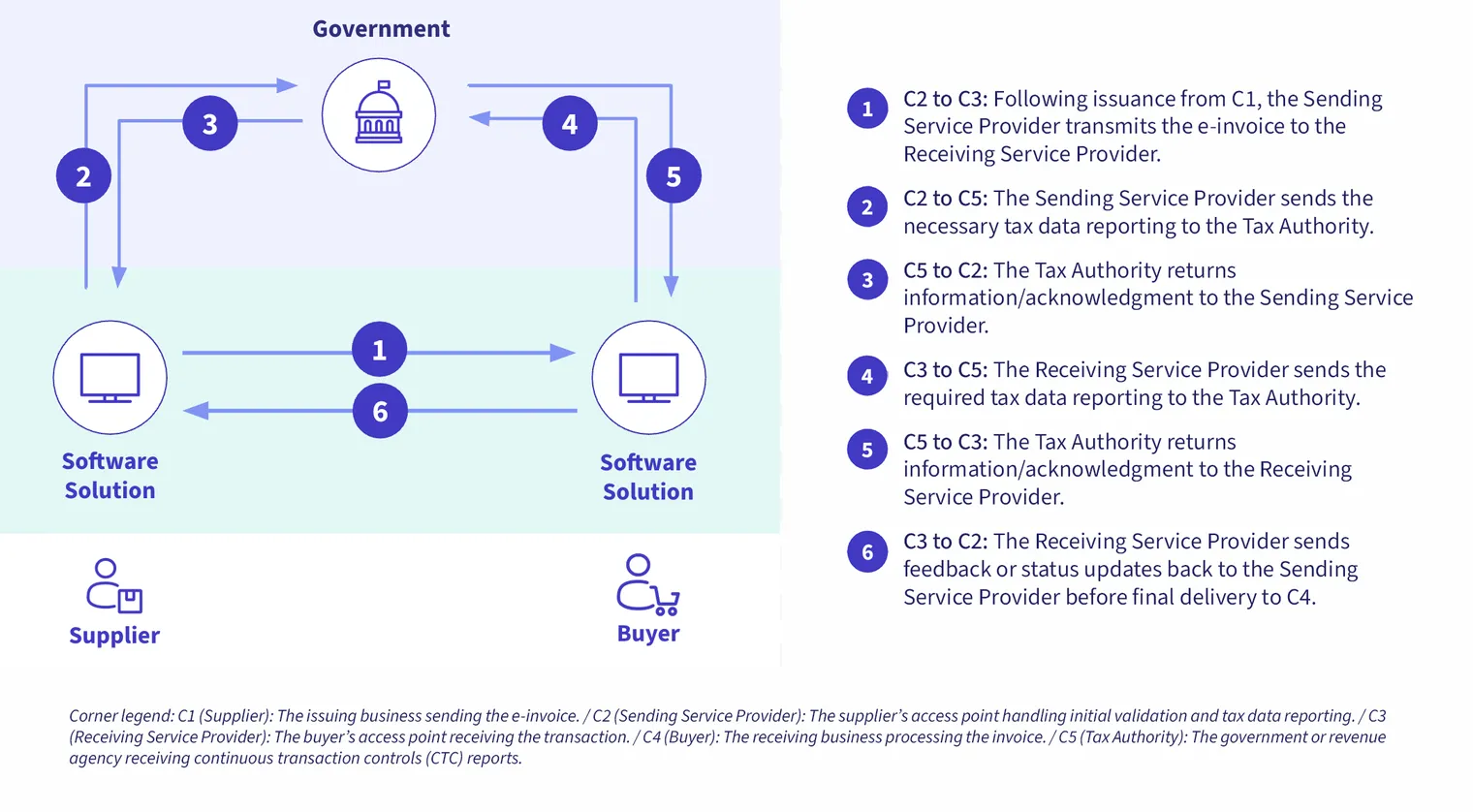
At every transmission step, automated engines run extensive validation suites:
Syntax checks: Verifying the XML schema matches official UBL 2.1 or UN/CEFACT CII specifications.
Business rules & code lists: Confirming mandatory fields are present and currency, country, or unit codes belong to approved ISO lists.
Arithmetic consistency: Ensuring line extensions, tax breakdowns, and total amounts sum up correctly.
Identity & transport security: Confirming digital signatures, transport certificates, and the syntactic validity of VAT numbers.
Notice what is missing: substantive tax correctness.
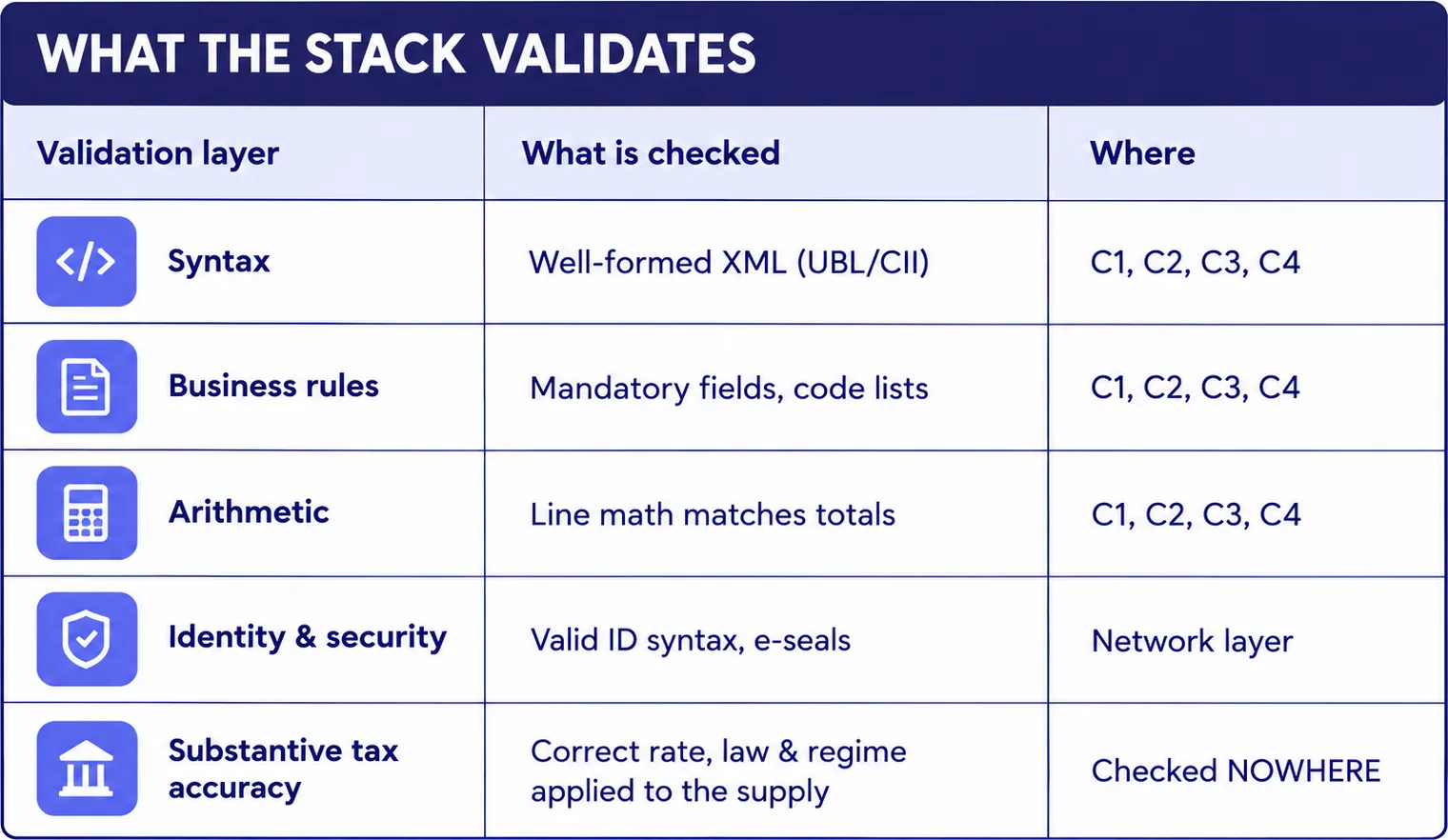
Every check in the existing stack verifies that an invoice agrees with itself; not one check verifies that it agrees with the tax law.
Consider a domestic German supply of books invoiced at the standard 19% rate instead of the 7% reduced rate. Or consider a Belgian wholesaler selling €10,000 of goods to a French retailer: the billing engine defaults to domestic settings, wrongly applying 21% Belgian VAT instead of zero-rating the intra-Community supply.
The XML file is structurally pristine. The VAT numbers are authentic. The math matches down to the cent. It clears every Schematron rule, glides through access points, registers with the tax authority, and lands in the buyer’s accounting ledger.
It is structured, timely, and still incorrect.
The real-time trap: why consistent is no longer enough
In the analogue past, VAT errors sat quietly in company archives. They were resolved during periodic manual reconciliations or when an auditor arrived years after the fact - if ever.
Continuous transaction controls and ViDA remove that temporal cushion. Invoices are becoming self-executing instruments:
They pre-fill VAT returns on state platforms.
They automatically trigger buyer deduction claims.
They directly feed automated data-mining and anomaly-detection engines deployed by revenue authorities.
When an incorrectly rated invoice enters this environment, the error does not linger unnoticed; it propagates instantly in every direction.
For the supplier, wrongly charged VAT is legally owed to the treasury until an arduous credit-and-reissue cycle is completed. For the buyer, the position is less comfortable than it looks: VAT that was not legally due cannot simply be deducted as input tax, and a deduction taken on it may be questioned on audit.
Stated plainly: real-time reporting of wrong tax is not compliance; it is simply the faster distribution of errors.
Furthermore, the mandate wave brings millions of small and mid-sized enterprises (SMEs) onto these rails. Unlike global corporations, these businesses generally do not operate enterprise-grade tax calculation engines. They rely on default ERP tax codes and overburdened external accountants. Mandating digital pipes without addressing the quality of the data flowing through them equips millions of businesses with a faster way to make mistakes.
The root cause: free text, and no agreed classification
Every country's VAT legislation determines tax treatment based on the nature of the supply: whether an item constitutes foodstuffs or catering, construction works or repair, medical equipment or cosmetics, physical goods or digital services. Downstream of that classification, tax rules are deterministic. Upstream lies unstructured reality.
This raises the question: why has the e-invoicing ecosystem left tax determination untouched? The obstacle is semantic, not computational, and it has two distinct parts.
First, in Europe, the nature of the supply travels as free text. Under the European e-invoicing standard EN 16931, what has been supplied is described in the mandatory item name (known technically as BT-153) and optionally, where provided, a more detailed item description (BT-154). Both are free text, and both can be written in any language the parties agree on. A machine reading that line has nothing structured to reason from.
Second, there is no agreed classification to put in its place. EN 16931 provides an optional structured classification code (BT-158), which can carry a code identifying the type or category of goods or services, but it accepts codes from a number of schemes; no scheme is agreed, and nothing in the network consumes it for tax purposes. A field that can carry any code and is required to carry none is not a semantic layer.
EN 16931-1 was revised in 2026. Whatever the standard comes to allow, what the reporting requirements actually call for is a separate question, and that is where the gap sits.
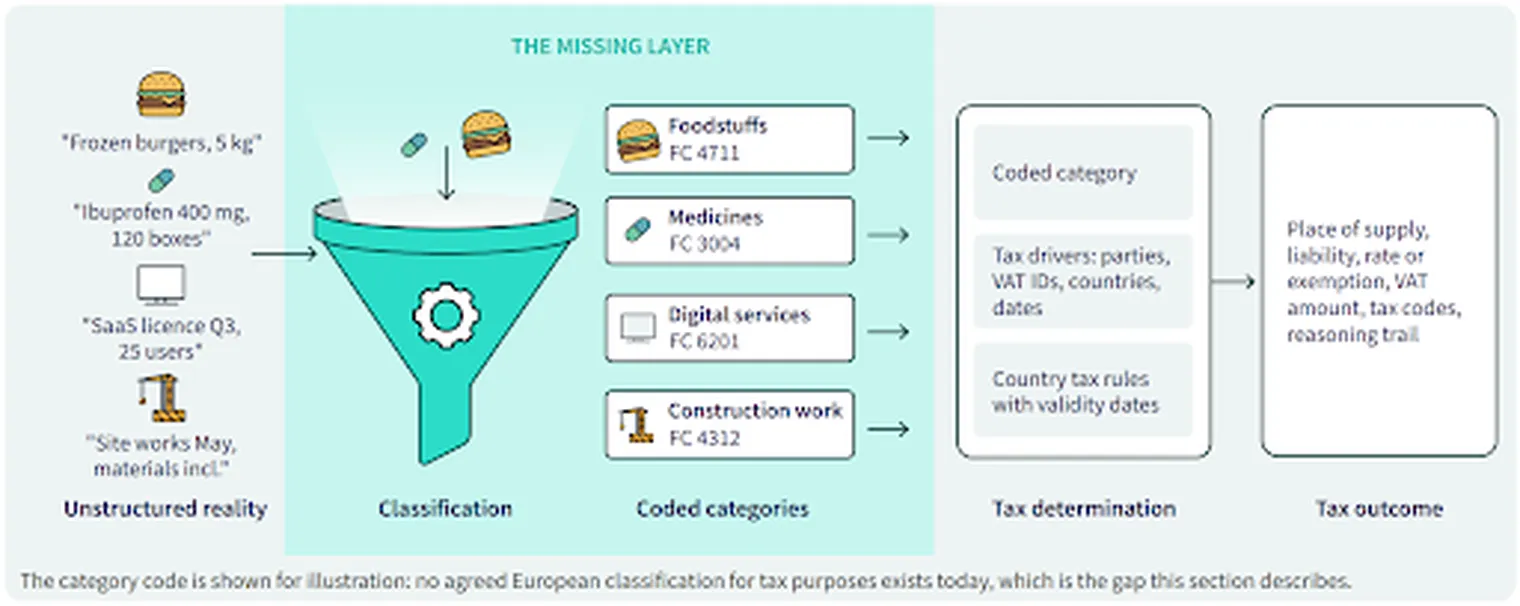
Outside Europe, jurisdictions have responded to this vacuum by imposing mandatory national classification schemes, such as HSN/SAC codes in India, item codes in Malaysia, or NCM codes in Brazil. The result is global semantic fragmentation. In Europe, the absence of an agreed tax classification means automated systems have no structured, comparable data from which to determine VAT treatment.
What a tax quality layer looks like
Solving this challenge requires a dedicated tax quality layer embedded within the transactional flow.
Such a layer cannot merely be another post-audit dashboard. To protect trading partners and maintain network efficiency, it must satisfy clear architectural principles:
Prevention at issuance: Validation must occur before the invoice is dispatched into the network or reported to authorities (Corner 2). Catching errors after transmission is detection; a quality layer provides prevention.
Line-level determination: Evaluating transactions line by line against jurisdictional VAT law, rather than relying on document-level plausibility checks.
Deterministic and auditable: Compliance checks must generate a complete and auditable reasoning trail, ready for inspection by tax auditors.
Taxonomy-agnostic mapping: The system must seamlessly translate unstructured line descriptions into internal fiscal concepts without forcing businesses to adopt complex proprietary coding systems.
Non-blocking deployment: A resilient layer begins by providing advisory warnings and buyer-side risk controls, escalating ambiguous edge cases to human specialists while allowing routine, standard-rated lines to flow uninterrupted.
Where should this layer reside?
While enterprise tax engines sit isolated inside bespoke ERPs, the certified service provider layer (Corner 2 and Corner 3) represents the natural operational home. Certified service providers connect directly to trading partners, manage network reporting, and sit at the exact junction where document validation occurs.
The question ahead
As mandatory B2B issuance phases roll out across Germany, Belgium, France, Slovakia, Spain, and the broader EU under ViDA's continuous reporting paradigm, many market participants assume that format standardisation resolves the compliance equation. However, for cross-border businesses navigating a maze of fragmented national rules, distinct classification systems, and varying continuous transaction control models, technical delivery remains complex and unresolved. A dedicated tax quality layer embedded within certified service providers provides the essential architectural bridge, enabling both operators and enterprises to turn fragmented compliance burdens into a controlled and auditable process.
The next frontier of digital finance is data substance. Businesses, service providers, and software vendors must confront a straightforward operational question:
Who checks that the tax on your electronic invoices is right, and when?
Today, across most of the network, the answer remains: no one, at any point. Introducing a robust tax quality layer addresses this gap by checking whether the tax treatment is correct, rather than merely whether the invoice is technically valid.
For an in-depth analysis of semantic standardisation and structural tax quality in mandated e-invoicing, read the full Banqup white paper: The Missing Tax Quality Layer: Why e-invoicing networks can now deliver and report any invoice in real time but still cannot tell you whether the tax on it is right (by Jan Druppel and Danny Vermeiren).